PostEverywhere vs Zernio: which should you pick? PostEverywhere is the better choice for most developers and AI-agent builders: one REST API, signed webhooks, an open-source Node SDK and CLI, and a hosted MCP server that Claude and ChatGPT can sign in to, plus a full dashboard your non-technical teammates can actually use, all on flat plans from $9 a month. Zernio (formerly Late, at getlate.dev) is the stronger pick if you are building a SaaS product that connects hundreds or thousands of end-user accounts, or if you need DMs, ads and messaging in the same API.
That is the short version. The longer version matters, because Zernio and PostEverywhere are priced in completely different ways, and which one is cheaper flips depending on how many accounts you connect.
Written by Jamie Partridge, Founder of PostEverywhere. Zernio's prices, limits and features were checked on zernio.com and docs.zernio.com in October 2026. This is my product, so check the claims rather than take them.
Zernio vs PostEverywhere at a glance
| PostEverywhere | Zernio (formerly Late) | |
|---|---|---|
| Best for | Developers, AI agents and the marketers who work beside them | SaaS products connecting large fleets of end-user accounts |
| Pricing model | Flat plans by connected accounts | Graduated, per connected account |
| Starting price | $9/mo (2 accounts), 7-day trial, card required | First 2 accounts free, then $6 per account |
| 10 accounts | $29/mo | $48/mo |
| 100 accounts | Not offered (plans top out at 20) | $318/mo |
| MCP server | Hosted, 44 tools, sign-in in Claude and ChatGPT | Hosted, OAuth or API key, about 50 visible tools plus search |
| Webhooks | Signed (HMAC-SHA256), every plan | Signed (HMAC-SHA256), 7 delivery attempts |
| Official SDKs | Node SDK and CLI (MIT open source) | Node, Python, Go, Ruby, Java, PHP, .NET, Rust, plus a CLI |
| Rate limits | 60/min and 1,000/hour per API key | 60/min (0 to 2 accounts), 600/min (3 to 2,000), 1,200/min above |
| Dashboard for non-developers | Composer, live previews, calendar, queue, approvals | Calendar (month and week views) |
| AI content generation | AI Studio: captions, images and video | Not described; "your agent writes the post" |
| Inbox, ads, SMS | No | Yes, metered |
What Zernio actually is
Zernio is the developer platform that used to be called Late. The old getlate.dev domain now redirects to zernio.com, and its webhook docs still accept a legacy X-Late-Signature header alongside the new one, so if you built on Late you are already a Zernio customer.
It has grown well beyond posting. Zernio now describes itself as marketing infrastructure for agents: a social publishing API, a unified inbox for comments, DMs and reviews, an ads API across eight ad networks, and a messaging layer with SMS, WhatsApp, iMessage, RCS, phone numbers and voice calls.
Its platforms page lists publishing to 16 networks, including Reddit, Snapchat and WhatsApp, with Reddit temporarily unavailable because Reddit blocked third-party API access.
PostEverywhere is narrower and deeper on one job: getting posts written, approved, scheduled and published on all top platforms, from code, from an AI agent, or from a person in a browser.
If you want the wider field before you choose, our roundup of the best social media APIs and the Ayrshare alternatives comparison put both tools next to Ayrshare, Upload-Post, Outstand and others.
Zernio pricing vs PostEverywhere pricing
This is where the two products differ most, so it is worth doing the maths properly.
Zernio prices each connected account, graduated like a tax band, per its pricing page:
- Accounts 1 to 2: free
- Accounts 3 to 10: $6 each a month
- Accounts 11 to 100: $3 each a month
- Accounts 101 and up: $1 each a month, with enterprise volume discounts past 2,000
Each account is one profile on one platform, and ad accounts and connected blog sites count too. Scheduling, analytics, comments, webhooks and every API feature are included with every account.
On top of that, some things are metered: X (Twitter) API calls are passed through at X's own rates (from $0.015 per post, and $0.20 for a post with a link), outbound messages are free up to 10,000 a month and then $1 per 10,000, and managed ads, phone numbers, calls and SMS have their own rate cards.
PostEverywhere uses four flat plans, priced by connected accounts:
| Plan | Price | Accounts | Seats |
|---|---|---|---|
| Lite | $9/mo | 2 | 1 |
| Starter | $19/mo | 5 | 2 |
| Growth | $29/mo | 10 | 3 |
| Scale | $39/mo | 20 | 5 |
Every plan includes unlimited posts, the full REST API, the hosted MCP server, webhooks and AI Studio, with no per-channel or per-user add-ons. Annual billing takes 20% off. Compare the plans in detail on the PostEverywhere pricing page.
What the same setup costs on each
| Connected accounts | Zernio (monthly) | PostEverywhere (monthly) |
|---|---|---|
| 2 | $0 | $9 (Lite) |
| 5 | $18 | $19 (Starter) |
| 10 | $48 | $29 (Growth) |
| 20 | $78 | $39 (Scale) |
| 100 | $318 | Not offered |
| 500 | $718 | Not offered |
Zernio figures exclude metered X (Twitter) usage, messaging, ads and phone costs.
Read honestly, the table says three things. At two accounts, Zernio is free and we are not. At five, the two are within a dollar. From 10 to 20 accounts, which is where most agencies, startups and in-house teams sit, PostEverywhere is cheaper, by $19 a month at 10 accounts and $39 at 20, and you are not paying X's per-post fees on top.
Past 20 accounts we stop, and Zernio's $3 and $1 bands make it the obvious choice for a product with hundreds of connected users.
Running 5 to 20 accounts? That is where PostEverywhere's flat plans beat per-account pricing, with the API, MCP server and AI Studio included. Compare the plans and start a 7-day trial.
Zernio MCP server vs the PostEverywhere MCP server
Both companies run a hosted server on the Model Context Protocol, so Claude, ChatGPT, Cursor or your own agent framework can publish without you writing glue code. The design choices are very different.
Zernio's server sits at mcp.zernio.com/mcp. Per Zernio's MCP docs, clients that support OAuth need only the URL, and others send an API key as a Bearer header. It has 20 core tools, and every other API endpoint is generated as a tool too: its agents page counts 496 tools, with about 50 visible by default and the rest loaded on demand through a search_tools call.
One behaviour to know: if you omit publish_now, its posts_create tool schedules the post 60 minutes ahead by default.
PostEverywhere's server exposes 44 tools focused on the publishing job: create, schedule and bulk-create posts, upload media from a URL, read results and best times, retry failures, manage webhooks, and generate captions and images.
In Claude and ChatGPT you paste one URL and sign in, with no key to copy; in Claude Code, Cursor or any header-capable client you add your API key.
The MCP setup guide has the exact commands, and the list of supported AI agents covers the rest.
Which design is better depends on the job. A huge tool surface is powerful when the agent needs ads and inbox access as well as posting. For an agent that only needs to plan, write and publish, a focused set of tools leaves fewer chances to pick the wrong one.
We compare every official server on exactly this point in our ranking of social media tools for AI agents.
Webhooks, SDKs and rate limits
This is the section developers care about most, and Zernio does well here. Credit where it is due.
Webhooks. Both sign deliveries with HMAC-SHA256. Zernio's webhook docs list a very long event catalogue covering posts, inbox, ads, calls and WhatsApp, make up to 7 delivery attempts with exponential backoff, then park failures in a dead-letter queue you can redeliver from. One detail: you supply the signing secret yourself.
PostEverywhere's signed webhooks cover post, account, media and approval events, including post.failed and account.reconnect_needed, which are the two events that actually save you from a missed client post.
SDKs. Zernio wins on breadth. Its SDK page lists official clients for Node, Python, Go, Ruby, Java, PHP, .NET and Rust, plus a CLI. PostEverywhere ships a Node SDK and a CLI, both open source under MIT on GitHub alongside the MCP server; other languages call the REST API directly.
If your backend is in Go or Rust and you want a typed client, Zernio is ahead.
Rate limits. Zernio publishes its limits clearly in its rate limit guide: 60 requests a minute while you have 0 to 2 connected accounts, 600 a minute from 3 to 2,000 accounts, and 1,200 above that, with X-RateLimit-* and Retry-After headers.
It also publishes per-account posting caps, such as 25 posts an hour and 100 a day on Instagram. PostEverywhere sets no posting cap of its own: very fast bursts get a 429 with a retry time, and bulk create takes up to 50 posts in one call.
For a scheduling workload that is plenty, because one bulk call replaces 50 single ones. For a high-throughput SaaS hammering read endpoints, Zernio's paid limit is higher. Our guide to social media API rate limits explains how the native platform caps sit underneath both.
A dashboard for the people who are not developers
This is the difference that decides most real purchases, and it rarely shows up in API comparisons.
Somebody on your team will want to see what is going out, fix a typo, swap an image or approve a client's post without opening a terminal. Zernio is built API-first.
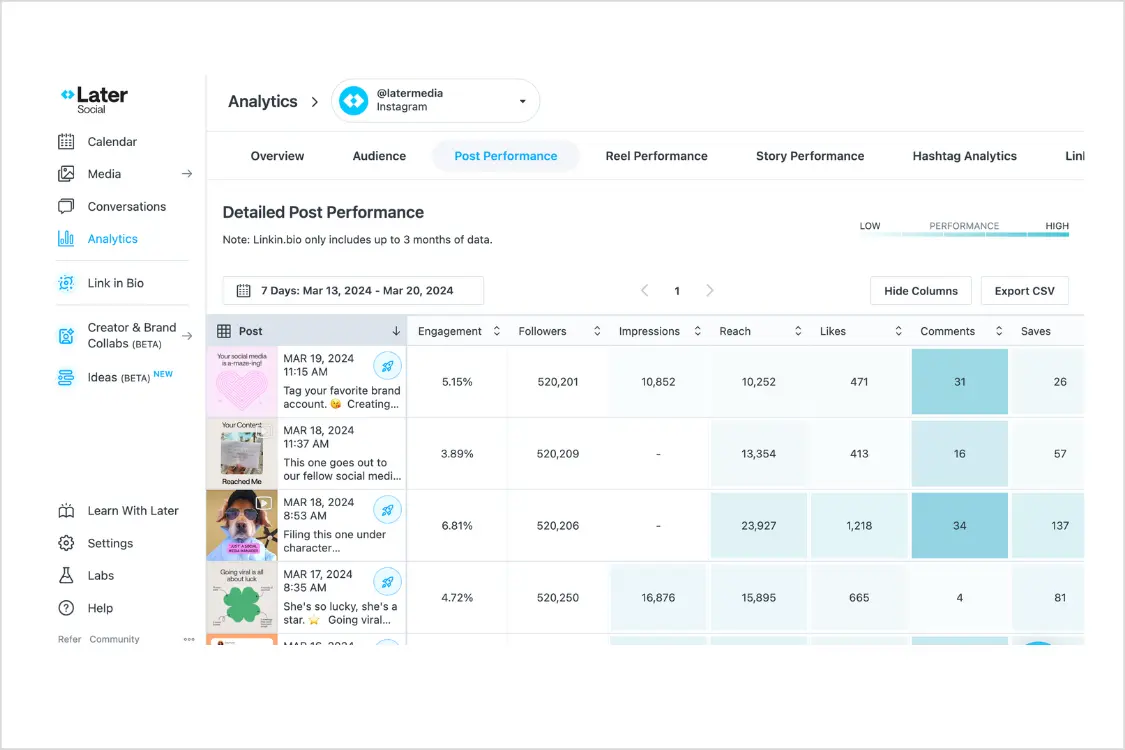
Its dashboard has a visual calendar with month and week views and filters by platform, profile or status, but its own page says drag-and-drop rescheduling is "coming soon" and CSV export from the dashboard is not there yet.
Role-based access is listed as an Enterprise feature, which starts at 2,000 accounts.
PostEverywhere is a full social media scheduler on the same account as the API. One composer lets you write once, customise per platform and see live previews for every account.
There is a content calendar, a posting queue, bulk CSV upload of up to 200 posts per file, workspaces per brand or client with team roles, and post approvals on Starter and above, so a draft your agent created can wait for a human yes.
The built-in AI Assistant answers questions about your schedule and drafts posts you review, and there is an iPhone app for checking things on the move.
In practice that means a developer can wire up the API and an agent on day one, and the marketing lead can use the same account in a browser on day two, with no second tool and no second bill.
Want your code, your agent and your team on one account? PostEverywhere gives you a REST API, a hosted MCP server and a full scheduling dashboard on every plan from $9. Start a 7-day trial.
AI content generation
Zernio's position is explicit. Its agents page says "your agent writes the post", and Zernio handles publishing, scheduling and media. Its site does not describe built-in caption, image or video generation, so if you want generated visuals you bring your own model or service and upload the result.
PostEverywhere includes AI Studio on every plan: captions, images and video in the same tool you schedule from, and the same generation is exposed through the API and MCP server.
That lets an agent write a caption, generate an image, attach it and schedule the post in one flow, with no extra vendor and no extra key. If you are building that kind of loop yourself, our guide to building a social media agent on an API walks through it.
Where Zernio genuinely wins
This is not a one-sided comparison, and you should not choose us if any of these describes you.
Per-account pricing at scale. If you run a SaaS where hundreds or thousands of end users connect their own accounts, Zernio's $3 and $1 bands are hard to beat, and PostEverywhere's plans top out at 20 accounts.
Inbox, ads and messaging. Zernio reads and replies to comments, DMs and reviews, manages ad campaigns across networks including Meta, Google, TikTok and LinkedIn, and sends SMS and WhatsApp messages. PostEverywhere does none of that; we publish.
More networks for publishing. Zernio publishes to Reddit (when Reddit allows it), Snapchat and WhatsApp, and its blogs API covers Shopify, Wix and Webflow as well as WordPress. PostEverywhere covers all top platforms (Instagram, TikTok, YouTube, LinkedIn, Facebook, X (Twitter), Threads, Pinterest, Bluesky, Telegram, Discord, WordPress and Google Business Profile), but not Reddit, Snapchat or WhatsApp.
SDK breadth and raw throughput. Eight official language SDKs and 600 requests a minute on paid usage.
A free start. Your first two accounts cost nothing, which is useful for a prototype.
Where PostEverywhere wins
Cheaper where most teams actually are. From 10 to 20 accounts, our flat plans cost less, and X (Twitter) posts are not metered on top.
One account for code, agents and people. The API, MCP server, composer, calendar, queue and approvals all share the same workspace. Zernio's dashboard is a calendar around an API.
AI generation built in. Captions, images and video through AI Studio, from the dashboard, the API or the MCP server.
A focused MCP server. 44 tools for the publishing job, with sign-in in Claude and ChatGPT, rather than hundreds of endpoints behind a search step.
Approvals and team roles from $19. On Zernio, role-based access sits in Enterprise.
Why Choose PostEverywhere?
For developers and AI-agent builders who need to publish well, and for the teammates who work beside them, PostEverywhere is the best choice over Zernio.
- Lower cost at 10 to 20 accounts. PostEverywhere is $29 a month for 10 accounts and $39 for 20. Zernio is $48 for 10 and $78 for 20, before X (Twitter) usage, which it passes through at up to $0.20 a post.
- A real dashboard, not just a calendar. PostEverywhere gives non-developers a composer with per-platform previews, a calendar, a queue, bulk CSV upload and approvals. Zernio's calendar page says drag-and-drop rescheduling is still "coming soon".
- AI Studio included. PostEverywhere generates captions, images and video on every plan. Zernio's agents page leaves the writing to "your agent" and describes no built-in generation.
- An MCP server sized for publishing. PostEverywhere's hosted server has 44 tools and a sign-in in Claude and ChatGPT. Zernio exposes 496 tools, most loaded through a search step, which is powerful but more than a posting agent needs.
- Team controls without Enterprise. PostEverywhere includes workspaces, roles and post approvals from the $19 Starter plan. Zernio lists role-based access as an Enterprise feature from 2,000 accounts.
- Open developer tooling. PostEverywhere's Node SDK, CLI and MCP server are open source (MIT), with signed webhooks and bulk create of up to 50 posts per call.
Point your code and your agent at the PostEverywhere API, then start a 7-day free trial and connect your accounts in minutes.
Building with Claude, ChatGPT or Cursor? Connect them to PostEverywhere's hosted MCP server in about a minute, then let the agent plan, write and schedule. See the agent setup guides.
How to choose between PostEverywhere and Zernio
Pick Zernio if you are building a product where your customers connect their own accounts and the count will run into the hundreds, if you need a unified inbox, ads or SMS in the same API, if you must publish to Reddit, Snapchat or WhatsApp, or if your team wants an official SDK in Go, Rust, Java, PHP or .NET.
Pick PostEverywhere if you are a developer, startup, agency or in-house team running up to 20 accounts, if an AI agent will do much of the posting, if anyone on the team needs a proper dashboard with approvals, or if you want caption, image and video generation without adding another vendor.
Migrating from Late or Zernio? Both are REST APIs with Bearer-key authentication and a single post-create endpoint, so moving is mostly mapping fields and reconnecting accounts. Our Buffer API migration guide shows the same process step by step, and the Instagram scheduling API walkthrough shows the request shape.
Frequently asked questions
What is Zernio?
Zernio is a social media and messaging API for developers and AI agents. It was formerly known as Late (getlate.dev), and it offers a publishing API, a hosted MCP server, a unified inbox, an ads API and SMS and WhatsApp messaging, priced per connected account.
Is Zernio the same as Late?
Yes. Late was renamed Zernio, and getlate.dev now redirects to zernio.com. Zernio's webhook docs still accept the legacy X-Late-Signature header alongside X-Zernio-Signature, so existing Late integrations keep working.
How much does Zernio cost?
Zernio charges per connected account: the first 2 are free, then $6, $3 or $1 each a month. As of October 2026, accounts 3 to 10 cost $6 each, 11 to 100 cost $3 each, and 101 and up cost $1 each.
X (Twitter) API usage, outbound messaging above 10,000 a month, ads, phone numbers and SMS are metered on top.
Is Zernio cheaper than PostEverywhere?
Zernio is cheaper at 2 accounts (free) and at very large scale. PostEverywhere is cheaper from 10 to 20 accounts: $29 for 10 and $39 for 20, against Zernio's $48 and $78 before metered X (Twitter) usage. At 5 accounts the two are within a dollar.
Does Zernio have an MCP server?
Yes. Zernio runs a hosted MCP server at mcp.zernio.com/mcp with OAuth or API key sign-in, about 50 tools visible by default and the rest loaded on demand. PostEverywhere's hosted MCP server has 44 publishing tools and a sign-in in Claude and ChatGPT, included on every plan.
Which has better rate limits, Zernio or PostEverywhere?
Zernio allows more requests per minute on paid usage: 600 a minute from 3 to 2,000 accounts, and 60 a minute on the free tier. PostEverywhere sets no posting cap of its own, with bulk create of up to 50 posts per call, which covers scheduling workloads.
Can non-developers use Zernio?
Partly. Zernio's dashboard includes a calendar with month and week views, but its own page says drag-and-drop rescheduling is coming soon. PostEverywhere includes a full composer, calendar, posting queue, bulk CSV upload and post approvals on the same account as the API.
Does PostEverywhere support Reddit, Snapchat or WhatsApp like Zernio?
No. PostEverywhere covers all top platforms, including Instagram, TikTok, YouTube, LinkedIn, Facebook, X (Twitter), Threads, Pinterest, Bluesky, Telegram, Discord, WordPress and Google Business Profile, but not Reddit, Snapchat or WhatsApp. If those are essential, Zernio is the better fit.
The bottom line
Zernio is an impressive API platform, and for a SaaS that will connect hundreds of customer accounts, or a product that needs inbox, ads and messaging, it deserves to be on your shortlist.
For everyone else, the comparison is simpler. If you run up to 20 accounts, want an AI agent to do the posting, and need your team to work in the same account, PostEverywhere costs less and does more of the job: REST API, signed webhooks, a hosted MCP server, AI Studio and a full dashboard, on every plan from $9.
Start your 7-day trial, or see how we compare with other API-first tools in PostEverywhere vs Postiz and the wider Ayrshare alternatives roundup.

Founder & CEO of PostEverywhere. Writing about social media strategy, publishing workflows, and analytics that help brands grow faster.