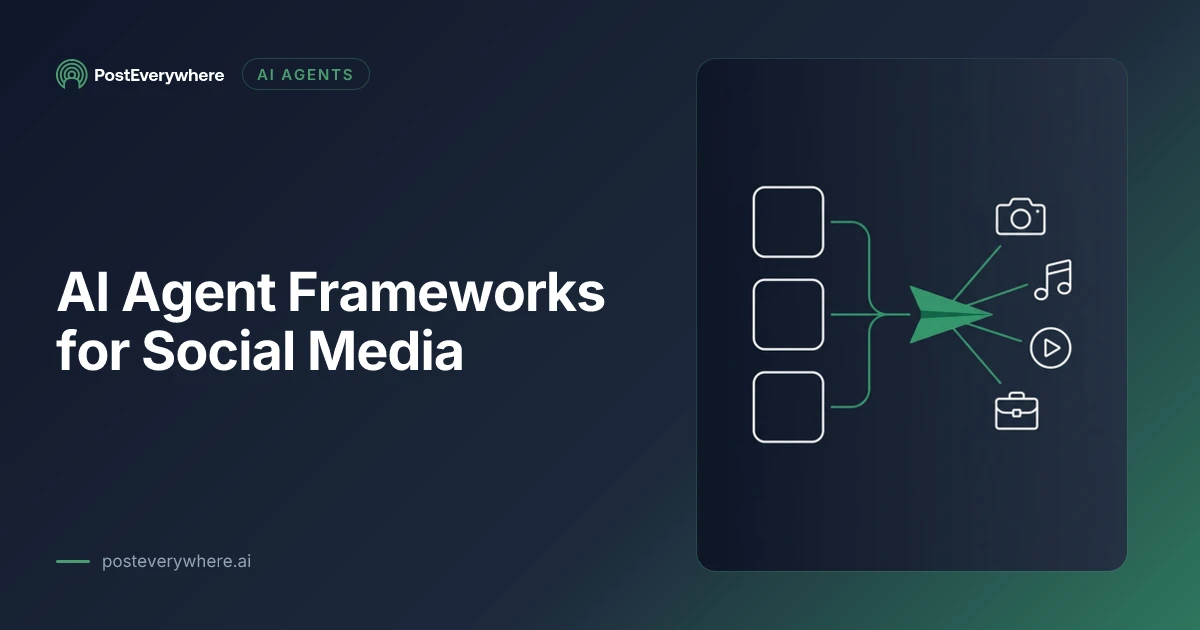
Most guides to AI agent frameworks compare them on abstractions, benchmarks and star counts. That is not much help if you have a specific job in mind.
This one compares eight frameworks against a single concrete task: build an agent that decides what to post, writes it, and publishes it to real social accounts on a schedule.
That task exposes differences the general comparisons miss, and it surfaces a problem that catches almost everyone out. The framework is rarely the hard part.
The Short Answer
If you are writing Python and want the shortest path, use the OpenAI Agents SDK. It has the fewest abstractions of the mature options and its primitives (agents, handoffs, guardrails) map cleanly onto a content workflow.
If you are writing TypeScript, use the Vercel AI SDK. If you want multiple specialised agents that collaborate, use CrewAI. If you want a visual builder your marketing team can edit without you, use n8n.
If you need durable, resumable execution with human approval steps, use LangChain on LangGraph.
None of these choices will determine whether your project succeeds. What determines that is how you handle platform authentication and publishing, which is covered further down and is the reason most social posting agents never make it past a demo.
If you would rather not build one at all, an agentic social media scheduler can handle the publishing side for you, and our roundup of ready-made agent products covers that route.
What a Posting Agent Actually Needs
Strip away the marketing and a social posting agent needs four things. (For what agents actually do once they are built, our report on AI agents in social media has first-party usage data.)
A model and a loop. Something that reasons about what to post and can call tools repeatedly until the job is done. Every framework here provides this, and they are more alike than different.
Tools. Function calling so the agent can fetch your content calendar, look at analytics, generate an image, create voice content with a Murf voice agent, and publish. Again, universal.
Memory or state. So the agent knows what it posted last week and does not repeat itself. Support varies, and this is a real differentiator.
Publishing access. OAuth tokens for every network, token refresh, media upload, per-platform formatting rules, retry logic, and rate limit handling. Almost no framework helps with this at all.
That last item is where the work actually lives. It is worth reading our overview of what social media AI agents do before choosing tooling, because the framework decision matters less than most people assume.
LangChain
LangChain is the most widely used option and has narrowed its focus considerably. Its current headline primitive is create_agent, described in its own documentation as "a minimal, highly configurable agent harness" composed from model, tools, prompt and middleware.
The important structural fact is that LangChain agents are built on top of LangGraph, which supplies durable execution, persistence and human-in-the-loop support. LangSmith sits alongside for tracing and evaluation.
For a posting agent: the durability is the reason to choose it. If your workflow is "draft the post, wait for a human to approve it, then publish", LangGraph handles the waiting properly. The run can pause for hours and resume.
Building that yourself on a simpler framework is genuinely annoying. If the approver is a colleague rather than you, team roles and permissions are worth designing in from the start.
Against: it is the heaviest option here, and the ecosystem moves fast enough that tutorials go stale quickly. If your agent just writes and posts with no approval gate, this is more machinery than you need.
CrewAI
CrewAI organises work around agents that collaborate. Its documented concepts are Agents composed "with tools, memory, knowledge, and structured outputs using Pydantic", Crews that orchestrate them, Flows that "manage state, persist execution, and resume long-running workflows", and Tasks supporting "sequential, hierarchical, or hybrid processes with guardrails, callbacks, and human-in-the-loop triggers". It requires Python 3.10 or later.
For a posting agent: the crew metaphor genuinely fits social media, which is one of the few domains where it does. A researcher agent finds the topic, a writer drafts the copy, an editor checks it against brand guidelines, a publisher schedules it.
That maps to how content teams already work, so the structure is easy to reason about.
Against: multiple agents means multiple model calls, so a crew costs several times what a single well-prompted agent costs for the same output. Worth checking that the collaboration is buying you quality rather than just latency and spend.
Give any agent publishing access. One endpoint publishes to all top platforms with auth, retries and media handling already solved. See the API or browse assistant connectors.
OpenAI Agents SDK
The OpenAI Agents SDK describes itself as a way to "build agentic AI apps in a lightweight, easy-to-use package with very few abstractions". Its three primitives are Agents, handoffs (including agents used as tools), and Guardrails for validating inputs and outputs.
It is Python-only and open source, installed with pip install openai-agents.
For a posting agent: the guardrails are the standout. Publishing is irreversible in a way that most agent tasks are not, so validating output before it goes live is not a nice-to-have.
A guardrail that blocks posts containing competitor names, unapproved claims or the wrong pricing is straightforward here and fiddly elsewhere, and it pairs well with an approval queue on the publishing side.
Against: Python only, and the handoff model is less expressive than a full graph if your workflow branches heavily. OpenAI also publishes broader agent guidance worth reading alongside the SDK docs.
Vercel AI SDK
The Vercel AI SDK is a TypeScript toolkit for building AI applications and agents across React, Next.js, Vue, Svelte and Node.js. It splits into AI SDK Core for generation, structured objects and tool calls, AI SDK UI for chat interfaces, and harnesses for running established agent setups.
It standardises across more than 20 model providers and supports MCP for tool integration.
For a posting agent: if your product is a web app and you want a human reviewing drafts in a UI, this is the obvious pick. The UI hooks mean the approval interface is close to free, which matters more than it sounds when the alternative is building a review queue from scratch.
Pair it with a publishing API and the whole surface is a single tool definition.
Against: TypeScript only. If your content pipeline already lives in Python, the ecosystem pull is the other way.
n8n
n8n is a workflow automation platform with AI nodes rather than a code-first agent framework, and for a lot of social media work that is the right shape.
For a posting agent: it is the only option here that a marketer can edit without you. When the schedule needs changing at 6pm on a Friday, someone other than an engineer can do it.
It is self-hostable, which matters for teams that will not put brand credentials in a third-party cloud, and it handles cron scheduling natively rather than making you build it.
Against: complex branching logic becomes unwieldy on a canvas, and version control is awkward compared to code. We cover the connection patterns on our social media API page.
Pydantic AI and Mastra
Two newer entrants worth knowing about.
Pydantic AI brings the ergonomics of Pydantic to agent building, with type-safe structured outputs as the organising idea. For a posting agent this is genuinely useful, because a post is a structured object (text, media, platform targets, schedule time) rather than free text.
Getting a validated object out of the model rather than a string you have to parse removes a whole category of bug.
Mastra is the TypeScript equivalent of that instinct, bundling workflows, agents and evals into one opinionated package.
For a posting agent: both are good choices if correctness of the output shape matters more to you than orchestration flexibility. Both have smaller communities, so expect to read source rather than Stack Overflow.
The structured-output instinct fits publishing well, since every network enforces its own format rules.
AutoGen
AutoGen from Microsoft focuses on multi-agent conversation, with agents that talk to each other to solve a problem.
For a posting agent: it is the most research-oriented framework here, and the conversational multi-agent pattern is a heavier fit for content production than CrewAI's task-oriented one. Reach for it if you are experimenting with agent interaction patterns rather than shipping a posting pipeline.
For shipping, the comparison in agents versus schedulers is the more useful frame.
The Auth Problem Nobody Warns You About
Here is where most social posting agents die, and it has nothing to do with which framework you picked.
To publish to all top platforms you need a developer app on each one. Several require review before they will let you post on behalf of users, and those reviews take days to weeks and can be rejected.
You then need OAuth flows for each, token storage, and refresh logic, because tokens expire on different schedules and some expire in hours. Media upload is often a separate multi-step endpoint.
Every platform has its own character limits, aspect ratios, and video specs. Some now charge per call: X bills $0.200 for a post containing a link.
Estimate that honestly and it is weeks of engineering before your agent posts anything, followed by ongoing maintenance every time a platform changes something. None of it is interesting work, and none of it differentiates your product.
There are two ways around it.
Give the agent an API. A unified publishing API exposes one endpoint that reaches every network, so from the framework's point of view publishing is a single tool with a single schema.
This works with every framework on this page, and our agent build guide walks through the implementation.
Give the agent an MCP server. MCP is "an open-source standard for connecting AI applications to external systems", described in its own documentation as "like a USB-C port for AI applications".
It is supported by Claude, ChatGPT, VS Code and Cursor among others. Point an MCP-capable client at a publishing server and the agent gains posting ability with no integration code at all.
We compare the two routes in API versus MCP, and list what is available in our roundup of the best social media MCP servers. The same kind of server can publish to a blog as well; our WordPress MCP guide walks through one request that posts an article and its announcements.
Skip the OAuth work entirely. PostEverywhere handles auth, tokens, media and retries across all top platforms. Plans from $9/mo, 7-day trial, card required. See pricing.
Which One Should You Pick
| If you want | Pick | Why |
|---|---|---|
| Shortest path in Python | OpenAI Agents SDK | Fewest abstractions, guardrails suit publishing |
| Shortest path in TypeScript | Vercel AI SDK | Core plus UI hooks, 20+ providers |
| Specialised collaborating agents | CrewAI | Crew model maps to content team roles |
| Human approval before posting | LangChain on LangGraph | Durable execution, resumable runs |
| Non-engineers editing the workflow | n8n | Visual canvas, self-hostable, native scheduling |
| Guaranteed output structure | Pydantic AI or Mastra | Type-safe structured outputs |
| Multi-agent research | AutoGen | Conversation-first design |
| No framework at all | Claude Agent SDK or a connector | Often enough for scheduled posting |
That last row is not a joke. A large share of "social media agent" projects are a cron job, a prompt and a publishing call. If that describes yours, an assistant wired to a publishing tool through our connectors will get you there this afternoon, and you can graduate to a framework when you actually need orchestration.
Our roundup of existing agent products covers the buy rather than build option.
FAQ: AI Agent Frameworks
Which AI agent framework is best for social media automation?
For Python, the OpenAI Agents SDK offers the shortest path with the fewest abstractions, and its guardrails suit publishing because posts cannot be unpublished cleanly. For TypeScript, the Vercel AI SDK is the strongest choice.
For workflows a non-engineer needs to edit, n8n is better than any code framework. The framework matters less than how you solve platform authentication.
Do I need an agent framework to automate social media posting?
Often no. If your workflow is "generate content on a schedule and publish it", a scheduled script or an assistant connected to a publishing tool covers it. Frameworks earn their complexity when you need multiple specialised agents, branching decisions, durable runs that pause for approval, or tool use that varies by situation.
Can LangChain post to social media directly?
Not by itself. LangChain provides the agent harness, tools and orchestration, but it does not ship platform integrations for social networks. You supply publishing as a tool, either by writing per-platform API calls yourself or by calling a unified publishing API that covers every network through one endpoint.
What is the difference between CrewAI and LangChain?
CrewAI organises work around multiple collaborating agents with defined roles, using Crews, Flows and Tasks. LangChain centres on a single configurable agent harness built on LangGraph, with durable execution and human-in-the-loop support.
CrewAI suits role-based content workflows, while LangChain suits workflows needing persistence and approval gates.
How much does it cost to run a social media agent?
Model calls dominate for most builds, at roughly a cent or two per content generation depending on model and prompt length. Multi-agent crews multiply that by the number of agents.
Publishing costs depend on your route: a scheduling platform charges a flat subscription with no per-post fee, whereas some platform APIs meter it, with X charging $0.200 per post containing a link.
Is MCP better than using an API for agent publishing?
They solve different problems. MCP removes integration work when your agent runs inside an MCP-capable client such as Claude, ChatGPT or Cursor, since the client discovers the tools automatically. A REST API is the right choice when your agent runs as your own service, because you control retries, scheduling and error handling directly.
Can these frameworks handle posting to multiple platforms at once?
Only if you give them a tool that does. No framework here ships multi-platform publishing. You either build per-platform integrations, which means separate developer apps, OAuth flows and media handling for each network, or you call a single endpoint that fans out to all of them.
Our guide to cross-posting covers the formatting differences that still apply either way.
Which framework handles human approval before publishing?
LangChain on LangGraph has the strongest support, since runs persist and can pause indefinitely awaiting input. CrewAI supports human-in-the-loop triggers on tasks. n8n handles it naturally with a wait node.
The Vercel AI SDK makes the approval interface easy to build because of its UI hooks, though you supply the persistence yourself.

Founder & CEO of PostEverywhere. Writing about social media strategy, publishing workflows, and analytics that help brands grow faster.