How to Cross-Post on Social Media: The Complete 2026 Guide

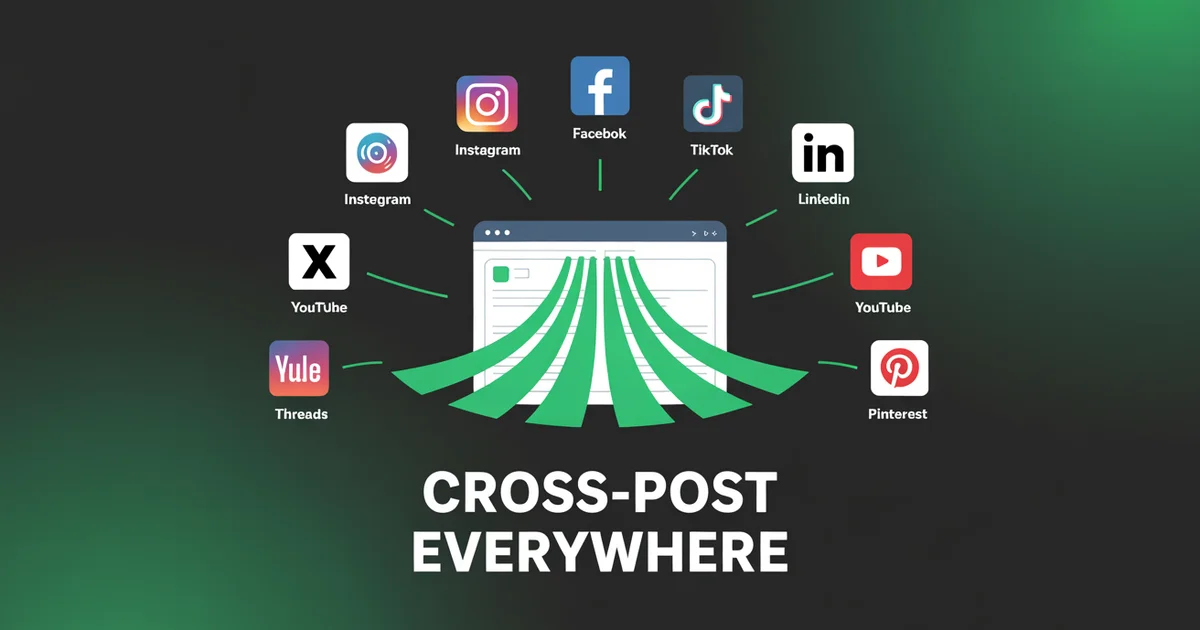
Cross-posting in 2026 is harder than it should be, and the platforms made it that way on purpose.
Meta's IG-to-Facebook auto-share quietly broke in April 2026. TikTok and Instagram don't talk to each other and never will. X's API repricing in 2025 wiped out a generation of cross-poster apps. YouTube Shorts has a watermark detector. Pinterest discontinued its native short-form format. Most "cross-post your social media" guides are stale by six months.
This is a working guide to what actually publishes correctly across Instagram, TikTok, LinkedIn, Facebook, X (Twitter), YouTube, Threads, and Pinterest in 2026, pair by pair, with the specific bugs and workarounds for each. Use the directory below to jump to the platform pair you need.
Edited by Jamie Partridge, Founder. Reviewed 26 April 2026
TL;DR
- No major platform supports universal cross-posting natively. Meta cross-posts within its own family (IG → FB, IG → Threads). Everyone else expects you to log in twice.
- Even the native cross-posters are quietly broken. Reels often render as still images on Facebook. IG hashtags get hidden on Threads. The April 2026 Meta Account migration silently disabled sharing for many accounts.
- Third-party schedulers (cross-platform publishers) bypass every native bug by talking to each platform's API independently, but only if they support both endpoints, which is now harder for X after the 2025 pricing changes.
- Cross-posting is not duplication. Audience overlap on most pairs sits at 50-80%, which means cross-posting is frequency reinforcement, not content laziness, when done with per-platform tailoring.
The fastest path to cross-posting that actually works: PostEverywhere publishes to 8 platforms simultaneously, with per-platform caption customisation and per-platform timing. Start free trial →
The 2026 cross-posting reality
Cross-posting used to be simple. You wrote a post, ticked a box, and it appeared everywhere. Three things broke that model:
1. Platforms started competing instead of cooperating. TikTok and Meta have no interoperability and never will. Threads launched in 2023 explicitly as a "Twitter killer"; its cross-posting integration is one-way to Instagram only. X's API tier overhaul in 2024-2025 cut off most third-party publishers.
2. Algorithms started penalising lazy duplicates. Mosseri's January 2025 statement on Instagram's recommendation system was clear: identical content gets deduplicated, and only one version is recommended. YouTube Shorts has a watermark detector that demotes uploaded TikToks. Pinterest's "non-Pinterest content" classifier devalues content that looks ported from elsewhere.
3. Native cross-posting tools are maintained by interns. Meta's Reels-to-Facebook bug, where the video renders as a still image, has its own help article that has existed since at least 2024 and still works as documented. The bug is the documentation.
The takeaway: in 2026, cross-posting is a tooling problem, not a strategy problem. Strategy is figuring out which platforms your audience genuinely uses. Tooling is delivering the content there reliably without losing reach to algorithm penalties or platform bugs. Before you cross-post anything, check your asset against the platform-by-platform aspect ratio guide — wrong dimensions are the most common reason cross-posts look unprofessional.
Native cross-posting capabilities matrix
Which platforms can publish to which others without third-party tools, as of April 2026:
| From → To | Threads | TikTok | YouTube | X | ||||
|---|---|---|---|---|---|---|---|---|
| n/a | ✅ Toggle (buggy on Reels) | ✅ One-way share | ❌ | ❌ | ❌ | ❌ | ❌ | |
| ⚠️ Single image only | n/a | ❌ | ❌ | ❌ | ❌ | ❌ | ❌ | |
| Threads | ✅ Toggle | ✅ Toggle | n/a | ❌ | ❌ | ❌ | ❌ | ❌ |
| TikTok | ❌ | ❌ | ❌ | n/a | ❌ | ❌ | ❌ | ❌ |
| YouTube | ❌ | ❌ | ❌ | ❌ | n/a | ❌ | ❌ | ❌ |
| X | ❌ | ❌ | ❌ | ❌ | ❌ | n/a | ❌ | ❌ |
| ❌ | ❌ | ❌ | ❌ | ❌ | ⚠️ Twitter integration discontinued 2012 | n/a | ❌ | |
| ❌ | ❌ | ❌ | ❌ | ❌ | ❌ | ❌ | n/a |
The honest read: Meta is the only platform family with meaningful native cross-posting, and even within Meta the toggles break, mute audio, or render Reels as still images. Everywhere else, you're either copy-pasting manually or using a third-party scheduler.
The 12 cross-posting guides by use case
The cluster below covers every high-volume platform pair we've researched in detail. Each guide includes the native method (where one exists), the specific bugs to avoid, real algorithm context for 2026, and a step-by-step third-party workflow.
Meta family pairs
These three pairs share the same Accounts Center linking architecture but break in completely different ways.
- How to post to Instagram and Facebook at the same time: covers the Reels-as-photo bug, the April 2026 Meta Account migration that silently disabled sharing toggles, and Mosseri's actual algorithm guidance on cross-posted content.
- How to post to Instagram and Threads at the same time: Threads' Topic Tag system fights Instagram's hashtag stuffing; cross-posted hashtags get hidden behind a "Show hashtags" expander. Reels don't carry across.
- How to cross-post Instagram Reels to Facebook Reels: the narrow Reels-to-Reels case. Audio rights asymmetry between IG and FB music libraries causes silent Reels on Facebook.
Short-form video triangle (TikTok / Reels / Shorts)
The three-way distribution problem at the core of 2026 creator workflows.
- How to cross-post Reels, Shorts and TikTok at the same time: the anchor guide for the short-form video triangle. Three algorithms, three monetisation models, three audience cultures.
- How to post to Instagram and TikTok at the same time: Meta and ByteDance have no interoperability. Watermark issues, audio rights asymmetry, and the "no native" workaround.
- How to post TikTok to YouTube Shorts: YouTube Shorts pays real money via the Partner Program; TikTok Creator Rewards collapsed. Why TikTok creators are uploading to YouTube first now.
- How to post TikTok to Instagram Reels without watermark: the Mosseri penalty data, the four ranked watermark-removal methods, and the legal grey area around third-party download tools.
- How to remove TikTok watermark before posting: the broader watermark-removal workflow for distribution to any platform. Includes the "original cross-posting" approach that competitor guides skip because their business model depends on selling download tools.
Text + microblog pairs
- How to post the same thing to Twitter and Threads: the 280-vs-500 character asymmetry, the X API repricing fallout, and Bluesky as the rational third destination.
- How to post to LinkedIn and Twitter at the same time: B2B tonal translation. LinkedIn 3,000-character allowance vs X's 280, threading vs single posts, and LinkedIn's external-link reach penalty.
Visual + discovery pair
- How to post to Instagram and Pinterest at the same time: Instagram is feed-first (hours), Pinterest is search-first (years). Same vertical media, fundamentally different distribution timeframes.
Reverse intent (disable instead of enable)
- How to stop Instagram from auto-posting to Facebook: for users who want the opposite of cross-posting. Brand separation, audience privacy, and the April 2026 migration that silently re-enabled toggles.
When you should NOT cross-post
Cross-posting is a default tactic in 2026, but there are clear cases where posting separately wins:
1. The platforms have completely different audiences. A LinkedIn thought-leadership post about B2B SaaS pricing has zero relevance to a TikTok audience. Cross-posting it dilutes both posts. Use platform-specific content instead.
2. Native features matter more than reach. Instagram Stories with polls, X Spaces, LinkedIn carousels, TikTok duets: these don't translate to other platforms. Use the native feature; don't cross-post.
3. Brand positioning differs by platform. A company that's "fun and irreverent" on TikTok and "polished and professional" on LinkedIn shouldn't cross-post. Maintain the persona on each.
4. The content was made FOR a specific platform's algorithm. A 7-second TikTok with trending sound, a YouTube Short with an SEO-optimised title, a LinkedIn post with a "PDF carousel": these are platform-specific by design. Cross-posting them generally underperforms.
5. Compliance or regulation. Healthcare, legal, financial services: disclaimers and disclosures differ by platform. Cross-posting can create compliance gaps. Our /for/financial-services and /for/healthcare guides cover the platform-specific requirements.
For everything else (content marketing, brand awareness, consistent presence, recycled evergreen content), cross-posting wins on time and audience reach.
Native vs third-party: when to use which
| Scenario | Native (Meta Business Suite, in-app toggles) | Third-party scheduler |
|---|---|---|
| Posting to 2 platforms in the Meta family only | ✅ Works for most content; Reels-to-Facebook still buggy | ✅ Better control, no bugs |
| Posting to 3+ platforms | ❌ Not possible (requires 3+ separate apps) | ✅ One composer, all platforms |
| Per-platform caption customisation | ⚠️ Limited; Meta forces the IG version on FB | ✅ Per-platform variants |
| Per-platform scheduling timing | ❌ Native tools don't do this | ✅ Schedule each platform at its own optimal time |
| Cross-platform analytics | ❌ Each platform's analytics in isolation | ✅ Unified analytics |
| Team workflows + approvals | ❌ Personal account-bound | ✅ Team workspaces |
| Recovering when a native toggle breaks | ❌ Must wait for Meta to fix | ✅ Bypass via direct API |
| Cost | Free | $19+/mo |
For solo creators on 1-2 Meta platforms only, native is fine. For everyone else (multi-platform creators, agencies running multi-client workflows with social media tools for agencies, multi-brand teams, B2B marketers), third-party is mandatory. The math stops working at three platforms.
Cross-post to Instagram, Facebook, TikTok, LinkedIn, X, YouTube, Threads, and Pinterest from one composer. PostEverywhere handles per-platform caption tailoring, scheduling, and analytics in a single workspace. Start free trial →
How PostEverywhere handles cross-posting
The product approach is the same across every cluster guide above, so we cover it once here. Each cluster guide goes deeper on the platform-pair specifics.
One composer, eight platforms. Connect each social account once via official API. Upload content once. Customise the caption, hashtags, mentions, and media crop per platform without re-uploading. Schedule each at its own optimal time, or post all simultaneously. Track per-platform performance from a unified analytics dashboard. If you're also juggling several brands or client accounts at once, our guide to managing multiple social media accounts covers the workflow side — logins, separation, and team handoff.
Why this bypasses native bugs: PostEverywhere talks to each platform's publishing API independently: Instagram's Graph API, Facebook's Pages API, TikTok's Content Posting API, YouTube's Data API, etc. There's no Meta-internal cross-share endpoint involved, which means the Reels-as-photo bug, the silently-disabled toggles, and the audio-mute issue don't exist. A Reel posts to Facebook through Facebook's Reels endpoint as a real Reel.
Where it doesn't help: PostEverywhere can't fix platform-side algorithm penalties for genuinely identical content. If you're stuffing identical posts to every platform, the algorithms will still demote the duplicates. The fix is per-platform tailoring, which the AI caption generator automates: write one base post, get five platform-tailored variants in a click.
Pricing: Starts at $19/mo for 10 connected accounts (Starter plan). 7-day free trial on every tier. See /pricing for full plan comparison.
Cross-posting mistakes that hurt more than they save
Five patterns we see repeatedly in user audits:
- Identical text everywhere. Algorithms detect this. So do humans who follow you on multiple platforms. Use per-platform variants. Even minor changes (different opening line, platform-specific hashtags, adjusted CTA) signal effort.
- Wrong aspect ratio. Posting a 9:16 vertical Reel as a 16:9 LinkedIn video gets letterboxed and looks lazy. Crop per platform; most schedulers do this automatically. See our social media image sizes guide for current specs.
- Hashtag bleed. Instagram-style hashtag stacks (
#fitness #motivation #healthylife) on LinkedIn read as spammy. Threads has a 1-tag-per-post Topic Tag system. Adapt the hashtag strategy per platform. - Same posting time everywhere. Instagram's audience peaks at 7-9am; LinkedIn peaks at 9am workday-start; TikTok peaks at 7-11pm. Posting to all simultaneously wastes most of them. Stagger using best-time-to-post data.
- Cross-posting platform-specific features. Polls, AR filters, Spaces, Lives: these don't cross-post. Use the native feature, post natively, and complement with cross-posted content rather than trying to replicate.
Frequently asked questions
Does cross-posting hurt my reach on each platform?
Not when done with per-platform tailoring. Mosseri's January 2025 algorithm guidance penalises recycled content: TikTok-watermarked Reels, posts that are 70%+ visually identical to existing content, accounts that repost others' content more than 10 times in 30 days. It does not penalise a creator posting their own original work to two of their own accounts on different platforms with platform-tailored captions. The myth that "cross-posting kills reach" is mostly outdated SEO advice repeated without sourcing.
What's the fastest cross-posting workflow in 2026?
For 2 platforms in the Meta family, native toggles are still fastest (when they work). For 3+ platforms or any non-Meta combination, a third-party scheduler is the only realistic option. Meta Business Suite tops out at IG + FB; everything else requires logging into each app separately. PostEverywhere and similar tools collapse 3-8 logins into one composer, which is where the time savings actually come from.
Is cross-posting against any platform's terms of service?
No platform prohibits cross-posting your own original content. What's restricted is reposting other people's content (without permission), removing platform watermarks (TikTok's ToS prohibits this), and using unofficial APIs to scrape or auto-post in ways the platform doesn't sanction. Cross-posting via official APIs (which is what reputable schedulers use) is fine.
Can I cross-post Stories or Reels?
Stories: only natively within Meta (IG Story → FB Story toggle exists; nowhere else has a Stories cross-post). Reels: yes via third-party schedulers, but each platform places Reels content differently. Facebook Reels is a separate placement from regular Feed; Pinterest video Pins behave differently from Reels-as-uploaded; YouTube Shorts has different metadata requirements (60-second hard cap, vertical 9:16 only). Each cluster guide above covers the specific Reels behaviour for its pair.
What about cross-posting to Bluesky and Mastodon?
Bluesky has an open API and most third-party schedulers added support in 2024-2025. Mastodon's federated nature makes it harder. You'd post to your home instance, and ActivityPub propagates from there. Threads launched fediverse integration in 2024, which means Threads posts can theoretically reach Mastodon users, but the bridge is still maturing. The Twitter and Threads guide covers the current Bluesky/fediverse state in detail.
Why did my cross-posts stop working in April 2026?
The Meta Account migration that began on 23 April 2026 reorganised cross-app sharing settings under a unified Meta Account. During the rollout, many users found their previously-active sharing toggles silently disabled. Re-link them in Instagram Settings → Accounts Center → Sharing across profiles. The Instagram and Facebook guide covers the migration in detail.
Should I cross-post AI-generated content the same way I cross-post original content?
Yes, with one caveat: AI-generated images and videos increasingly trigger platform-specific authenticity flags. Meta now labels AI content; YouTube requires creators to disclose AI-generated material in Shorts; TikTok has its own AI-content disclosure system. The cross-posted version inherits the original's metadata, but always check each platform's current disclosure requirements before publishing. Tools like the AI image generator and AI video generator handle disclosures correctly per platform.
Where do I start if I've never cross-posted before?
Pick the two platforms where your audience overlaps most heavily. For most creators, that's Instagram and one other platform (Facebook for older audiences, TikTok for younger, LinkedIn for B2B, Pinterest for visual niches). Read the relevant guide above, set up a single test post with per-platform tailoring, measure performance for two weeks, then expand. Don't try to launch on all 8 platforms in week one.
Related guides
- Cross-posting feature overview: product page
- Post to all social media at once: pillar feature page
- The original cross-posting guide: older general overview
- Cross-posting vs repurposing: when to do which
- Best cross-posting tools (compared): competitor breakdown
- How to schedule posts to multiple platforms: scheduling deep dive
- How to post content across all social media platforms: workflow guide
Skip the bugs and the manual logins. PostEverywhere cross-posts to 8 platforms from one composer, with per-platform tailoring, per-platform timing, and unified analytics. Start free trial →
Founder & CEO of PostEverywhere. Writing about social media strategy, publishing workflows, and analytics that help brands grow faster.