What's the best Sprout Social alternative? PostEverywhere is the best Sprout Social alternative for AI agents and automation: instead of paying per seat for an AI layer that lives inside Sprout, you bring the agent you already use, Claude or ChatGPT, and it drafts and schedules posts through PostEverywhere's hosted MCP server on flat plans from $9/month. Among the other Sprout Social alternatives, Agorapulse is the closest inbox match and Hootsuite includes social listening.
Sprout Social is a polished, full-featured social media management platform. It's also one of the most expensive. If you've landed here, you probably already know that, and you're wondering whether you really need to spend $199/seat/month (billed annually) on the Standard plan just to schedule posts and read comments.
Updated October 2026: Sprout Social restructured its pricing this year. Per seat, per month, the lineup is now Essentials at $79 billed annually ($99 monthly), Standard at $199 ($249 monthly), Professional at $299 ($399 monthly), and Advanced at $399 ($499 monthly).
Essentials covers publishing and reporting for 5 profiles; the all-in-one inbox starts on Standard. The big addition is Trellis, Sprout's agentic AI layer that auto-drafts replies, suggests post variations, and routes inbox conversations to the right team member.
Every plan lists 100 Trellis credits per seat per month. Social listening is still a separate add-on (Standard and up) with no published price.
The short answer: most teams don't need any of that. There are Sprout Social alternatives that cover 90% of what most teams actually use, at a fraction of the cost.
But I want to be honest upfront. Sprout Social isn't overpriced for nothing. Its analytics are genuinely deep. Its social listening (when you pay extra for the add-on) is powerful.
Trellis is one of the more polished agent layers in the category. The unified inbox handles high-volume customer service better than almost anything else on the market. If money were no object, Sprout would be hard to beat.
For most teams, though, money is very much an object. And when you do the math — $199/seat on Standard, $299/seat on Professional, $399/seat on Advanced, plus annual contracts — the costs add up fast.
A five-person marketing team on the Professional plan is looking at nearly $18,000 per year before add-ons.
That's the gap these alternatives fill. Not by being better at everything, but by delivering the features most teams actually rely on — scheduling, analytics, collaboration, and cross-posting — without the enterprise tax.
Most teams that switch find they were paying Sprout prices for a workflow that's really just cross-posting on social media reliably across the same six or seven networks every week.
For a direct head-to-head comparison, see our detailed PostEverywhere vs Sprout-social comparison.
Quick comparison
| Tool | Best for | Starting price | Free plan or trial | What an AI agent can do (MCP) |
|---|---|---|---|---|
| PostEverywhere | Full-platform scheduling with AI agents | $9/month | 7-day free trial | Publish, schedule, queue, best time, bulk, retry, connect accounts |
| Hootsuite | Listening without Sprout add-ons | $99/user/month (annual) | No free plan | – |
| Sotrender | Deep analytics and benchmarking | Custom quote | 7-day free trial, no card | None listed |
| Agorapulse | Inbox management and ROI reporting | $79/user/month | See pricing page | – |
| Buffer | Simple scheduling on a tight budget | Free; paid from $5 per channel | Free plan, 3 channels | – |
| Sendible | Agencies managing many clients | $35/month | See pricing page | None listed |
| SocialPilot | Bulk scheduling at scale | $25.50/month | See pricing page | – |
| Metricool | Budget analytics and benchmarking | Free; paid from $25/month | Free plan | – |
Why teams leave Sprout Social
Before jumping into alternatives, it's worth understanding what drives the switch. Based on user reviews, community discussions, and Sprout's own 2.3 out of 5 rating on Trustpilot, a few themes come up repeatedly.
The pricing structure punishes growth. Sprout charges per seat, and there's no way around it. When you hire a new social media coordinator or bring on a freelancer, that's another $79-$399/month (billed annually) under the new 2026 pricing.
Tools like PostEverywhere and SocialPilot include multiple users in their base plans, so growing your team doesn't mean growing your bill at the same rate.
Contract lock-in catches people off guard. Sprout Social uses annual contracts by default, and cancellation isn't always straightforward. Multiple reviewers report being charged for months after requesting cancellation, with support responses that feel templated rather than helpful.
Essential features sit behind paywalls. Social listening isn't included in any standard plan — it's a separate add-on, priced only on request. Competitive analysis, sentiment tracking, and advanced reporting all require higher tiers. Unlimited profiles start at Professional ($299/seat).
By the time you've assembled the feature set you actually want, you're deep into enterprise pricing.
The value gap hits smaller teams hardest. A 50-person marketing department at a Fortune 500 company can absorb Sprout's pricing. A 3-person agency or a startup social media manager cannot.
And yet both groups need scheduling, analytics, and a unified inbox. The alternatives below serve that second group without making them feel like second-class users.
1. PostEverywhere: Best Sprout Social Alternative for AI Agents


Publishes to all top platforms
 Instagram
 Facebook
 X
X LinkedIn
 TikTok
 Threads
 Bluesky
 Telegram
 Discord
 YouTube
 Pinterest
 WordPress
 Google Business Profile
Why PostEverywhere wins
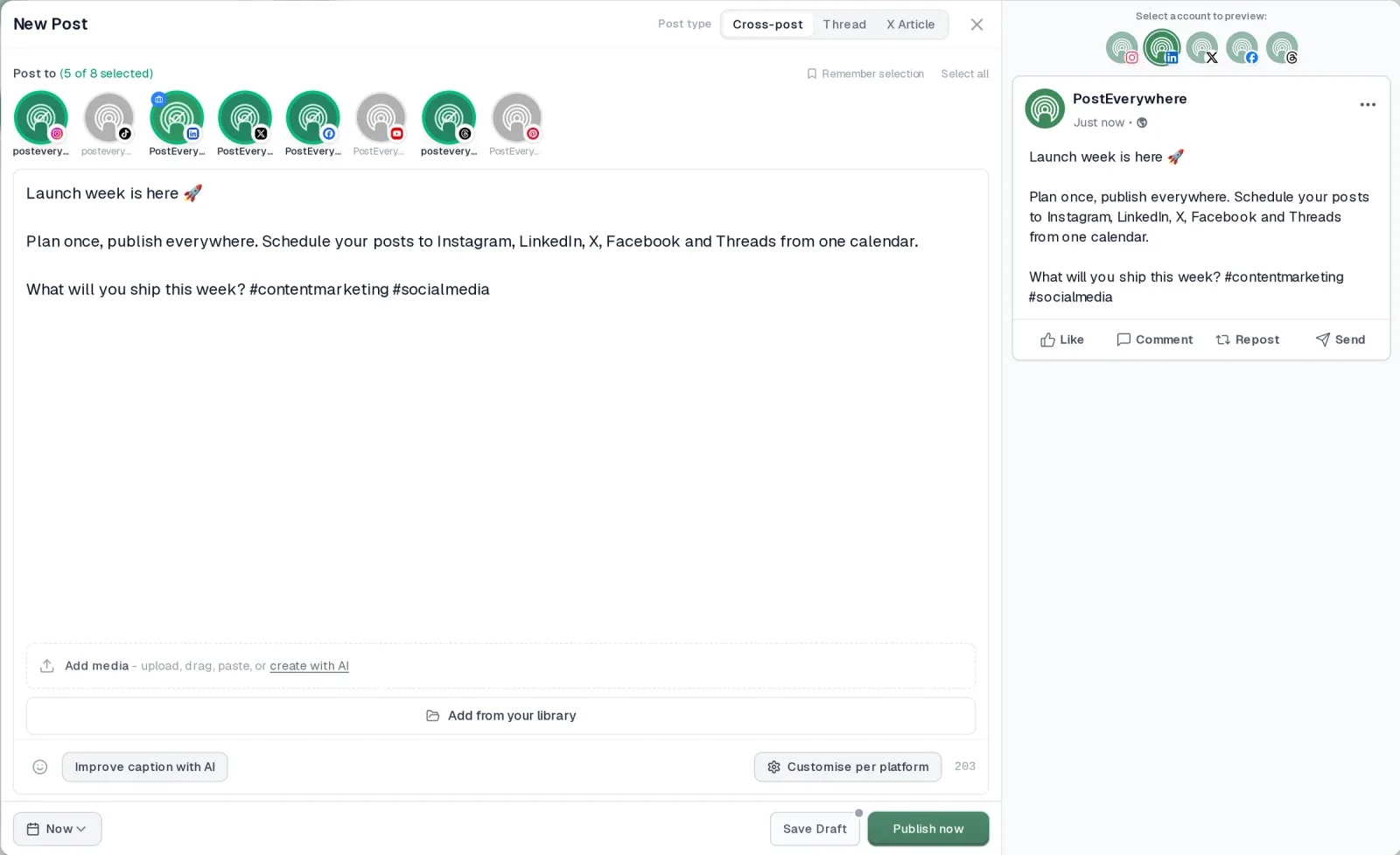
- It's simple. One composer for every platform: write the post once, tweak the caption per platform, check the live preview for each account and schedule it.
- One flat price, nothing locked away. From $9 a month. Every plan includes unlimited posts, the full API, the hosted MCP server and AI Studio, with no per-channel fees.
- Every top platform in one place. Instagram, TikTok, YouTube, LinkedIn, Facebook, X, Threads and Pinterest, plus Bluesky, Telegram, Discord, WordPress and Google Business Profile.
- Your AI agent can run it. Connect Claude, ChatGPT or Cursor in about a minute and ask it to plan, write and schedule your posts.
- Create in the same tool. AI Studio makes captions, images and video, so you don't need a second app before you post.
How PostEverywhere works
- Connect your accounts. Link your social accounts once, across all top platforms.
- Create the post. Write it in the composer, make images and video in AI Studio, or ask Claude or ChatGPT to draft and schedule it for you.
- Schedule it everywhere. Tweak the caption for each platform, check every preview, and it goes out on time from one calendar.
Switching from Sprout Social?
| Sprout Social | PostEverywhere | |
|---|---|---|
| What an AI agent can do (MCP) | – | Publish, schedule, queue, best time, bulk, retry, connect accounts |
Connect your accounts, then schedule your first post from the composer or ask your AI agent to do it. Your Sprout Social account keeps running until you cancel it.
Built for AI agents
- Agents do the whole job. A full hosted MCP server with up to 44 tools: publish, schedule, use your queue or the best time, bulk-schedule 50 posts at once, check results, retry failures and send links to connect new accounts. Some rival MCP servers only read data or create drafts.
- $29 a month for 10 accounts, flat. Full API and agent access included, with no per-channel, per-seat or per-call fees. The same 10 accounts cost $60 a month on Buffer and $99 per user (billed annually) on Hootsuite.
- Nothing gated. API, MCP and webhooks come with every plan, from Lite. Several rivals keep their API for higher tiers or a sales call.
- Connected in a minute. One click adds PostEverywhere to Claude, with one-click installs for Cursor and VS Code. ChatGPT adds it under Plugins.
Plans: Lite $9 a month (2 accounts), Starter $19 (5), Growth $29 (10), Scale $39 (20). Every plan includes unlimited posts, the full API, the hosted MCP server and AI Studio.
“This tool has truly made my content posting so much easier, I can't work without it. I can schedule my posts days in advance while working on other projects. Set it and forget it.”
Also in PostEverywhere: a posting queue, bulk upload from CSV, approvals, analytics, an API and the iPhone app.

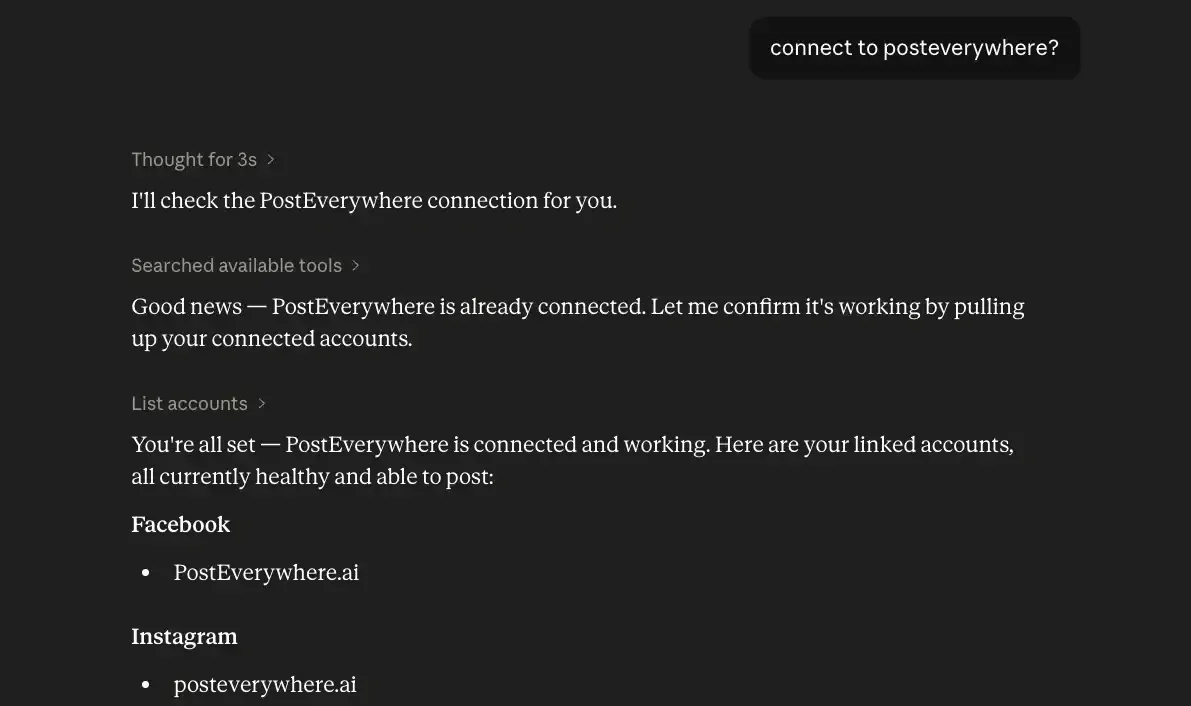
PostEverywhere is the agentic social media scheduler built for AI agents. Sprout's Trellis works inside Sprout, seat by seat; PostEverywhere works with the agent your team already uses, so Claude or ChatGPT can draft and schedule across every account through the hosted MCP server, and developers get the REST API and webhooks on the same flat plan.
Full disclosure: this is our product. I'm including it first because I genuinely believe it's the strongest alternative for teams moving away from Sprout Social's pricing, and I'll be transparent about where it falls short.
PostEverywhere was built specifically for the gap Sprout Social leaves open: teams that need professional-grade social media scheduling and AI content creation without spending hundreds per seat. Every plan includes bundled seats, which immediately solves one of the biggest pain points with Sprout's per-seat model.
The AI content generator is where PostEverywhere pulls ahead of most alternatives on this list. You can generate platform-optimized captions, repurpose long-form content into social posts, and create variations for A/B testing — all from within the scheduling workflow.
The AI image generator takes it a step further, producing custom visuals so you're not recycling the same stock photos as everyone in your niche.
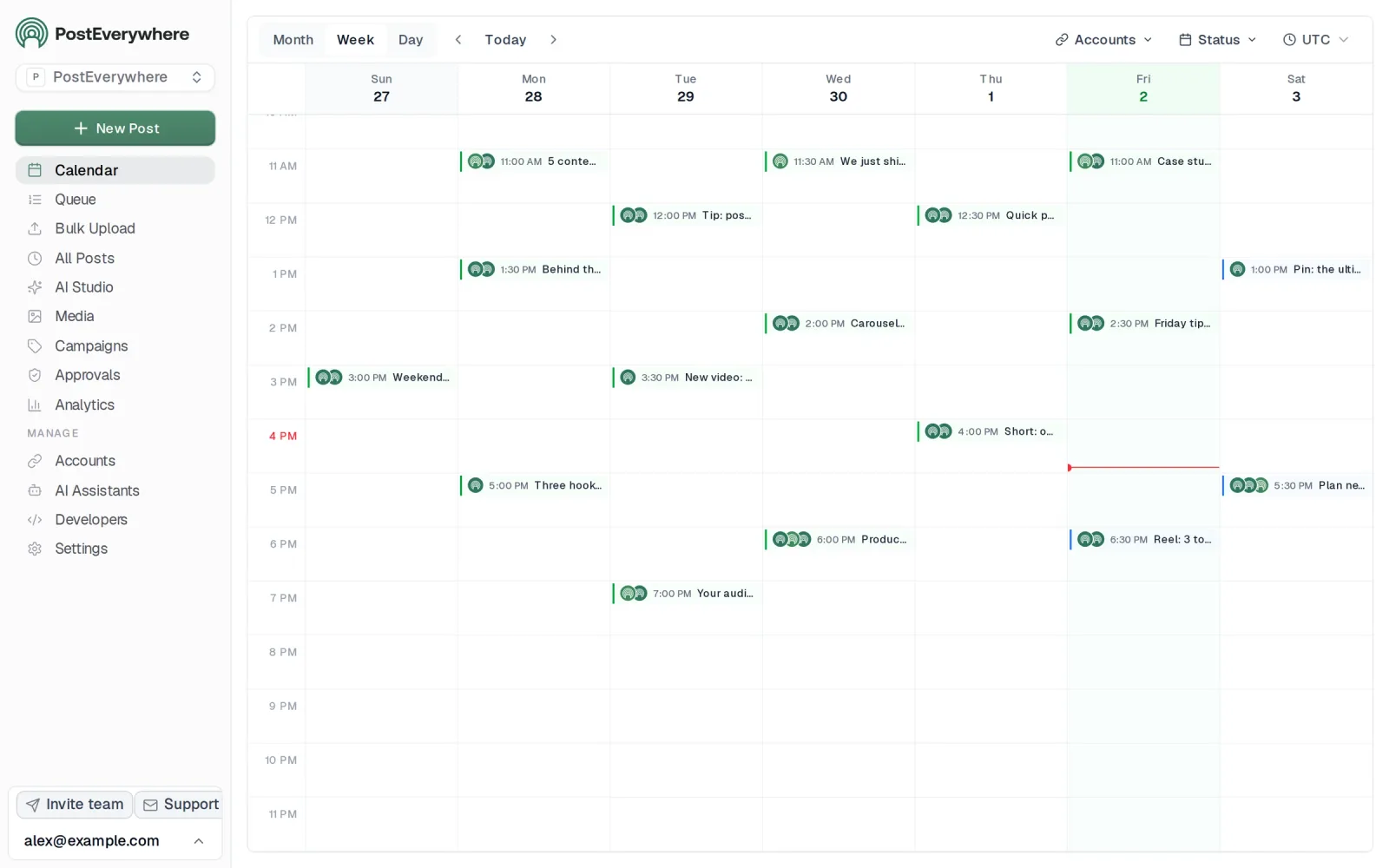
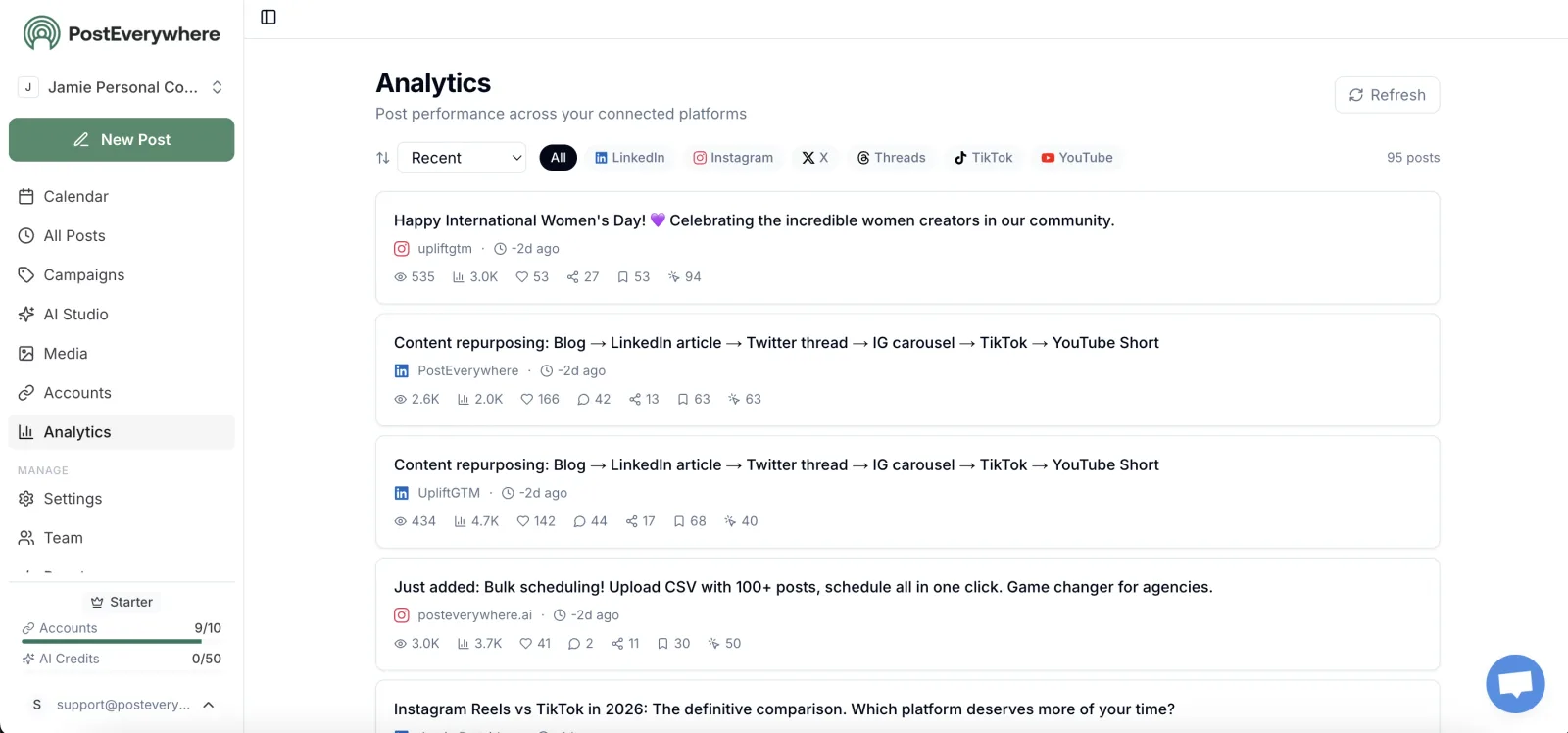
Scheduling works across Instagram, Facebook, LinkedIn, X, YouTube, TikTok, and Threads. The visual calendar gives you a clear overview of what's going out and when, with drag-and-drop rescheduling that feels natural. Cross-posting lets you post to all social media at once without duplicating work, and the best time to post feature suggests times based on when your posts have done best on each platform.
For B2B teams, that includes one-click flows to post to LinkedIn and Twitter at the same time with platform-specific tone adjustments.
For teams managing client accounts or multiple brands, the multi-account management keeps everything organized without the tab-switching chaos. You can connect up to 20 social accounts on the Scale plan, which covers most small agency rosters.
Where PostEverywhere doesn't match Sprout: there's no social listening tool, no CRM integration, and the analytics, while solid, aren't as granular as Sprout's enterprise reporting. If you need to monitor brand mentions across the web or tie social interactions to a CRM pipeline, Sprout still has the edge.
But here's the thing — most teams switching from Sprout weren't using those features anyway. They were paying for them, but they weren't using them.
Pricing: Lite $9/month (2 accounts), Starter $19/month (5 accounts), Growth $29/month (10 accounts), Scale $39/month (20 accounts). See all plans.
Best for: Teams and agencies that want full-platform scheduling with social media automation agents and don't need enterprise social listening.
The catch: No social listening and no CRM integrations. It's built to be driven by an AI agent or your own code instead, through the API, webhooks and MCP server. No free plan (7-day free trial available).
Switching from Sprout Social? PostEverywhere's Scale plan at $39/month costs less than half of a single Sprout Essentials seat, with seats included. Start your 7-day trial and migrate in under 10 minutes.
Why Choose PostEverywhere?
For teams whose real job is creating and publishing content, PostEverywhere is the better choice than Sprout Social: seats included instead of billed one by one, AI that brings your own agent rather than metering credits per seat, and every top platform on a flat plan from $9/month.
- Seats included, not billed per head. PostEverywhere's Scale plan is $39/mo for 20 accounts and 5 seats. Sprout Social charges $79 to $399 per seat per month on annual billing, so a five-person team on Professional pays nearly $18,000 a year before add-ons.
- More accounts on the entry plan. PostEverywhere's Growth plan covers 10 accounts for $29/mo. Sprout's Essentials seat covers 5 profiles, and unlimited profiles only start on Professional at $299 per seat.
- Your agent, not a per-seat AI layer. Trellis lives inside Sprout with 100 credits per seat each month. Connect Claude, ChatGPT or Cursor to PostEverywhere's hosted MCP server in about a minute and the agent can plan, write, schedule and publish posts, upload media and read analytics and best times.
- AI content creation built in. AI Studio writes captions and creates images and video inside the scheduler, and one composer lets you customise each post per platform with live previews per account.
- Built for developers too. The full REST API, signed webhooks, an open-source (MIT) MCP server, Node SDK and CLI come with every plan, with no enterprise tier required.
- Teams and clients covered. Workspaces per brand or client, roles and post approvals from Starter up, plus a content calendar, posting queue, bulk CSV upload of up to 200 posts per file and an iPhone app.
Compare plans on our pricing page, then start a 7-day free trial and move your schedule across before your Sprout renewal.
2. Hootsuite: social listening on a smaller budget
 Hootsuite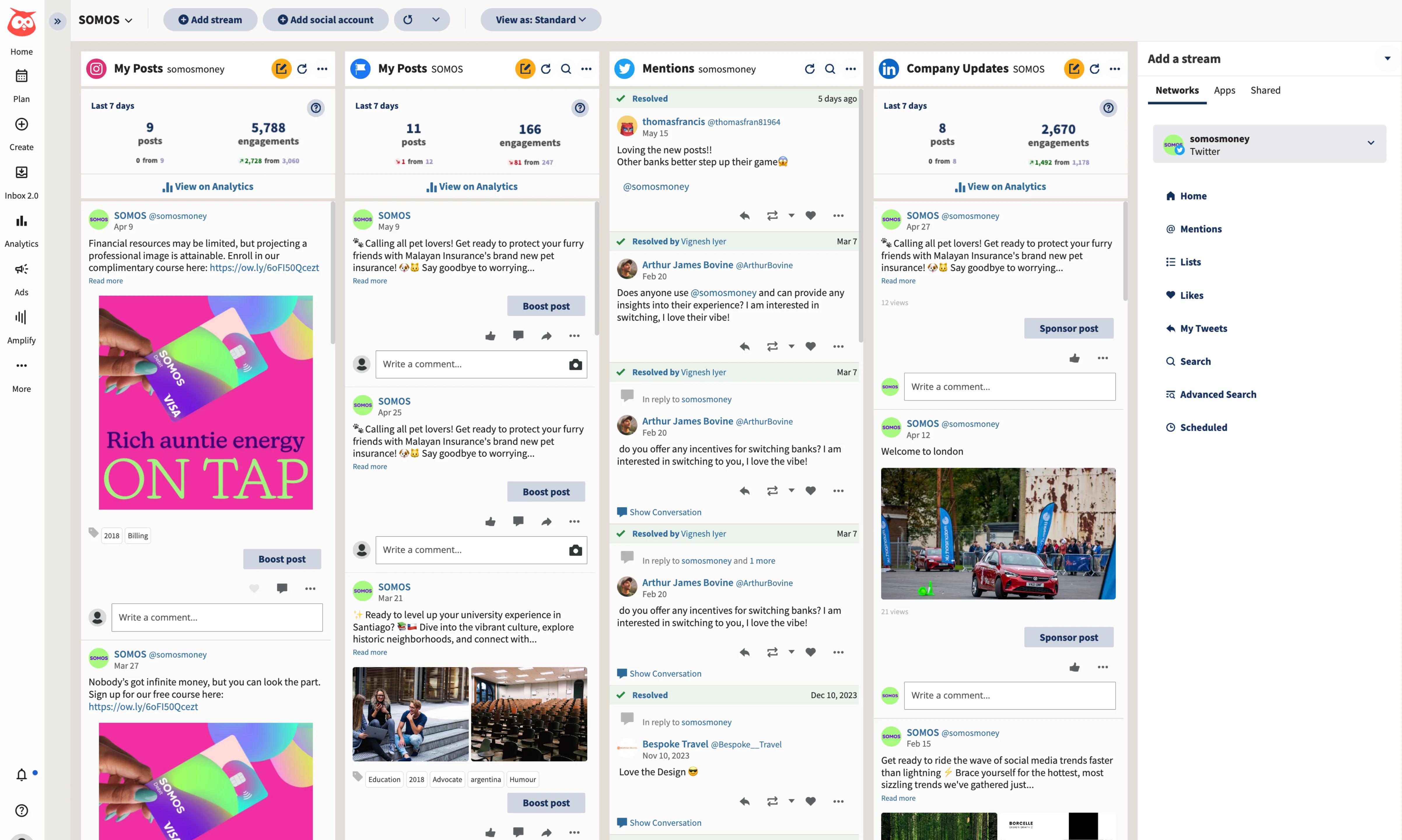
Hootsuite is the closest thing to Sprout Social in terms of feature depth, and it's the only alternative on this list that includes social listening in its core plans (via its Talkwalker integration).
If monitoring brand mentions and tracking industry conversations is non-negotiable for you, Hootsuite is the natural landing spot.
The platform supports scheduling across all major networks, offers a unified inbox for managing messages and comments, and provides analytics that go deeper than most mid-market tools. The dashboard can feel cluttered compared to cleaner alternatives, but that complexity comes with capability — you can set up custom streams to monitor specific keywords, hashtags, or competitor accounts in real time.
Hootsuite has gone through significant changes recently, cutting its free plan and restructuring pricing. The current starting point of $99/month is considerably cheaper than Sprout, though it's still a meaningful investment for solo creators or very small teams.
The analytics and reporting are strong enough for client-facing work, and the app marketplace integrates with tools like Canva, Google Drive, and Salesforce.
Where Hootsuite stumbles: the interface hasn't aged gracefully. Power users learn to navigate it, but the learning curve is real. The mobile app gets mixed reviews. And customer support, once a strength, has become inconsistent based on recent user feedback.
For a deeper enterprise-vs-enterprise breakdown, our Sprout Social vs Hootsuite comparison covers exactly where each platform wins on inbox, analytics, and seat pricing.
Pricing: Starting at $99/user/month (billed annually).
Good for: Teams that need social listening without paying Sprout's add-on pricing.
The catch: Steeper learning curve, interface feels dated, no free plan.
3. Sotrender: analytics depth beyond Sprout's reporting
 SotrenderMCP server: none listed
Sotrender takes a different angle than the other tools on this list: it commits fully to analytics and benchmarking, with no scheduling or publishing layer of its own. If your actual frustration with Sprout is paying $199+/month mainly for reporting that you could get deeper elsewhere, Sotrender slots in as the dedicated analytics platform, paired with PostEverywhere, Buffer, or another scheduler for the publishing side of the workflow.
The platform covers Facebook, Instagram, LinkedIn, YouTube, and TikTok with automated dashboards, competitor benchmarking, and historical data analysis with seasonality insights. Beyond standard performance reporting, it includes paid campaign optimization recommendations, influencer profile verification, and content effectiveness tagging.
Their published client list includes Allegro, Rossmann, Decathlon, UNICEF, and Santander, which signals the kind of enterprise reliability agencies running brand-name accounts tend to need.
Sotrender is rated a Leader in G2's Social Media Analytics category with consistent 9.3-9.7 user ratings, and offers a 7-day free trial with no credit card required. Pricing is custom-quoted rather than published on their site, which fits the agency and enterprise positioning but makes early-stage budget comparison harder than tools with transparent tiers.
Where Sotrender stumbles for some buyers: no scheduling means you still need a separate publishing tool, so your stack cost goes up rather than down if you were hoping to consolidate everything into one Sprout replacement.
The custom pricing model requires a sales conversation before you see numbers. And the historical analysis depth is most useful for accounts already running consistent content programs, less so for newer brands without six-plus months of data to mine.
Pricing: Custom quote, 7-day free trial.
Good for: Agencies and enterprise teams that want dedicated analytics depth with deep benchmarking, paired with a separate scheduling tool.
The catch: Analytics-only with no scheduling or publishing, plus custom pricing means no public tiers to compare.
4. Agorapulse: social inbox and ROI tracking
 Agorapulse
Agorapulse is the alternative that most closely matches Sprout Social's inbox experience. If your team spends significant time responding to comments, DMs, and mentions across platforms, Agorapulse handles that workflow beautifully — with assignment rules, saved replies, and a zero-inbox approach that keeps conversations from falling through the cracks.
What makes Agorapulse unique is its ROI tracking. You can tag content and social interactions with UTM parameters and track them through to conversions, giving you actual revenue attribution data. Most social media scheduling tools stop at engagement metrics.
Agorapulse connects social activity to business outcomes, which is exactly the kind of data that justifies your social budget to stakeholders.
The publishing tools are solid if not groundbreaking. You get a visual content calendar, bulk scheduling, and content queues for evergreen posts. Analytics cover all the essentials and export cleanly for client reports.
The interface is modern and intuitive — noticeably easier to navigate than Hootsuite or Sprout.
Pricing: Starting at $79/user/month.
Good for: Teams where inbox management is a primary workflow and ROI reporting matters for budget justification.
The catch: Per-user pricing (like Sprout, though cheaper). Limited social listening compared to Sprout or Hootsuite. Agorapulse also doesn't natively handle workflows like posting to Instagram and Threads at the same time with platform-specific tone, so multi-platform creators may still need a separate publisher.
For more options, see our guide to Agorapulse alternatives.
5. Buffer: simplicity on a tight budget
 Buffer
Buffer is the opposite of Sprout Social in almost every way — and that's its appeal. Where Sprout packs in features for enterprise teams, Buffer strips back to the essentials and makes them work cleanly.
If you've been paying for Sprout but mostly just scheduling posts and checking basic analytics, Buffer does that for a fraction of the cost.
The free plan supports up to three channels with limited scheduling, which is enough for a solo creator or someone testing the waters. Paid plans start at just $5/month per channel, making Buffer one of the more affordable options available. The interface is clean, with almost no learning curve.
Buffer added AI caption suggestions and engagement analytics in recent updates, which narrows the gap with more feature-rich tools. It also supports Mastodon and Bluesky, which is worth noting if you're active on decentralized platforms.
Where Buffer won't cut it: there's no unified inbox, no social listening, and collaboration features are minimal. If you need approval workflows, team assignments, or client-facing reports, you'll outgrow Buffer quickly.
It's a scheduling tool, not a social media management platform, and that distinction matters.
Pricing: Free (3 channels). Paid plans from $5/month per channel.
Good for: Solo creators, freelancers, or very small teams that need simple, affordable scheduling.
The catch: No inbox management, minimal collaboration tools, analytics are basic.
Need more than scheduling? PostEverywhere includes AI content generation, cross-posting, and a visual calendar starting at $9/month — with bundled seats and no per-channel fees. Compare plans.
6. Sendible: for agencies managing many clients
 SendibleMCP server: none listed
Sendible is purpose-built for agencies, and it shows in features that Sprout Social handles well but charges a premium for. White-label reporting, client dashboards, and custom branding let you present social media management as your own product.
If you run a social media agency and Sprout's per-seat pricing is eating into your margins, Sendible is worth a serious look.
The platform supports 12 networks — more than most competitors — including Google Business Profile, WordPress, and Canva integration built directly into the composer. The content library stores approved assets, and the priority inbox surfaces the most important conversations first.
Sendible's automation is where it separates from simpler tools. You can set up automated reports, RSS-to-social publishing, and smart queues that recycle evergreen content. For agencies managing dozens of client accounts, these time-saving features compound quickly.
The analytics are solid for client reporting but don't reach the depth of Sprout's competitive benchmarking. And the interface, while functional, has a slightly steeper learning curve than Buffer or PostEverywhere.
But for the agency use case specifically, the feature set punches well above its price point.
Pricing: Starting at $35/month (Core: 6 profiles, unlimited users).
Good for: Social media agencies that need white-label reporting and multi-client management.
The catch: Interface can feel dense, analytics aren't as deep as Sprout's, less intuitive for non-agency users.
7. SocialPilot: bulk scheduling at scale
 SocialPilot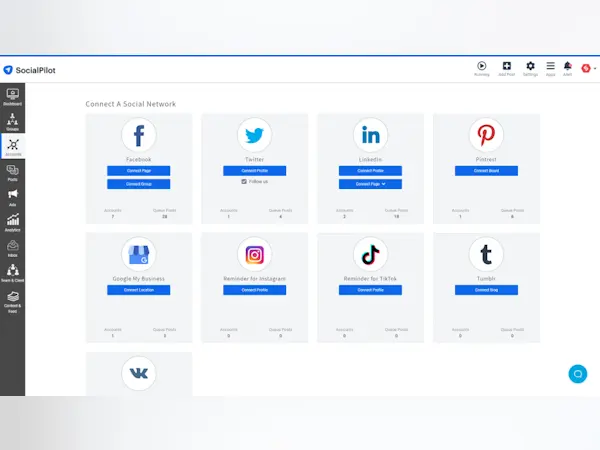
SocialPilot targets the operational side of social media management — the part where you need to get a high volume of content scheduled and published without bottlenecks. If your workflow involves batching content creation and scheduling weeks of posts in advance, SocialPilot handles that more smoothly than most alternatives.
Bulk scheduling lets you upload up to 500 posts via CSV, which is a lifesaver for agencies or content teams working from spreadsheets. The content curation feature suggests relevant articles and posts to share, and the client management tools let you organize accounts by client with separate approval workflows.
SocialPilot also offers white-label options for agencies, similar to Sendible but at a lower price point (compare Sendible alternatives). The analytics and reporting cover the essentials — post performance, audience growth, and engagement trends — with PDF export for client presentations.
Where SocialPilot falls short: the design feels utilitarian rather than polished. AI features are limited compared to tools like PostEverywhere. And the social inbox, while present, isn't as refined as Agorapulse's or Sprout's. You're trading interface polish for raw scheduling efficiency.
Pricing: Starting at $25.50/month.
Good for: Teams and agencies that batch-create content and need bulk scheduling with client management.
The catch: Interface isn't as polished, limited AI capabilities, inbox management is basic. For B2B-focused teams, our Oktopost alternatives guide covers tools with CRM integration and employee advocacy features.
8. Metricool: a free Sprout Social alternative for analytics
 Metricool
Metricool takes a different angle than most Sprout Social alternatives: it leads with analytics and adds scheduling on top. If your primary frustration with Sprout is paying $199+/month mainly for the reporting, Metricool delivers surprisingly deep analytics — including competitor tracking — on a free plan.
The free tier includes one brand with connected social profiles, basic scheduling, and analytics that cover reach, engagement, follower growth, and best posting times. Paid plans unlock competitor analysis, custom reports, and API access.
The competitor tracking feature is genuinely useful — you can benchmark your performance against specific accounts without paying for Sprout's listening add-on.
Metricool also includes a link-in-bio tool and ad management for Facebook and Google Ads, which adds value if you're running paid campaigns alongside organic content. The interface is clean and data-forward, making it easy to spot trends and pull insights without wading through menus.
The scheduling features are functional but not the platform's strength. You won't find the AI content tools you'd get with PostEverywhere or the bulk scheduling power of SocialPilot. Metricool is best as an analytics-first platform that happens to do scheduling, rather than a full social media scheduler with analytics bolted on.
If inbox management is a priority for your agency, our Statusbrew alternatives guide covers tools with stronger unified inbox features.
Pricing: Free plan available. Paid plans from $25/month.
Good for: Budget-conscious teams that prioritize analytics and competitor benchmarking over advanced scheduling.
The catch: Scheduling features are basic, limited collaboration tools, free plan has constraints on historical data.
Want AI-assisted scheduling and analytics in one platform? PostEverywhere combines an AI content generator, visual calendar, and performance analytics with plans starting at $9/month. No per-seat pricing, no hidden fees. See how it works.
How to choose the right Sprout Social alternative
Choosing the right alternative depends on which Sprout Social features you actually use versus which ones you're paying for but ignoring. Here's a framework.
Start with your primary workflow. If you spend most of your time scheduling posts, tools like PostEverywhere, Buffer, and SocialPilot prioritize that workflow. If your day revolves around responding to messages and comments, Agorapulse's inbox is the closest match to Sprout's.
If you need social listening specifically, Hootsuite is your best bet at this price range.
Count your seats honestly. Sprout's per-seat pricing is its biggest drawback for growing teams. PostEverywhere includes seats in the plan price on every tier. Buffer charges per channel, not per user. SocialPilot includes multiple users at lower tiers.
Calculate what your actual team costs look like across each platform — the differences are often dramatic.
Consider what you're willing to lose. Every alternative on this list has trade-offs compared to Sprout. No tool here matches Sprout's reporting depth across the board. None offer the same level of CRM integration. Social listening is either absent or less sophisticated.
But if you're honest about which features drive real value for your team, the cost savings almost always outweigh the feature gaps.
Run a parallel trial. Most of these tools offer free trials or free plans. Before cancelling Sprout, spend a week using cross-posting platforms through your potential replacement. Test the scheduling flow, check the analytics against what Sprout reports, and make sure the inbox (if you need one) catches everything. Migration doesn't have to be a leap of faith.
For a broader comparison beyond Sprout alternatives specifically, our guide to the best social media scheduling tools covers 12 platforms with detailed feature breakdowns. And if you're evaluating individual platforms, we've published dedicated guides for Later alternatives and Planoly alternatives as well.
Frequently asked questions
What is the best free alternative to Sprout Social?
Metricool and Buffer both offer functional free plans. Metricool is stronger on analytics and includes competitor tracking, while Buffer focuses on simple scheduling across three channels. Neither matches Sprout Social's feature set, but for basic scheduling and performance tracking, they're legitimate free options.
Why is Sprout Social so expensive?
Sprout Social prices for enterprise teams with large budgets. The per-seat model, mandatory annual contracts, and add-on pricing for features like social listening reflect an enterprise sales approach. The product is genuinely powerful, but the pricing assumes you need everything it offers — which most small-to-midsize teams don't.
Is Hootsuite cheaper than Sprout Social?
It depends on the plan. As of October 2026, Hootsuite Standard is $99/user/month billed annually, the same as Sprout Social's Essentials plan on monthly billing ($79 annually) and half of Sprout's $199/seat Standard plan.
Hootsuite also includes social listening basics in its plans, which is a paid add-on with Sprout. For teams that need listening capabilities, the savings are substantial.
What is Trellis and is it worth paying for Sprout Social in 2026?
Trellis is Sprout Social's agentic AI layer, rolled out as part of the 2026 pricing refresh. It auto-drafts replies, suggests post variations, surfaces engagement opportunities, and routes inbox conversations to the right team member.
Sprout's pricing page lists 100 Trellis credits per seat per month on every plan, from Essentials ($79/seat annually) up to Advanced ($399). Trellis is genuinely capable, but if your team mainly schedules posts and reviews analytics, PostEverywhere's built-in AI content generator and AI agents cover that same workflow for $9-$39/month flat, with no per-seat charges.
Can I switch from Sprout Social without losing data?
Most alternatives let you connect accounts and start fresh, but historical data from Sprout won't transfer directly. Export your Sprout Social reports before cancelling so you have baseline data for comparison.
Your scheduled posts will need to be recreated in the new platform, but connected social accounts retain their native analytics.
Does PostEverywhere have a social inbox like Sprout Social?
PostEverywhere focuses on scheduling, AI content creation, and cross-platform publishing rather than inbox management. If responding to comments and DMs from a unified inbox is your primary workflow, Agorapulse is a closer match to Sprout's inbox experience.
PostEverywhere is the better choice if scheduling and content creation are your core needs — particularly if your weekly workflow includes cross-posting Reels, Shorts, and TikTok at the same time across multiple brands.
What's the best Sprout Social alternative for agencies?
Sendible and SocialPilot are both built for agency workflows. Sendible offers white-label reporting and supports 12 platforms. SocialPilot provides bulk scheduling for up to 500 posts and client management tools at a lower price. PostEverywhere also works well for agencies with its multi-account management supporting up to 20 accounts on the Scale plan.
Is Sprout Social worth the price?
For enterprise teams with dedicated social media departments, complex reporting requirements, and budgets that absorb $200-400/seat without friction — yes, Sprout Social delivers genuine value. For everyone else, the alternatives on this list cover the core workflows at 50-90% lower cost.
The honest question isn't whether Sprout is good (it is), but whether your team uses enough of its capabilities to justify the spend.
How do I cancel my Sprout Social contract?
Review your contract terms first — Sprout Social uses annual agreements by default, and early termination may involve fees. Contact support directly (not just through the billing portal) and request written confirmation of your cancellation date and final charge.
Some users report success negotiating shorter remaining terms, especially if you cite pricing concerns. Export all your data and scheduled content before initiating cancellation.
Sprout spreads its AI features across tiers. For a like-for-like on what each tool's AI actually does, see the best AI social media managers.

Founder & CEO of PostEverywhere. Writing about social media strategy, publishing workflows, and analytics that help brands grow faster.