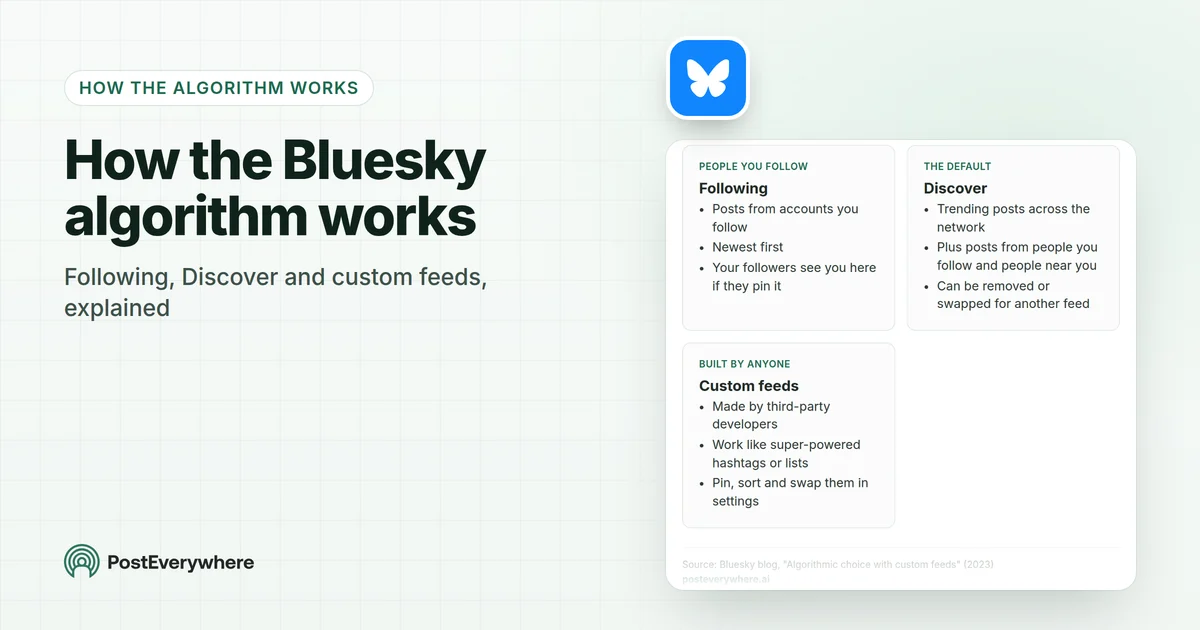
Social media algorithms decide who sees your content. Not your follower count, not the time you post, not the hashtags you use. The algorithm. Most people have no idea how it actually works, which is why they keep chasing hacks that stopped working years ago.
PostEverywhere schedules your posts on every top platform at the times your audience is online, so you can put this guide into practice. See how it works.
Here's the truth: every major platform runs its own recommendation system, but underneath, they all optimise for the same handful of signals. Once you understand those signals, and how each platform weighs them, you stop fighting the algorithm and start working with it.
This guide breaks down how algorithms function across Instagram, TikTok (schedule with our TikTok scheduler), YouTube, Facebook, LinkedIn, X (Twitter), Threads, and Pinterest.
Not the surface-level "post at 9am" advice, but the actual mechanics of how content gets ranked, distributed, and shown to new audiences, using what the platforms have published themselves.
Table of Contents
- What Is a Social Media Algorithm? Definition and Examples
- What Algorithms Actually Optimise For
- The 5 Signals Every Algorithm Shares
- How Algorithms Have Changed in 2025-2026
- Why "Beating the Algorithm" Is the Wrong Framing
- How Each Platform's Algorithm Works
- How Consistent Scheduling Improves Algorithmic Reach
- FAQs
- Next Steps
What Is a Social Media Algorithm? Definition and Examples
A social media algorithm is the set of rules and machine-learning models a platform uses to decide which posts each user sees, in what order, and how often. In plain terms, it's the ranking system that sits between everything published on the platform and the few hundred posts any one person will actually scroll past today.
The meaning is the same on every network: the feed is sorted by predicted interest, not by time.
Every platform runs several of these at once. Instagram says it doesn't have "a singular algorithm", and ranks Feed, Stories, Reels and Explore separately. TikTok's For You feed, YouTube's home page and Search, and LinkedIn's feed each have their own model.
What they share is the input: signals about the post (format, topic, early engagement), about the viewer (what they've watched, liked and skipped), and about the relationship between the two.
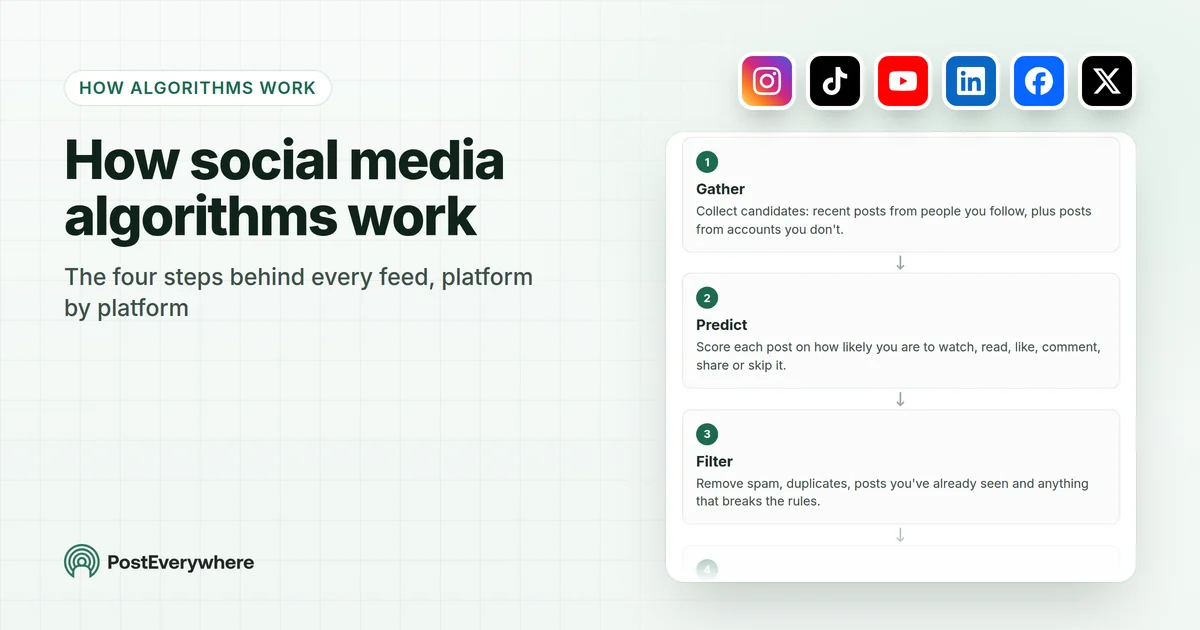
The same four steps sit behind every feed
Each platform words it differently, but the ones that explain their ranking describe the same loop.
- GatherCollect candidates: recent posts from people you follow, plus posts from accounts you don't.
- PredictScore each post on how likely you are to watch, read, like, comment, share or skip it.
- FilterRemove spam, duplicates, posts you've already seen and anything that breaks the rules.
- Mix and showOrder the rest, spread out creators and sounds, and add recommendations or ads.
Every like, share, skip and "not interested" you give feeds the next round of ranking.
You can see the whole loop in X's open-source ranking code, the one major feed you can read line by line. It collects recent posts from accounts you follow and from accounts you don't, scores each one on how likely you are to engage, filters out duplicates and posts older than 48 hours, then blends in recommendations and ads.
Three everyday examples of an algorithm at work:
- A boost. A short video holds most viewers to the end and picks up shares in its first hour. The platform reads that as a strong interest signal and shows it to a larger test audience, then a larger one, so reach keeps climbing for days.
- Suppression. A company page posts a bare link with a one-line caption. Few people stop or comment, so the post is shown to a small slice of followers and stalls. Nothing was "banned"; the ranking model simply predicted low interest.
- Recovery. An account that went quiet for two months starts posting on a steady schedule again. Early posts reach fewer people than before, then distribution rebuilds as fresh engagement data comes in.
The rest of this guide covers what those systems optimise for and how each platform weighs the signals differently.
What Algorithms Actually Optimise For
Every social media platform wants the same thing: keep users on the app longer. The algorithm is a prediction engine designed to surface content that people will spend time with and come back for.
It's not trying to reward "good" content or punish "bad" content. It's trying to predict what each individual user will engage with next.
This reframes how you should think about content strategy. The question isn't "what does the algorithm want?" It's "what does my target audience want to spend time on?"
Algorithms optimise for three things, in roughly this order:
Engagement. Content that generates meaningful interactions (comments, shares, saves, replies) signals to the algorithm that it's worth showing to more people. Scrolling straight past sends the opposite signal: Meta says Facebook's feed predicts how likely you are to scroll past a post rather than engage with it.
Check your own numbers with an engagement rate calculator to see where you stand against industry benchmarks.
Retention. How long someone spends with your content matters as much as whether they interact with it. Watch time on video, dwell time on posts, swipes through carousels: these tell the algorithm whether your content delivered on its promise.
A 60-second Reel that people watch for 55 seconds will usually beat a 15-second Reel that people skip after 4 seconds, even if the shorter one gets more likes.
Relevance. Algorithms match content to users based on interest signals: what topics they've engaged with before, what accounts they follow, what they've searched for. This is why niching down works so well: the algorithm can more easily categorise your content and match it to the right audience.
If your posts bounce between recipes, fitness tips, and business advice, the algorithm doesn't know who to show them to.
The 5 Signals Every Algorithm Shares
Despite their differences, the major platforms look at some version of these five signals. The weight varies by platform, and not every platform has published how it uses each one.
What each platform says it looks at
Only signals the platforms have published themselves, in their own words where possible.
- Instagram ReelsInstagram
- How likely you are to reshare it
- Whether you watch it all the way through
- Likes, and visits to the audio page
- For YouTikTok
- Finishing a longer video is a strong signal
- Likes, shares, follows and comments
- Follower count is not a direct factor
- Home and Up nextYouTube
- What and how you watch
- Likes, dislikes and subscriptions
- Answers to satisfaction surveys
- FeedFacebook
- How likely you are to scroll past
- Average time spent on each post
- Your ties to the people and groups who posted
- FeedLinkedIn
- Dwell time: how long members spend on a post
- Predicting posts people are likely to skip
- Reactions, comments and reposts (engagement)
- For YouX (Twitter)
- Predicted likes, replies, reposts and DM shares
- Dwell time and video watch time
- Negatives: not interested, mute, block, report
Watch time and dwell time. How long someone actually spends on your content tells the algorithm a lot. For video, it's how much people watch. For carousels, it's how far they swipe.
For text posts, it's how long someone pauses before scrolling. TikTok says that finishing a longer video is a strong signal, and LinkedIn's engineers have written about ranking the feed on dwell time.
The social media statistics guide has more on how people spend time on each app.
Saves and bookmarks. A save tells the algorithm that someone wants to come back to this. Instagram lists saves among the most important actions it predicts on Explore, and our Instagram algorithm guide covers how that feeds into distribution.
Shares and sends. When someone shares your content, whether by DM, to their Story, or off-platform, they're putting their own name behind it. Instagram's Reels ranking predicts how likely you are to reshare a Reel, and X's open-source model scores shares, including shares by DM, for every post.
On TikTok, shares are one of the interactions that shape the For You feed. On Facebook, Meta ranks around your ties to the people and groups who posted.
Comments and replies. Not all comments are equal. A one-word "nice!" comment says less than a multi-sentence reply that sparks a thread. Comments start conversations, and conversations keep people on the app.
On LinkedIn, posts that generate genuine professional discussion tend to travel further than posts that only collect reactions.
Profile visits. When someone views your content and then visits your profile, it signals high interest. Instagram's Feed ranking predicts how likely you are to tap a poster's profile photo, and X's model scores profile clicks.
It's a strong signal on Instagram, Threads, and X.
How Algorithms Have Changed in 2025-2026
The biggest shift in recent years is the move from social graph to interest graph. Historically, your feed was shaped by who you followed. Now, it's shaped by what you're interested in, regardless of whether you follow the creator.
TikTok pioneered this with the For You feed, and it says plainly that "neither follower count nor whether the account has had previous high-performing videos are direct factors". Instagram's Explore shows only accounts you don't follow, and Reels leans heavily on recommendations. YouTube Shorts works the same way.
Even X's Following feed is now ranked rather than purely chronological.
Machine-learning ranking has replaced hand-written rules. The old feeds leaned on fixed formulas. The new ones are models trained on billions of interactions that predict outcomes. When X open-sourced its new ranking code in January 2026, TechCrunch reported that X described "no manual feature engineering for content relevance".
The more these models learn, the harder they are to game with artificial engagement.
Original content gets priority. TikTok says it doesn't recommend "duplicated content, content you've already seen before, or any content that's considered spam", and Instagram has said it wants to reward original creators over accounts that repost them.
This is the biggest change for content strategies that relied on curation and resharing. If you cross-post, upload clean files rather than watermarked downloads.
Short-form video is what the recommendation feeds are built around, but the bar has risen. Simply posting a Reel or Short isn't enough: the content needs to hold attention for its whole length.
This is where AI content generators can help you craft hooks and scripts that keep viewers watching.
Small creators get a real test. Because follower count isn't a direct factor on TikTok, a new account's video can reach people who have never heard of it, and recommendation surfaces on Instagram, YouTube and Threads work in a similar way.
Every feed rewards posts that people engage with early. PostEverywhere publishes at the times you choose, and suggests your best times from your own results. See the social media scheduler.
Why "Beating the Algorithm" Is the Wrong Framing
Here's where most algorithm advice goes wrong: it treats the algorithm as an opponent. "How to beat the Instagram algorithm." "Hack the TikTok algorithm." "Outsmart the LinkedIn algorithm."
This framing leads to exactly the wrong behaviour. You end up chasing engagement bait, using trending audios that don't fit your brand, and obsessing over metrics that don't translate to business results.
The algorithm isn't your enemy. It's a distribution engine, and it's remarkably good at what it's designed to do: match content to interested audiences. Your job isn't to trick it.
Your job is to create content that genuinely deserves to be matched to your target audience.
That means focusing on three things that every algorithm rewards regardless of platform:
Create content people want to spend time with. Not content that looks good in a feed preview. Not content optimised for impressions. Content that, once someone starts consuming it, they don't want to stop. This is what drives watch time, dwell time, and completion.
Make content worth sharing. One of the highest-leverage things you can do for reach is create content that people send to their friends. Ask yourself: would someone screenshot this and text it to a colleague? Would someone send this in a group chat?
If not, the content might generate likes but it won't generate reach.
Be consistent. There's no "consistency bonus" in the code, but consistent publishing gives the algorithm more data to work with and keeps your audience used to hearing from you. This is where scheduling your content in advance makes the biggest difference: you can batch-create when inspiration strikes and keep a steady cadence without being chained to your phone.
Knowing how often to post on each platform is half the battle.
How Each Platform's Algorithm Works
Every platform uses a different recommendation model with different weights, different surfaces, and different priorities. Here's what makes each one different, and what you need to know to create content that performs on each.
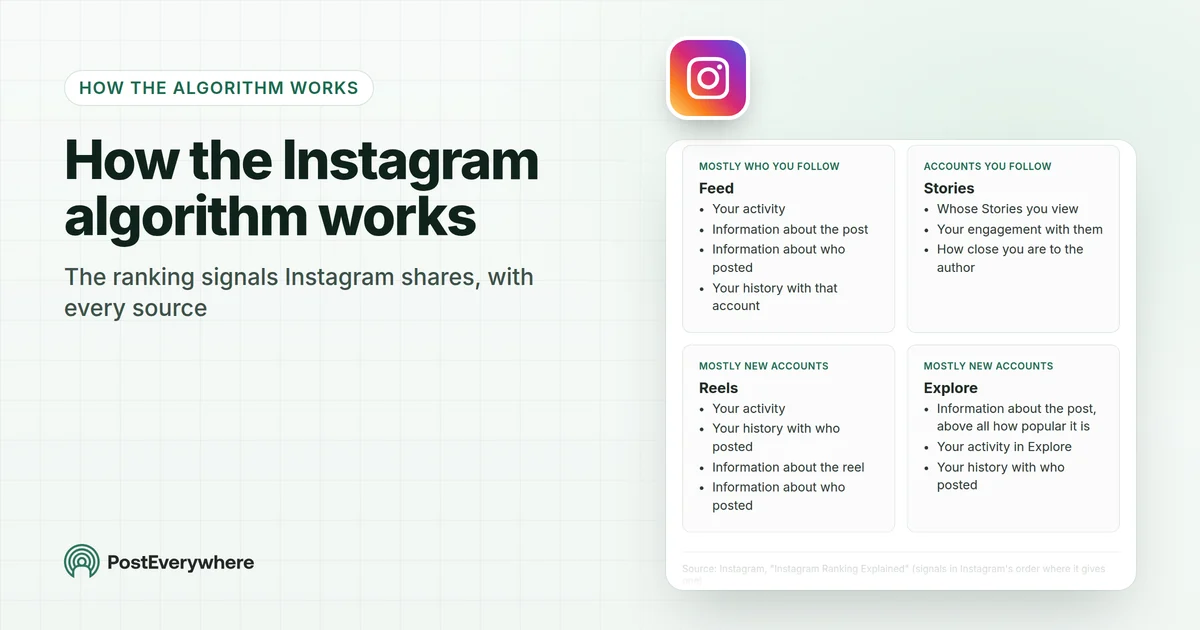
Instagram doesn't use one algorithm. It runs separate ranking systems for Feed, Reels, Stories, and Explore, each with different signals. For Reels, Instagram says it predicts how likely you are to reshare a Reel, watch it all the way through, like it, and visit its audio page.
Head of Instagram Adam Mosseri has named watch time, likes and sends as the top signals, with likes mattering more for followers and sends more for reaching new people.
In our own data from 14,000+ Instagram posts scheduled with PostEverywhere, Reels did 14% better and carousels 13% better than the same account's usual post, while single images did about 1% worse. Original content consistently created gets the best treatment.
Read the full Instagram algorithm breakdown
TikTok
TikTok's algorithm is the most aggressive recommendation engine in social media. It tests content with viewers who don't follow you and scales distribution based on how they respond, and TikTok says follower count isn't a direct factor.
The signals it names include likes, shares, comments, follows and whether people finish watching, with finishing a longer video counting as a strong signal.
In January 2026, TikTok's US operations moved to a new US joint venture, ending years of uncertainty about a ban. The way the For You feed recommends videos is unchanged in TikTok's own explanation.
Read the full TikTok algorithm breakdown
YouTube
YouTube says its recommendations are based on what and how you watch, your likes, dislikes and subscriptions, and answers to satisfaction surveys. A strong title and thumbnail get the click; whether people keep watching and feel the time was well spent decides how widely the video is recommended.
YouTube Shorts runs on its own feed, closer to TikTok's model, while long-form video builds deeper watch time with subscribers. In our data, YouTube was the platform where the day you post mattered least.
Read the full YouTube algorithm breakdown
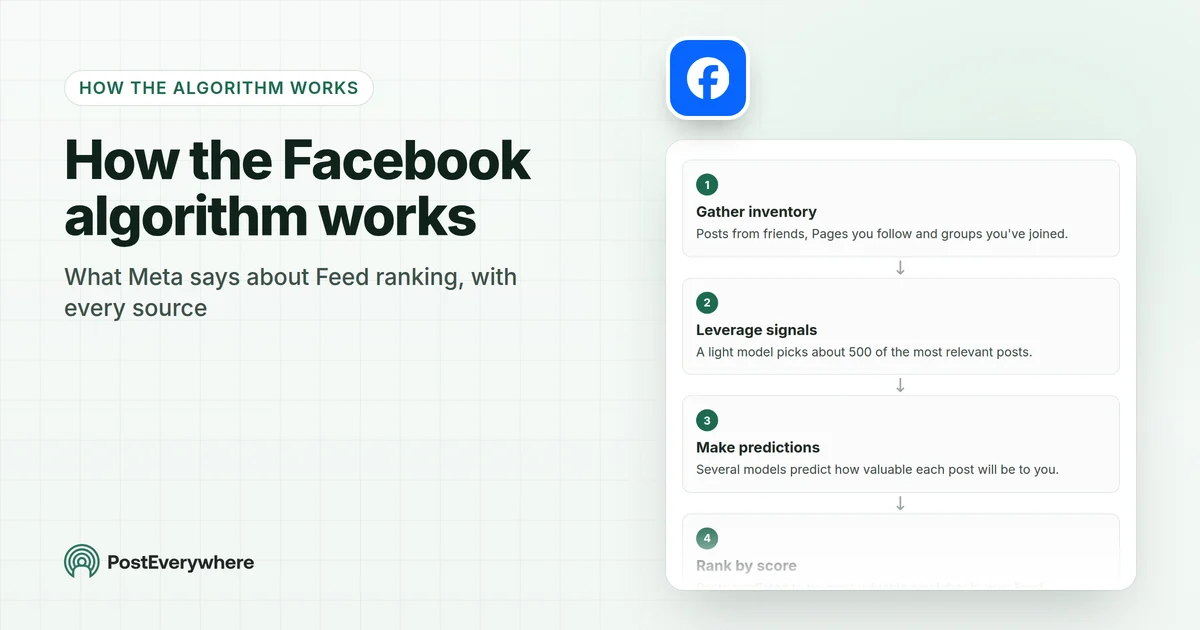
Facebook's algorithm has moved towards Reels, Groups and recommended content from accounts you don't follow. Meta says the feed predicts how likely you are to scroll past a post, how long you spend on posts, and how strong your intent is to interact with the friends and groups involved.
Meaningful interactions still matter more than passive engagement. A post that generates a real comment thread between friends will usually beat a post with lots of reactions but no conversation. Video, especially Reels, is where Facebook is pushing hardest.
Read the full Facebook algorithm breakdown
LinkedIn's algorithm leans more on your existing network than most. Your connections and followers see your content first, and their response helps decide whether it travels further. Dwell time is a core signal: LinkedIn's engineers have written about using how long members spend on a post, and predicting which posts people are likely to skip.
The platform pushes back on engagement bait (polls with no professional context, "agree?" posts, tag-your-network spam) and rewards real expertise. Posts that show genuine knowledge tend to outperform viral-format content.
Read the full LinkedIn algorithm breakdown
X (Twitter)
X's algorithm runs two tabs: Following and For You. Since late 2025 even the Following tab is ranked by default, with a chronological view still available. For You is where most new reach comes from.
X's open-source model scores each post on predicted likes, replies, reposts, quotes, shares, clicks and dwell time, and negative actions such as "not interested", mute, block and report push a post down.
Account type matters too. Buffer found that link posts from regular accounts got almost no engagement in 2025, while X Premium accounts still got some, and saw roughly ten times the reach of regular accounts overall.
Read the full X algorithm breakdown
Threads
Threads is the newest platform in this group, and its algorithm is still evolving. Its main feed mixes posts from accounts you follow with recommended posts based on your interests and activity.
Threads rewards conversation starters: posts that generate genuine reply threads tend to travel further than broadcast-style posts. Every Threads profile is tied to an Instagram account, which is also how many people find you there.
Read the full Threads algorithm breakdown
Pinterest works more like a visual search engine than a feed. People find pins through search and recommendations for weeks or months after they go up, and Pinterest's help centre on pin performance and distribution says there is no set engagement window and that pins can resurface seasonally.
Clear keywords in the title and description, a good image and a relevant destination link matter more than the hour you pin.
Read the full Pinterest algorithm breakdown
Let your AI agent do the scheduling. Ask Claude or ChatGPT to draft a week of posts for every platform and schedule them with PostEverywhere. Connect your AI agent.
How Consistent Scheduling Improves Algorithmic Reach
There's a compounding effect most algorithm guides miss: consistency gives the algorithm something to work with.
When you publish regularly, the platform keeps learning who responds to your posts and what they respond to. Each new post starts with better information behind it. Disappear for a few weeks and then dump three posts in one day, and that information is stale: your audience's attention has moved on, early engagement is weaker, and early engagement is what the ranking models read first.
How much does the exact day matter? We checked across 40,500+ posts scheduled with PostEverywhere, comparing each post with the same account's usual result.
How much the day you post matters
Gap between each platform's best and worst day, against the same account's usual post (percentage points). A bigger gap means the day you pick makes more difference.
| Platform | Gap between best and worst day |
|---|---|
| 38 points | |
| Facebook* | 30 points |
| X (Twitter)* | 20 points |
| TikTok | 19 points |
| 17 points | |
| YouTube | 9 points |
| 7 points |
On Instagram and YouTube, the gap between the best and worst day was under 10 points. On LinkedIn it was 38 points, with Wednesday far ahead. So on most platforms, posting regularly matters more than the day you choose, and on a few, the day is worth getting right too.
Our best time to post guides break this down by platform.
This is why scheduling your social media content matters more than most people realise. It's not about automation for convenience; it's about keeping the consistency that algorithms reward. When you batch-create content and schedule it in advance, you can post at your best times without needing to be online every day.
Building a real presence across platforms requires more than just posting; it requires a strategy. If you're working on growing your social media presence, consistency is one of the biggest levers you can pull.
Use a hashtag generator to find relevant tags for each platform, pair it with AI-generated captions that match each platform's tone (see our list of the best AI caption generators), and schedule everything in advance. The algorithm does the rest.
Publish everywhere from one calendar. PostEverywhere posts to Instagram, TikTok, YouTube, LinkedIn, Facebook, X (Twitter), Threads and Pinterest, each tailored to its platform. Start your 7-day free trial. Plans start at $9 a month.
How PostEverywhere helps with every algorithm
Every algorithm in this guide rewards the same habits: posting consistently, posting when your audience is online, and making each post fit the platform. PostEverywhere is built for that:
- Schedule to Instagram, TikTok, YouTube, LinkedIn, Facebook, X (Twitter), Threads, Pinterest and more from one calendar, each post customised for its platform
- Post when each audience is online: best-time suggestions learn from when your own posts do best
- Write and adapt captions with AI Studio, and keep a steady rhythm with the posting queue
- Let your AI agent do it: ask Claude or ChatGPT to draft and schedule a week of posts through PostEverywhere (connect your AI agent)
See the social media scheduler, or start a 7-day free trial; plans start at $9 a month.
FAQs
Do social media algorithms punish you for not posting?
Not directly; there's no "penalty" in the code. But feeds favour fresh content, and your engagement drops when your audience stops expecting new posts from you. After a long gap, it usually takes a run of consistent posts to rebuild your reach.
Do hashtags still matter for algorithms?
Less than they used to. Most platforms now understand what your post is about from the content itself, without relying on hashtags. They can still help with categorisation on some platforms, but they're not the reach driver they were in 2020.
When you do use them, an AI hashtag generator can help you pick the right ones.
How do algorithms handle cross-posted content?
Platforms push back on duplicated and reposted content: TikTok says it doesn't recommend duplicated content, and Instagram favours original creators. If you cross-post content, upload clean files without another app's watermark and adapt the format to each platform. Native-looking content beats obvious reposts.
Can you reset the algorithm on your account?
No. There's no "reset button" for how a platform sees your account. What you can do is shift it by consistently creating different content. The algorithm keeps learning from your recent posts, so a sustained change in content strategy gradually changes who your posts reach.
Does the algorithm favour video over photos?
On most platforms, video gets more reach, partly because it produces more watch-time data. But a photo post that earns saves and shares will still beat a video people skip.
In our Instagram data, carousels did almost as well as Reels against an account's usual post. The format matters less than the engagement it drives.
How does the algorithm decide who sees my content first?
Most platforms show your content to a small group first: often your most engaged followers, or on TikTok and Reels, viewers who like similar content. If that group responds strongly (watching to the end, sharing, commenting), the algorithm widens distribution.
Read each platform's testing model in our guides for Instagram, TikTok, and YouTube.
Are engagement pods or engagement groups worth it?
No. Platforms look for inorganic engagement patterns, such as the same group of accounts engaging with each other's content within minutes of posting. At best, engagement pods inflate your metrics without driving real distribution.
At worst, they can trigger spam filters that reduce your reach to genuine followers.
Next Steps
Understanding how algorithms work is the foundation, but execution is what drives results. Here's how to put this into action:
Pick one platform to master first. Don't try to optimise for seven algorithms at once. Read the deep-dive guide for your main platform, whether that's Instagram, TikTok, YouTube, LinkedIn, Facebook, X, or Threads, and apply the tactics for that platform's ranking model.
Get consistent with scheduling. Use PostEverywhere to set up a regular publishing cadence and stick to it. The algorithm rewards reliability over volume.
Focus on shareable content. Before you publish anything, ask: would someone send this to a friend? If not, rework it until the answer is yes.
Track what actually matters. Stop obsessing over follower count and start tracking engagement rate, reach per post, and shares. Use our engagement rate calculator to benchmark your performance and identify what's working.
The algorithm isn't your enemy. It's a distribution engine that rewards content people genuinely want to consume. Create that content consistently, and the algorithm will do the rest.
Sources
Every outside fact in this article comes from the pages below. Our own figures come from posts scheduled with PostEverywhere, as explained where they appear.
- Instagram: Instagram ranking explained
- GitHub: xai-org/x-algorithm: Algorithm powering the For You feed on X
- Meta Transparency Center: How Facebook Feed ranking works
- TikTok Newsroom: How TikTok recommends videos #ForYou
- LinkedIn Engineering: Understanding dwell time to improve LinkedIn feed ranking
- TechCrunch: X open sources its algorithm while facing a transparency fine and Grok controversies
- YouTube: How YouTube recommendations work
- Buffer: Do Posts with Links Affect Content Performance on X?
- Pinterest Help: Pin performance and distribution

Founder & CEO of PostEverywhere. Writing about social media strategy, publishing workflows, and analytics that help brands grow faster.