The Threads algorithm doesn't rank your feed the way X (Twitter) does, and that's by design. Threads' For You feed is ranked by a set of machine learning models that predict how you'll react to each post, including whether you'll reply, which makes conversation one of the strongest things a post can earn.
PostEverywhere schedules your Threads posts at the times your audience is online, so you can put this guide into practice. See how it works.
Threads has grown from an Instagram side project to 500 million monthly active users, according to Meta, and in January 2026 it passed X in daily mobile users, according to Similarweb data.
With that growth comes more competition in the feed, and understanding how ranking works is the difference between posts that disappear and posts that reach thousands of new people. For more figures, see our social media statistics.
This guide explains how the Threads algorithm works in 2026, what Adam Mosseri has confirmed, which content formats perform best (hint: it's not plain text), and the tactics that drive reach and engagement.
TL;DR
- Threads uses an AI system of several machine learning models, not a single algorithm. The For You feed is ranked; the Following feed shows accounts you follow, newest first
- The models predict how likely you are to like, reply, tap through to the author, spend time on a post, or scroll past it
- Replies matter. How likely you are to reply is one of the things Threads predicts, and replies on a post's replies are among its signals
- Video and images beat plain text in Buffer's Threads data, and posts with links did worst
- Engagement bait is a known problem that Mosseri said Meta was "working to get under control"
- Post on a steady rhythm and reply to people quickly. Use the best Threads scheduler to stay consistent
Table of Contents
- How the Threads Algorithm Actually Works
- The Ranking Factors That Matter
- What Adam Mosseri Has Confirmed
- Content Formats: What Actually Performs Best
- Threads Features That Affect the Algorithm
- What Actually Works in 2026
- 10 Threads Algorithm Myths Debunked
- Threads vs. X: How the Algorithms Differ
- Recent Algorithm Updates (2024-2026 Timeline)
- FAQs
- Next Steps
How the Threads Algorithm Actually Works
Meta describes the Threads ranking engine as an AI system rather than a single algorithm. According to Meta's Transparency Center:
"The content on your Threads feed is selected, ranked, and delivered by an AI system. Within one AI system, multiple machine learning models work together to deliver your experience."
The core approach is the same as Instagram's: predict what you'll find valuable, then rank posts accordingly.
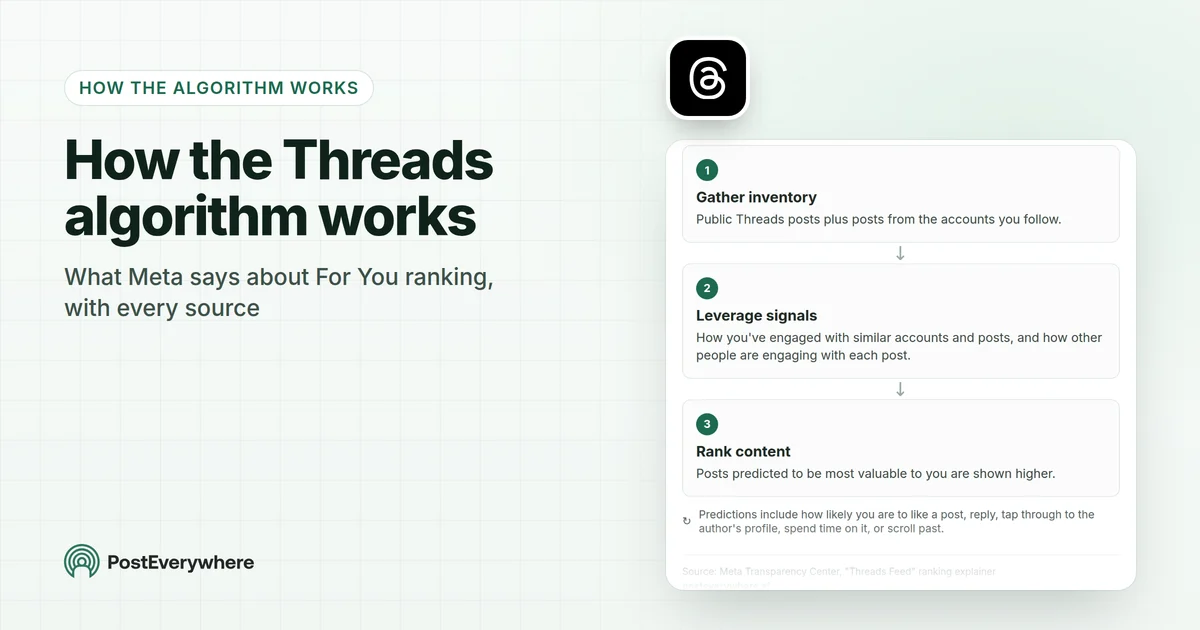
The Three-Step Ranking Process
- Gather inventory. The system collects public Threads posts plus posts from the accounts you follow
- Leverage signals. It looks at signals about each post and about you, such as how you've engaged with similar accounts and posts, and how other people are engaging with the post
- Rank content. Posts the system predicts will be most valuable to you are shown higher in your feed
How Threads ranks your For You feed
Meta describes three steps. Several models predict how you'll react to each post, and the posts it predicts you'll value most go to the top.
- Gather inventoryPublic Threads posts plus posts from the accounts you follow.
- Leverage signalsHow you've engaged with similar accounts and posts, and how other people are engaging with each post.
- Rank contentPosts predicted to be most valuable to you are shown higher.
Two Distinct Feeds
Threads offers two main feeds:
- For You: the default, ranked feed that blends posts from accounts you follow with recommended posts from accounts you don't. This is where the algorithm does its work
- Following: only posts from accounts you follow, newest first. X, by contrast, now ranks its Following feed with Grok by default, though a chronological view is still available
Threads gives people more than one feed
Only For You is ranked by the algorithm. People can also switch to Following, or nudge For You themselves.
- The defaultFor You
- Ranked by Meta's models
- Mixes accounts you follow with recommendations
- Where most new readers find you
- Only accounts you followFollowing
- Posts from accounts you follow
- Newest first
- Every post has the same chance
- You steer itDear Algo
- Post "Dear Algo" and ask for more or less of something
- Your For You feed adjusts for three days
- Others can repost a request to apply it too
The For You feed is where most reach happens. If you want new people to find your posts, this is the feed that matters, and the ranking factors below decide where your posts land in it.
Search and Trending
Threads supports keyword search and surfaces popular discussion topics. Topics also help people find posts: Meta says posts with a topic tag generally get more views than those without one (see topic tags below).
The Ranking Factors That Matter
Meta's Transparency Center lists what the system predicts for each post, and the signals it uses. Meta doesn't publish weights, and says its models and signals change often. Here's what it lists:
| What Threads predicts | What it means for you |
|---|---|
| How likely you are to like a post | Likes still count, especially from people who engage with you |
| How likely you are to reply | Posts that start conversations are favoured |
| How likely you are to tap through to the author's profile | Posts that make people curious about you help |
| How likely you are to click on a post, then on another | Posts that lead people deeper into Threads |
| How much time you spend viewing a post | Posts worth reading properly |
| How likely you are to scroll past without engaging | Posts people skip are shown less |
The signals behind these predictions include how you've engaged over the past hour, day, week and month, whether you've engaged with an author before, how a post is doing (its likes compared with how often it has been shown), and the replies and likes on its replies.
Two things stand out. First, how a post is doing counts, so its first responses matter: a post that gets a quick reaction has more to show the models. Second, replies count twice over: the models predict whether you'll reply, and they look at the replies a post is getting. Threads isn't just counting likes.
That's different from Instagram's algorithm, where watch time and sends lead.
What Adam Mosseri Has Confirmed
Instagram and Threads head Adam Mosseri has made several statements about how ranking works. They're worth paying attention to because they come from the person running the app.
Rebalancing toward followed accounts (November 2024): Mosseri said Threads had adjusted its algorithm to show less content from accounts you don't follow, and warned creators that their "unconnected" reach could dip.
Links now performing better (2025): Mosseri said: "We've been working on making sure links are ranked properly. Links have been working much better for more than a month now."
Engagement bait (October 2024): Mosseri said: "We've seen an increase in engagement-bait on Threads and we're working to get it under control."
Credibility and originality (2025-2026 direction): In his year-end memo, Mosseri listed goals including to "surface credibility signals about who's posting" and to "continue to improve ranking for originality". The direction is clear: original posts from real people over recycled content.
Account Status transparency: Threads has an Account Status page that shows whether any of your content was removed or can't be recommended, and lets you request a review.
Content Formats: What Actually Performs Best
Here's where the data contradicts what most people assume. Threads is seen as a text app, but plain text posts don't get the most engagement.
Buffer's engagement data for Threads found these median engagement rates:
| Format | Median engagement rate | Notes |
|---|---|---|
| Video | 5.55% | Best performer, about double plain text |
| Images | 4.55% | About 63% higher than plain text |
| Text-only | 2.79% | Still the most flexible format for starting conversations |
| Links | 2.34% | Lowest, even after Mosseri's ranking adjustment |
This doesn't mean text posts are worthless. They're the easiest way to start a conversation. But if you want the best chance of engagement, add a video or an image.
Post Specs
- Character limit: 500 characters per post
- Images: several per post, shown as a carousel
- Videos: up to 5 minutes long
- Topic tags: 1 per post (not traditional hashtags)
- Links: clickable in posts
Posting when your followers are around gives a post its best start. PostEverywhere schedules your Threads posts for the exact times you choose, and suggests times from your own results where the platform shares them. See the Threads scheduler.
Threads Features That Affect the Algorithm
Topic Tags (Not Hashtags)
Threads uses topic tags: you can add one per post. Unlike Instagram, where you can add several hashtags, Threads limits you to a single tag per post.
Meta says its internal data shows that posts with tagged topics generally receive more views than those without one. The composer suggests topics as you write, and Meta has tested letting people add up to 10 topics to their profile.
Communities
Communities are public, interest-based spaces that launched in October 2025 with more than 100 topics, and expanded to more than 200 in December 2025. Threads is also testing "Champion" badges for highly engaged members.
If your niche has an active community, posting there gives your posts an extra place to be found, alongside the For You feed.
Instagram Cross-Platform Signals
Your Threads account is tied to your Instagram profile, but Meta's Threads ranking explainer describes Threads signals only. Threads inherits your Instagram follower graph when people choose to follow you on both, and eligible Threads posts can be recommended to people on Instagram and Facebook.
The ranking itself is separate, so you need to earn engagement on Threads.
Fediverse / ActivityPub
Threads connects to the fediverse through ActivityPub. Posts from fediverse users appear in a separate feed rather than in line with other Threads posts, so turning on fediverse sharing isn't a way to grow your For You reach.
"Dear Algo" Feed Training
Since February 2026, people can post "Dear Algo" followed by what they want to see more or less of, and their For You feed adjusts for three days. Others can repost a request to apply it to their own feed.
It launched in the US, UK, Australia and New Zealand.
What Actually Works in 2026
Based on what Meta has published and the data above, here's what consistently drives results on Threads.
Posting Strategy
| Factor | Recommendation |
|---|---|
| Frequency | A steady rhythm you can sustain, such as several posts a week |
| Timing | When your audience is online. We don't yet have enough Threads results of our own to publish a best time; see our best time to post on Threads guide for a starting point and a test plan |
| First hour | Be around to reply, since replies and early responses count |
| Format priority | Video and images over plain text; links last |
Content Tactics
- Start conversations. Ask questions, share opinions, invite disagreement. Replies are something Threads predicts and measures
- Reply to replies quickly. It keeps the conversation going while the post is being shown
- Use one topic tag per post. Meta says posts with topics generally get more views
- Pair text with an image or video. Both beat plain text in Buffer's data
- Keep videos short and captioned. Hook people early, and add subtitles for people watching without sound
- Join relevant Communities. They give your posts another place to be found
- Cross-promote from Instagram. Share your Threads posts to Instagram Stories, and PostEverywhere's Instagram scheduler can queue the Instagram side next to your Threads posts
What to Avoid
- Engagement bait. "Like if you agree" and "Follow for more" are what Mosseri said Meta is working to get under control
- Flooding the feed. Many posts in a row split attention between them
- Generic, corporate tone. Threads rewards informal, genuine conversation
- Stuffing multiple hashtags. Threads only supports one topic tag per post
Let your AI agent do the scheduling. Ask Claude or ChatGPT to draft a week of Threads posts and schedule them with PostEverywhere, at your best times. Connect your AI agent.
10 Threads Algorithm Myths Debunked
1. "Threads is just like Twitter/X" The For You feeds work differently. Threads' models predict replies and time spent on each post, and its Following feed stays in date order, while X ranks its Following feed with Grok by default.
2. "Text-only posts perform best on a text-first platform" Buffer's data shows video and images both beat plain text on Threads, with images about 63% higher.
3. "Engagement bait works on Threads" Mosseri has said that Meta is working to get engagement bait under control. Posts begging for likes and follows also tend to get replies that say little, which isn't the conversation Threads is built for.
4. "The Fediverse boosts your reach" Fediverse posts sit in a separate feed, not in For You. Turning on fediverse sharing isn't a growth tactic.
5. "Links kill your reach" Not any more. Mosseri said in 2025 that links "have been working much better". They still get the lowest engagement of any format in Buffer's data, so pair a link with a strong line of text.
6. "Only Gen Z cares about authenticity" Threads' audience isn't just Gen Z, and genuine, original posts work across age groups. Mosseri's own direction for 2026 is to rank for originality and surface credibility signals.
That broad, working-age audience is why our Threads marketing brand playbook treats Threads as a serious commercial platform in the Meta stack.
7. "More hashtags = more reach (like Instagram)" Threads uses topic tags, not hashtags, and you can only add one per post. There's no multi-tag strategy.
8. "Posting more always means more reach" More posts mean more chances, but every post is ranked on how people respond to it. A steady rhythm of posts people reply to beats a flood of posts they scroll past, which is itself a signal Threads predicts.
9. "Your Instagram following automatically equals Threads success" Threads can inherit followers from Instagram, but ranking on Threads is separate. You need to earn engagement on Threads itself. Cross-promotion helps, but it isn't automatic.
10. "Follower count matters most" Threads ranks each post on predictions about each viewer: will they like it, reply, tap through, spend time on it? A post that sparks real replies can travel further than one from a bigger account that people scroll past.
Spend your time on posts worth sharing, not on posting them. PostEverywhere publishes to Threads and every other top platform from one calendar. Start your 7-day free trial. Plans start at $9 a month.
Threads vs. X: How the Algorithms Differ
With Threads passing X in daily mobile users in January 2026 (141.5 million vs 125 million on iOS and Android, according to Similarweb), the comparison matters more than ever.
| Factor | Threads | X |
|---|---|---|
| Algorithm focus | Predicted likes, replies, time spent | Predicted engagement and relevance |
| Feed options | For You (ranked) + Following (newest first) | For You (ranked) + Following (ranked by Grok by default) |
| Median engagement rate | 6.25% | 3.6% |
| Character limit | 500 | 280 (more for Premium) |
| Content tone | Conversational, casual | News-driven, opinion-driven |
| Monthly users | 500 million (Meta, June 2026) | X doesn't publish an official figure |
| Mobile daily users (Jan 2026) | 141.5 million | 125 million |
| Following feed | Newest first | Ranked by Grok, chronological view still available |
| Discovery | Topic tags, communities, For You | Hashtags, trending topics, search |
The biggest structural difference: X now ranks its Following feed with Grok by default. Threads keeps its Following feed in date order, which suits people who want to see everything from accounts they follow.
Buffer's data also shows Threads with a 73.6% higher median engagement rate than X (6.25% vs 3.6%, from a December dataset), though X posts get more engagements on average because of its larger, longer-established audience.
For a deeper look at how Instagram's separate algorithms compare, see our Instagram algorithm guide.
Recent Algorithm Updates (2024-2026 Timeline)
June 2026: Threads reaches 500 million monthly active users, according to Meta.
February 2026: "Dear Algo" launches, letting people adjust their For You feed for three days.
January 2026: Threads passes X in daily mobile users (141.5 million vs 125 million, Similarweb).
December 2025: Communities expand to more than 200 topics, with Champion badges in testing.
October 2025: Communities launch with more than 100 topics.
September 2025: Threads shows a prototype for telling the algorithm what you want more or less of, the idea that became Dear Algo.
Summer 2025: A separate fediverse feed launches. Mosseri says links are ranking better.
March 2025: Topics on profiles (up to 10, in testing) and topic prompts in the composer.
Late 2024: Mosseri flags the engagement bait problem, and the algorithm is rebalanced toward followed accounts.
Key Benchmarks
| Metric | Value |
|---|---|
| Monthly active users | 500 million (Meta, June 2026) |
| Mobile daily users | 141.5 million (Similarweb, January 2026) |
| Median engagement rate | 6.25% (Buffer) |
| Threads vs X median engagement | 73.6% higher (Buffer) |
| Best format for engagement | Video, 5.55% median (Buffer) |
For the latest platform changes, see our trends guide.
For exact dimensions and format specs, see our Threads image sizes guide.
Threads Algorithm Updates in 2026
The main ranking-related changes in 2026 so far:
- Dear Algo launched (February 2026). People can tell Threads what to show more or less of, and their For You feed adjusts for three days. Others can repost a request to apply it too.
- Originality and credibility. Mosseri's year-end memo set goals to keep improving ranking for originality and to show credibility signals about who's posting.
- Communities keep growing. More than 200 topic communities give posts another place to be found.
- Replies still count. Meta's ranking explainer lists how likely you are to reply, and the replies a post is getting, among the things it uses.
How PostEverywhere helps with the Threads algorithm
Every algorithm in this guide rewards the same habits: posting consistently, posting when your audience is online, and making each post fit the platform. PostEverywhere is built for that:
- Schedule Threads posts written for Threads, alongside the same idea adapted for X, Instagram and Bluesky
- Post when your followers are around with best-time suggestions, which learn your own times once your account has enough results
- Write and adapt captions with AI Studio, and keep a steady rhythm with the posting queue
- Let your AI agent do it: ask Claude or ChatGPT to draft and schedule a week of posts through PostEverywhere (connect your AI agent)
See the PostEverywhere Threads scheduler, or start a 7-day free trial; plans start at $9 a month.
FAQs
Does the Threads algorithm penalize scheduling tools?
No. Meta provides an official API for publishing to Threads, and none of the ranking signals Meta lists look at how a post was published. Tools like PostEverywhere use the official API to schedule and auto-publish posts. What matters is how people respond to the post.
Our Threads scheduling walkthrough covers the app's own scheduler and PostEverywhere step by step.
How often should I post on Threads in 2026?
Post on a steady rhythm you can sustain, such as several posts a week, rather than in bursts. Every post is ranked on how people respond to it, so quality and replies matter more than volume.
Consistency helps people get used to seeing and replying to you.
Do topic tags help with reach on Threads?
Yes. Meta says posts with topic tags generally receive more views than those without. You can only use one tag per post, so choose the most relevant option. Meta has also tested adding up to 10 topics to your profile.
What's more important on Threads: likes or replies?
Replies. Threads predicts how likely you are to reply to a post and looks at the replies a post gets, as well as likes. A post that starts a real back-and-forth gives the models more to work with than one that collects passive likes.
How do I check if the Threads algorithm is suppressing my content?
Use Account Status. It shows whether any of your content was removed or can't be recommended, and lets you request a review. Pair that with the Threads metrics and KPIs you should be tracking to spot drops early.
Can I reset or train the Threads algorithm?
Partially. With "Dear Algo", you post what you want to see more or less of, and your For You feed adjusts for three days. You can also switch to the Following feed for posts from accounts you follow, newest first.
For your own posts, the best "reset" is to post consistently and reply to people.
Is Threads better than X for engagement?
By median engagement rate, yes. Buffer found Threads' median rate 73.6% higher than X's (6.25% vs 3.6%). X posts still get more engagements on average because X has a larger, longer-established audience.
Does posting on Instagram help my Threads reach?
Indirectly. Threads is tied to your Instagram account, so Instagram followers can follow you on Threads in a tap, and eligible Threads posts can be recommended on Instagram and Facebook.
Ranking on Threads is still separate, so cross-promote your Threads posts on Instagram Stories to bring people over.
Want to put these algorithm insights into practice? Read our complete guide to getting more Threads followers for 15 growth strategies built on the ranking signals covered above.
Next Steps
The Threads algorithm rewards what most apps claim to but don't: genuine conversation. Replies, time spent and real interest count for more than follower numbers or posting hacks.
The accounts that win on Threads are the ones that consistently start conversations their audience wants to join, not the ones trying to game the system with engagement bait.
Here's how to put this guide into action:
- Schedule ahead and be there for the replies. Line up posts with PostEverywhere so you're free to reply when people respond
- Find your best posting times. A starting point and a three-week plan to find your own
- Spin up conversation starters. Draft hooks and genuine questions built to pull replies, not just likes
- Build a cross-platform presence. Turn Threads momentum into reach on Instagram and beyond
- See how the other feeds rank. The same signals behave very differently on Instagram and X
Sources
Every outside fact in this article comes from the pages below.
- Meta: New Features to Celebrate 500 Million Monthly Users on Threads
- Meta Transparency Center: How the Threads feed is ranked
- Social Media Today: X Now Algorithmically Ranks Posts in Following Feed
- TechCrunch: Threads adjusts its algorithm to show you more content from accounts you follow
- Influencer Marketing Hub: Why Links Are Now Performing Better on Threads, According to Adam Mosseri
- Engadget: Meta is working to fix Threads' engagement bait problem
- Om Malik: What is Instagram's Adam Mosseri really saying in his year end memo
- Instagram Help: Account Status
- Buffer: Best Content Format on Social Platforms in 2026: 45M+ Posts Analyzed
- Meta: New Threads Features for a More Personalized Experience That You Control
- Meta: Introducing Threads Communities: Find Your People
- TechCrunch: Threads expands open social web integrations with fediverse feed, user profile search
- Meta: Control Your Threads Feed With New Dear Algo Feature
- TechCrunch: Threads edges out X in daily mobile users, new data shows
- Buffer: 17 Threads Stats You Need to Know in 2025 (+ What They Mean for Your Strategy)
- TechCrunch: Threads is developing a tool that lets you 'tag' its algorithm to configure your feed
- TechCrunch: Threads adds new communities, tests badges for highly engaged members

Founder & CEO of PostEverywhere. Writing about social media strategy, publishing workflows, and analytics that help brands grow faster.