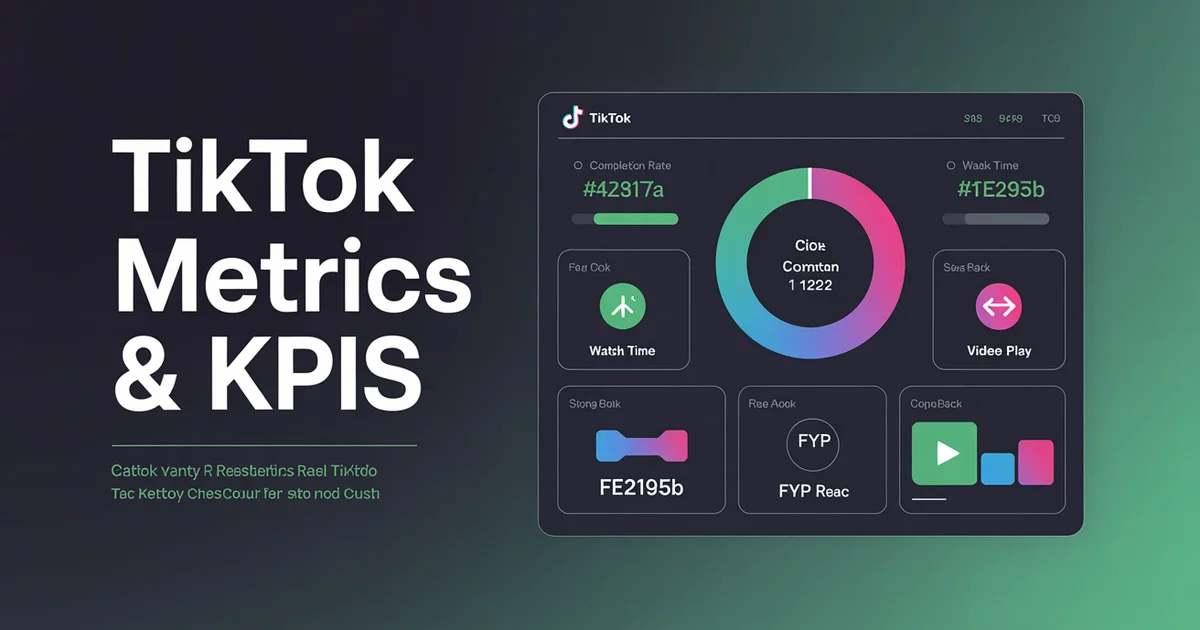
TikTok metrics don't work like the rest of social media — and if you're still grading your TikToks by likes, you're reading the wrong scoreboard.
I've spent the last three years watching clients pour effort into TikToks that racked up thousands of likes but went nowhere, while scrappy 15-second clips with half the likes did 2M views. The difference wasn't luck. It was completion rate. On TikTok, the For You Page is a ruthless optimiser — it rewards videos that hold attention and punishes the ones that don't, regardless of follower count or polish.
This is a spoke of our master social media metrics and KPIs guide, zoomed in on the numbers that actually move the needle on TikTok in 2026. I'll show you the formulas, the 2026 benchmarks from Socialinsider's 70M-post analysis, and exactly what I track weekly vs monthly for every TikTok account I manage.
Why TikTok metrics are different
Every other platform shows your content to your followers first and measures what happens. TikTok does the opposite. Your followers are an afterthought — the FYP is everyone else, and the algorithm decides whether to expand the audience based on one question: are people watching this video to the end?
That single shift changes everything. Follower count is vanity. Engagement rate is helpful but incomplete. The real scoreboard is watch time — specifically, what percentage of viewers finish the video, how many re-watch it, and how many share it. Get those three numbers right and the FYP will do the rest of the work for you.
If you want the full picture of how the algorithm ranks videos, I've written a standalone breakdown in how the TikTok algorithm works. This post is about the numbers you use to measure it.
The TikTok hierarchy of metrics
Not all engagement is created equal. Based on what TikTok creators and ads reps have confirmed publicly — and what I've observed across hundreds of accounts — the algorithm weights signals roughly in this order:
- Completion rate — did they watch the whole thing?
- Re-watches — did they loop it?
- Shares — did they send it to someone?
- Comments — did they stop to type something?
- Saves — did they bookmark it?
- Likes — did they double-tap?
- Follows from video — did it convert a viewer?
Likes are at the bottom for a reason. They're the lowest-friction action on the platform, which makes them the weakest signal of genuine interest. A share, by contrast, is someone actively choosing to put your brand in front of another human — that's gold to the algorithm, and it's the single biggest lever I've seen for getting pushed to new audiences.
Design your content for the top of this list, not the bottom.
Watch time metrics
Watch time is the foundation. Everything else is secondary.
Average watch time
The mean number of seconds viewers spent on your video. Find it in TikTok Analytics under each post's performance tab. On a 30-second video, anything above 18 seconds (60%) is healthy; above 24 seconds (80%) is excellent.
Completion rate (the formula)
The single most important TikTok KPI:
Completion rate = (Full video views / Total video views) × 100
TikTok's internal target is roughly 50%+ for longer videos and 70%+ for sub-15-second clips. My own rule of thumb across client accounts: if completion rate is under 40%, the hook is broken — re-cut the first 2 seconds before changing anything else.
Re-watch rate
Re-watch rate = (Total plays − Unique viewers) / Unique viewers × 100
Re-watches signal that the video was dense, funny, or confusing enough to loop. Short videos (sub-12 seconds) that loop cleanly routinely beat longer videos on reach because each loop counts as another play. A re-watch rate above 15% is strong; above 25% usually means you've got a hit.
Total play time
Aggregate seconds watched across all views. This is the absolute metric TikTok cares about at the account level — it's how you accumulate the "this account creates content people watch" signal over time. I track this monthly as a north-star number.
Stop guessing which TikToks deserve a bigger push. Schedule and analyse TikTok videos with PostEverywhere — post at peak times, track completion rate alongside engagement, and double down on the videos earning the FYP. Free 7-day trial, cancel anytime.
Reach metrics
Reach on TikTok splits into four distinct buckets, and confusing them is how people misdiagnose their performance.
FYP reach
The percentage of views that came from the For You Page. This is where the algorithm's verdict lives. Healthy accounts see 70–90% of views from FYP on their best videos. If your FYP percentage is under 50%, the algorithm isn't pushing you to new audiences — your video is stuck inside the follower bubble.
Personal profile reach
Views from people who tapped into your profile and watched. Low baseline, but spikes after a viral video — people binge old content when they discover you. Watch this metric climb as a lagging indicator of a hit.
Following feed reach
Views from your existing followers in the Following tab. In 2026 this is a surprisingly small slice — often under 10% on new posts — because most users live on the FYP. Don't build your strategy around it.
Sound page reach
Views from people browsing a trending sound's page. Using trending audio early (within the first 48 hours of the sound going up) can add 10–20% to your total reach. I check this on every video that uses a trending sound to see if the bet paid off.
Engagement metrics
TikTok engagement rate (formula)
TikTok-specific engagement rate is usually calculated against views, not followers, because views are the denominator the algorithm actually cares about:
TikTok engagement rate = ((Likes + Comments + Shares + Saves) / Views) × 100
For a follower-based version (useful for comparing against other platforms), swap Views for Followers. I run both through our free engagement rate calculator and keep both in the monthly report — they tell different stories.
If you want to see how TikTok engagement rates stack up against Instagram, LinkedIn, and the rest, the full breakdown is in social media engagement rate benchmarks.
Shares — the strongest engagement signal
On TikTok, a share is worth roughly 10 likes in algorithmic weight (this is my back-of-napkin estimate, not an official figure — but every TikTok rep I've spoken to has hinted at something in that ballpark). Shares expand the audience beyond the FYP by putting your video directly into DMs, other platforms, and group chats.
Content built for sharing — "send this to someone who…", relatable POVs, controversial takes, genuinely useful tips — consistently outperforms content built for likes. Track shares as a percentage of views: 0.5%+ is good, 1%+ is excellent, 2%+ is viral territory.
Saves
Saves indicate practical value — tutorials, recipes, how-tos, list content. A high save rate is the signal that your video has utility beyond entertainment. Target 1%+ of views for educational content.
Comments
Comment rate on TikTok is lower than Instagram because TikTok is a lean-back platform, but every comment is weighted heavily because it requires the viewer to break their scroll. Prompt comments directly in the video ("what would you do?") — it's the most reliable way to drive the metric up.
Likes
Still worth tracking, still the weakest signal. Use likes as the denominator for other ratios, not as a standalone KPI.
Audience metrics
Follower growth rate
Follower growth rate = ((New followers − Unfollows) / Starting followers) × 100
Measure weekly. TikTok follower growth is spiky — one viral video can add 10K followers overnight, then you'll bleed a few hundred over the next fortnight as casual viewers unfollow. Smooth the noise with a 4-week rolling average.
Active followers
The percentage of your followers who've engaged with any of your content in the last 28 days. TikTok doesn't expose this directly, but you can approximate it by comparing unique engagers to total followers. Anything above 20% is healthy; under 10% and you've got a dormant audience — time to re-engage or prune.
2026 TikTok benchmarks
Here are the numbers to measure yourself against. All figures from Socialinsider's 2026 social media benchmarks report, based on an analysis of roughly 70 million posts.
- Median engagement rate by view: 3.70% (up 49% year-on-year — TikTok is one of the only platforms where engagement is actually climbing)
- Average likes per post: 3,492
- Average comments per post: 50
- Average shares per post: 142 (trending up as the algorithm rewards share-worthy content)
- Average completion rate: 38% across all posts; top-quartile creators hit 55%+
- Average reach from FYP: 78% on posts that break 10K views
If you're below the median, don't panic — medians include every dormant brand account on the platform. Compare yourself to the top quartile for your niche instead. TikTok's own Creative Center has free niche-specific benchmarks updated weekly, and it's the first place I go when setting targets for a new client.
Want your TikTok metrics to stop being a mystery? PostEverywhere's TikTok scheduler tracks completion rate, shares-per-view, and FYP reach in one dashboard — so you can spot winning hooks before your competitors do. Start your 7-day trial today.
What to track weekly vs monthly
You don't need to stare at every metric every day. Here's the cadence I use with clients:
Weekly review (15 minutes, every Monday):
- Completion rate on every post from the past 7 days
- Shares per view on top 3 posts
- Follower growth rate (week-over-week)
- Which hook formats landed and which died in the first 2 seconds
Monthly review (60 minutes, first Monday of the month):
- Total play time (the north star)
- Engagement rate by view and by follower
- FYP reach percentage across the month
- Audience demographics shift (age, location, active hours)
- Best-performing video cross-referenced with best time to post data
- Save rate and share rate by content pillar
Quarterly review (half a day):
- Full content audit — kill pillars that aren't landing, double down on what is
- Benchmarks recalibration against Socialinsider's latest data
- Competitor delta — are you gaining or losing share of voice?
Stuck for content ideas to test new hooks against? I've got 100 TikTok content ideas mapped to high-performing formats, our free TikTok script generator turns any idea into a hook-payoff-CTA structure in one click, and our AI content generator spits out TikTok scripts that are actually tuned for completion rate.
For the rest of your stack, I've written equivalent KPI guides for Instagram metrics, YouTube metrics, and LinkedIn metrics. The hub guide ties them all together.
Frequently asked questions
What's a good completion rate on TikTok in 2026? For videos under 15 seconds, aim for 70%+. For 15–30 second videos, 50%+ is healthy. For 60-second+ videos, anything above 35% is strong. Top creators routinely hit 55% across the board — that's the bar if you're serious.
Is engagement rate more important than views on TikTok? No. On TikTok, views are the primary signal because they reflect how far the FYP is pushing you. Engagement rate tells you how strong your content is relative to the audience it reached — both matter, but views come first because they're the algorithm's input.
Why are shares weighted so heavily compared to likes? Shares expand the audience beyond the FYP — they actively put your content in front of new humans via DMs and other platforms. Likes are passive and low-friction, so they're a weak signal of genuine interest. A video with 10,000 likes and 50 shares will underperform one with 5,000 likes and 500 shares every time.
How do I measure ROI on TikTok without direct conversions? Track the assisted conversion path — UTM-tagged link-in-bio clicks, branded search lift (Google Trends for your brand name), and "how did you hear about us" survey responses. For ecommerce, TikTok Pixel attribution plus a 7-day post-view window catches most TikTok-influenced purchases that Last Click misses.
Does follower count still matter on TikTok? Less than any other platform. I've seen 500-follower accounts hit 5M views and 500K-follower accounts get 2K views on a post. Follower count is a weak signal to the algorithm — completion rate and shares matter 10x more. Use follower growth as a lagging confidence indicator, not a leading KPI.
How often should I check TikTok Analytics? Weekly for tactical adjustments, monthly for strategic direction. Daily checking is a waste of time — TikTok's algorithm often takes 48–72 hours to fully push a video, so a post that looks dead on day one can break out on day three. Don't make decisions on 24-hour data.
Wrap up
TikTok rewards creators who understand the hierarchy: watch time beats engagement, engagement beats follower count, and shares beat every other engagement type combined. Track those and you'll stop being surprised by which videos pop.
Everything else — the weekly reviews, the benchmark comparisons, the share-rate optimisations — is just execution on top of that foundation. Start with completion rate this week. Re-cut your last five videos' hooks if you're below 40%. Watch what happens.
And when you're ready to scale the whole operation — scheduling across accounts, tracking the metrics that matter in one dashboard, and turning analytics into next week's content plan — PostEverywhere's TikTok scheduler is built exactly for that. Running multiple platforms? Our social media scheduler handles all top platforms from one place. 7-day free trial, cancel anytime, and you can import your existing TikTok history on day one.
Now go check your completion rates.

Founder & CEO of PostEverywhere. Writing about social media strategy, publishing workflows, and analytics that help brands grow faster.