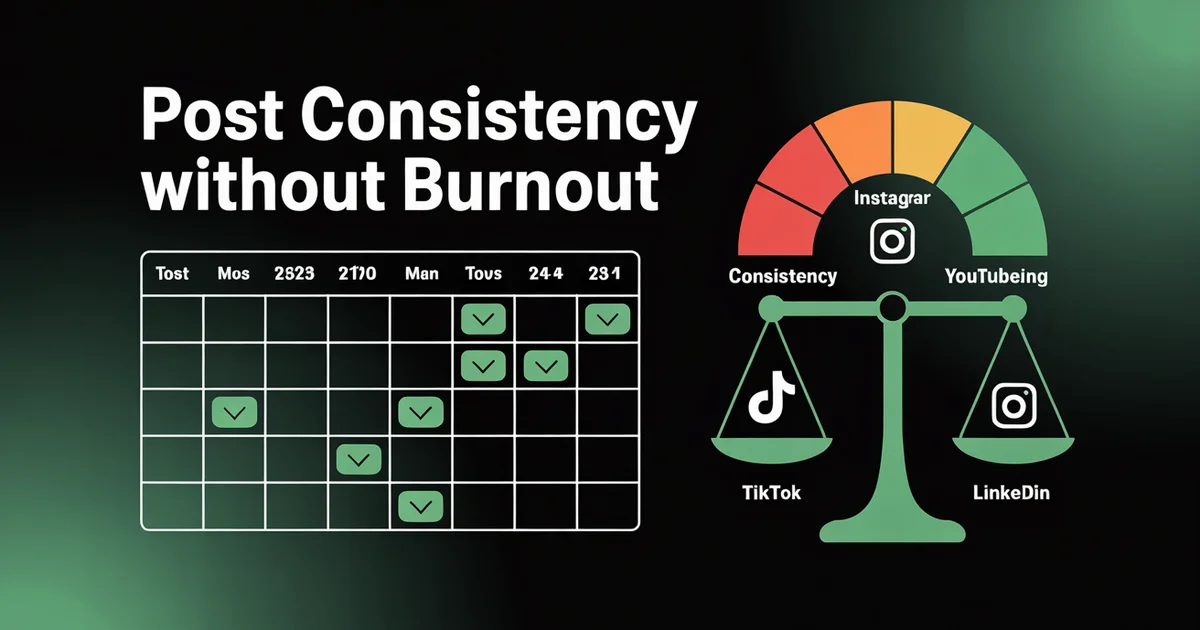
Posting consistently on social media without burning out requires a system — not more willpower. The problem isn't that you lack discipline. It's that most social media workflows are fundamentally broken: reactive instead of proactive, manual instead of automated, and designed around platforms instead of around the person doing the work.
According to the Milk Karten Social Media Manager Survey, 77% of social media managers report experiencing burnout. That number isn't a personal failure — it's a systems failure. When your workflow demands that you create, publish, respond, analyse, and strategise across 5-8 platforms every single day, exhaustion isn't a possibility. It's an inevitability.
This guide is for professional social media managers and business owners who already know what to post but can't sustain the pace. You don't need another "just be consistent" pep talk. You need a framework that makes consistency automatic so you can focus your energy on strategy and creative work that actually moves the needle.
Build your system today. PostEverywhere's social media scheduler lets you batch, schedule, and auto-publish across all platforms from one dashboard. Start your 7-day free trial — cancel anytime.
TL;DR
- Burnout isn't a motivation problem — it's a workflow design problem
- Content batching cuts production time by 60-80% vs daily creation
- The minimum viable posting frequency is lower than you think (see table below)
- AI-assisted drafting eliminates blank-page paralysis without sacrificing quality
- Cross-posting with platform customisation = 1 idea across all top platforms
- A content calendar is your single source of truth — not your head
- Falling off is normal — the system makes recovery easy, not shameful
Table of Contents
- Why Social Media Managers Burn Out
- The Minimum Viable Posting Frequency
- Content Batching: The Core of Sustainable Consistency
- AI-Assisted Drafting: Eliminate Blank-Page Paralysis
- Cross-Posting and Repurposing: One Idea, Seven Platforms
- Your Content Calendar Is Your Operating System
- Automate the Repetitive, Protect the Creative
- What to Do When You Fall Off
- 10 Myths About Consistent Posting (Debunked)
- FAQs
Why Social Media Managers Burn Out
Before you can fix the consistency problem, you need to understand why it breaks. The answer is almost never "laziness" — it's structural.
The Compounding Workload Problem
A Sprout Social survey found that 63% of social media managers handle responsibilities beyond social media, including email marketing, PR, and customer support. When social media is one of six jobs you're doing, it's always the first thing that slips because no single missed post feels catastrophic — until a month of missed posts compounds into a dead audience.
The Always-On Expectation
According to Buffer's State of Social Media 2025, 72% of marketers say they feel pressure to be constantly available for real-time engagement. Platforms are designed to reward immediacy — trending audio, breaking news, time-sensitive Stories — which trains managers to stay in reactive mode permanently. Reactive mode is the opposite of sustainable.
The Content Treadmill
Metricool's 2025 Social Media Study found that brands posting to 5+ platforms need an average of 25-40 pieces of content per week to maintain visibility. If every piece is created from scratch, that's an absurd creative workload. The managers who survive this aren't more talented — they have better systems for multiplying a single idea across formats and platforms.
The Metrics Anxiety Loop
When engagement dips (and it will — algorithms fluctuate), many managers respond by posting more, checking analytics obsessively, and second-guessing every creative decision. This creates a feedback loop: anxiety leads to overwork, overwork leads to lower-quality content, lower quality leads to worse metrics, worse metrics lead to more anxiety.
The solution to all four problems is the same: build a system that separates creation from publishing, automates what can be automated, and gives you clear boundaries around when you work and when you don't.
The Minimum Viable Posting Frequency
One of the biggest drivers of burnout is an unrealistic posting target. Before you build your system, you need to know the actual minimum required to stay visible on each platform. If you'd rather get the number for your own platform mix, our posting frequency calculator has a minimal-effort setting built for exactly this.
Based on data from Hootsuite's Social Media Trends 2025, Sprout Social's benchmarks, and our own analysis of 50,000+ accounts on PostEverywhere, here's the minimum viable frequency — the lowest cadence that still keeps the algorithm feeding your content to followers:
| Platform | Minimum Viable | Sweet Spot | Burnout Danger Zone |
|---|---|---|---|
| Instagram (feed + Reels) | 3x/week | 4-5x/week | 2x+/day |
| TikTok | 3x/week | 1x/day | 3x+/day |
| 2x/week | 3-5x/week | 2x+/day | |
| 2x/week | 3-5x/week | 2x+/day | |
| X/Twitter | 3x/week | 1-3x/day | 5x+/day |
| YouTube (long-form) | 1x/week | 1-2x/week | 3x+/week |
| YouTube Shorts | 2x/week | 3-5x/week | 2x+/day |
| Threads | 3x/week | 1x/day | 3x+/day |
For a detailed breakdown of these numbers, see our full guide: How Often to Post on Social Media.
The key insight: The "Minimum Viable" column is where you start when building (or rebuilding) your system. Not the sweet spot. Not the influencer's "post 3x a day" advice. The minimum. You can always scale up once the system is running. You can't scale up from a standing start when you're already fried.
The difference between minimum viable and sweet spot is often just 2-3 extra posts per week per platform — which, with proper batching and cross-posting, amounts to about 90 minutes of additional work. The difference between sweet spot and burnout danger zone, however, is exponential effort with diminishing returns.
Content Batching: The Core of Sustainable Consistency
Content batching means dedicating a single focused session to creating multiple pieces of content, rather than creating one post at a time throughout the week. It is the single most impactful change you can make to your workflow.
Why Batching Works
Context switching is expensive. Research from the American Psychological Association shows that switching between tasks can cost up to 40% of productive time. Every time you stop what you're doing to "quickly write a post," you're paying a cognitive switching tax — loading the platform context, finding the right tone, sourcing an image, writing the copy, tagging, and publishing. By batching, you pay that setup cost once and amortise it across 10-20 posts.
The Weekly Batching Framework
Here's the exact workflow that keeps posting sustainable:
Session 1: Ideation (30 minutes)
- Review last week's analytics — what performed, what didn't
- Pull 5-10 content ideas from your topic bank (more on this below)
- Map ideas to platforms and content types
- Prioritise based on timeliness and strategic goals
Session 2: Creation (90-120 minutes)
- Write all captions in a single sitting
- Design graphics or film video in a single batch
- Prepare all hashtags, tags, and links
- Save everything in one staging area (folder, doc, or directly in your scheduler)
Session 3: Scheduling (30-45 minutes)
- Upload all content to your social media calendar
- Set publishing times based on best time to post data
- Customise captions per platform
- Review the calendar view for gaps or clusters
Total: 2.5-3.5 hours per week for 15-25 posts across multiple platforms.
Compare that to daily posting: 30-45 minutes per platform per day, across 5 platforms, 7 days a week. That's 12-26 hours weekly. Batching cuts it by 75% or more.
Building Your Topic Bank
The number one reason batching sessions stall is sitting down with no ideas. Solve this by maintaining a running topic bank:
- Capture ideas continuously: Use your phone's notes app, a Slack channel, or a Notion database. Every time you see a question from a customer, a competitor's post that sparks a reaction, or an industry trend — drop it in the bank.
- Categorise by content pillar: Group ideas under 3-5 recurring themes (education, behind-the-scenes, product, community, thought leadership).
- Tag by platform fit: Some ideas work better as a LinkedIn text post. Others are visual and suit Instagram or TikTok. Tag them when you capture them, not when you're batching.
- Aim for a 4-week buffer: If your topic bank always has 30+ ideas in it, you'll never face a blank-page batching session.
Batch faster with AI. PostEverywhere's AI content generator turns a single topic into platform-optimised drafts in seconds — so your batching sessions focus on editing, not starting from zero. Try it free.
AI-Assisted Drafting: Eliminate Blank-Page Paralysis
Let's be clear about what AI does and doesn't do for social media consistency. It doesn't replace your voice, your strategy, or your judgment. What it does is eliminate the most energy-draining part of the workflow: staring at a blank screen trying to figure out how to start.
Where AI Saves the Most Time
According to HubSpot's State of AI in Marketing 2025, marketers using AI for content creation save an average of 12.5 hours per week. The highest-ROI uses for social media specifically are:
- First drafts from a brief: Give AI your topic, key message, and platform — get a draft to edit, not a blank page to fill.
- Caption variations: Write one caption, then generate 3-5 variations for different platforms and tones.
- Repurposing long-form to short-form: Paste a blog post or video transcript, get a week's worth of social posts pulled from the key points.
- Hashtag research: Generate relevant, platform-specific hashtag sets based on your topic and audience.
- Content calendar suggestions: Fill gaps in your schedule with AI-suggested topics based on your content pillars.
The Human-in-the-Loop Workflow
The most effective workflow isn't "AI writes everything" — it's "AI drafts, human edits":
- Input: You provide the topic, angle, key message, and any brand voice guidelines
- Draft: AI generates a first draft for each platform
- Edit: You refine tone, add personal anecdotes, insert specific data, and ensure accuracy
- Approve: Final review before scheduling
This workflow typically cuts caption writing time from 15-20 minutes per post to 3-5 minutes per post. Across 20 posts per week, that's 4-5 hours saved on writing alone.
Avoiding AI Slop
The risk with AI-assisted content isn't that it's bad — it's that it's generic. Guard against this by:
- Always editing for your specific voice — if AI writes "leverage," change it to whatever word you'd actually use
- Adding specific data, examples, and personal takes — AI provides structure; you provide substance
- Never publishing a draft you haven't read aloud — if it sounds like a template, it reads like one
- Using AI for ideation and structure, not as a ghostwriter — the best AI-assisted content is 60% human, 40% machine
Cross-Posting and Repurposing: One Idea, Seven Platforms
If you're creating unique content for every platform from scratch, you're working 5-7x harder than you need to. The professionals who post consistently without burning out don't create more — they multiply smarter.
Cross-Posting vs Repurposing
There's a meaningful difference between these two approaches, and the best strategy uses both. For a deep dive, see our guide: Cross-Posting vs Repurposing.
Cross-posting means publishing the same (or lightly adapted) content across multiple platforms simultaneously. Use cross-posting tools when:
- You have a text-first post that works across LinkedIn, X, Facebook, Threads, and Pinterest with minor tweaks
- You're sharing a link, announcement, or time-sensitive update
- You need maximum reach with minimum effort
Repurposing means transforming one piece of content into entirely different formats. Use content repurposing workflows when:
- You have a long-form blog post, podcast episode, or webinar
- You want to create a carousel from a listicle, a Reel from a blog section, or a thread from a case study
- You're targeting different audience segments on different platforms
The 1-to-7 Content Multiplication Framework
Here's how one idea becomes a week of content across all platforms:
Start with one core content piece (blog post, video, newsletter, or original research)
- LinkedIn post: Pull the key insight + add a personal take (300-500 words)
- X/Twitter thread: Break the piece into 5-7 punchy takeaways
- Instagram carousel: Design 5-10 slides summarising the main points
- Instagram Reel / TikTok: Record a 30-60 second talking-head summary
- YouTube Short: Edit the Reel into a slightly different cut with YouTube-optimised captions
- Facebook post: Share the LinkedIn version with a more conversational intro
- Threads post: Share the most provocative single takeaway as a conversation starter
One idea. Seven platforms. Created in one batching session. That's how you post 25+ times per week without creating 25 unique pieces of content.
Managing Multi-Account Publishing
If you're running social for multiple brands or managing several accounts per platform, the multiplication effect compounds — but so does the complexity. A multi-account management tool becomes essential to avoid the overhead of logging in and out of accounts, duplicating work, and losing track of what's been posted where.
Your Content Calendar Is Your Operating System
Your content calendar isn't a nice-to-have planning tool. It's the operating system that makes every other part of this framework function. Without it, batching sessions produce content that sits in folders, scheduling happens ad hoc, and consistency depends on memory instead of infrastructure.
What a Functional Content Calendar Does
A proper social media calendar gives you:
- A single source of truth: Every scheduled post, across every platform and account, visible in one view. No more "did I already post that to LinkedIn?"
- Gap detection: Visual identification of days or platforms with no content scheduled. If Wednesday is empty, you see it instantly — not at 4 PM on Wednesday.
- Content balance: At a glance, you can verify you're not posting five promotional pieces in a row or neglecting a platform for two weeks.
- Drag-and-drop rescheduling: When breaking news makes your planned post tone-deaf, or when inspiration strikes for something timely, you can rearrange without rebuilding.
- Team visibility: If you're working with designers, copywriters, or clients, the calendar serves as the shared workspace where everyone sees what's coming.
How to Set Up Your Calendar for Consistency
For a step-by-step guide to setting up a full month at once, see: How to Plan a Month of Social Media Content in One Day.
Step 1: Define your cadence per platform. Use the minimum viable frequency table above as your starting point. Map recurring slots: for example, LinkedIn every Tuesday and Thursday at 8 AM, Instagram every Monday, Wednesday, and Friday at 12 PM.
Step 2: Assign content pillars to days. Monday = educational. Wednesday = product/promotional. Friday = community/engagement. This removes daily decision-making about what type of content to create.
Step 3: Pre-populate recurring formats. If you do a weekly tip series, a monthly Q&A, or a Friday meme — put those in the calendar as recurring templates. They're the skeleton that your variable content fills around.
Step 4: Block batching sessions on your personal calendar. Treat content creation like a meeting. If it's not on your calendar, it doesn't happen.
Step 5: Review weekly, adjust monthly. Every Friday, spend 10 minutes reviewing next week's calendar. Every month-end, assess what's working and adjust cadence or pillar allocation.
Automate the Repetitive, Protect the Creative
Not everything in your workflow requires human judgment. The tasks that don't — publishing, optimal timing, cross-platform formatting — should be automated so your limited energy goes toward the tasks that do: strategy, creative direction, and genuine community engagement.
What to Automate
- Publishing at optimal times: Use smart scheduling to auto-publish when your audience is most active, rather than manually timing every post.
- Cross-platform distribution: Use cross-posting to publish one post across multiple platforms simultaneously with platform-specific formatting applied automatically.
- Bulk uploads: When you have a batch of content ready, use bulk scheduling to upload and schedule everything at once rather than one post at a time. See our guide: How to Bulk Schedule Social Media Posts.
- Recurring post series: Set up auto-recurring posts for evergreen content that performs well — testimonials, tips, and product features that can cycle monthly.
- Reporting: Automate weekly or monthly analytics reports so you're reviewing data, not compiling it.
What NOT to Automate
- Community engagement: Replies, DMs, and comments should always be human. Automated responses erode trust.
- Crisis response: When something goes wrong, pause scheduled content and respond in real-time.
- Trend participation: Jumping on trends requires human judgment about fit and timing. Schedule the evergreen; post the timely content manually.
- Creative direction: AI can draft; you decide what's worth saying.
For a comprehensive look at where social media automation delivers ROI and where it backfires, see our automation guide.
Automate your publishing, not your personality. PostEverywhere handles scheduling, cross-posting, and optimal timing across all top platforms, so you focus on the work that actually requires a human. See plans and pricing.
What to Do When You Fall Off
You will fall off. Everyone does. A holiday, a product launch that consumed all your bandwidth, a week where you just didn't have it in you. The question isn't whether you'll break your consistency streak — it's how quickly and painlessly you get back on.
Why "Falling Off" Feels Worse Than It Is
Here's the data that should make you feel better: According to Later's analysis of posting patterns, a 1-2 week gap in posting results in a 5-15% reach dip — not a catastrophic reset. Your followers don't unfollow en masse because you missed a week. The algorithm doesn't blacklist your account. You simply need to re-establish the posting signal.
The 3-Day Recovery Protocol
When you've fallen off, don't try to "make up for lost time" by posting 5x on day one. Instead:
Day 1: Post one high-quality piece on your primary platform. Pick the platform where your audience is most engaged. Post something valuable — not an apology, not a "we're back!" announcement — just good content.
Day 2: Extend to 2-3 platforms. Cross-post or repurpose yesterday's content to your secondary platforms. Re-establish presence without creating from scratch.
Day 3: Batch and schedule the next week. Sit down for a 2-hour batching session and get 7-10 posts scheduled. Now you're back on the system, not back on the treadmill.
Preventing the Next Fall-Off
The goal isn't to never miss a post — it's to build a system where missing a week doesn't cascade into missing a month:
- Maintain a 2-week scheduling buffer. If you always have 2 weeks of content scheduled ahead, you can take a week off without any visible gap in your posting.
- Keep 10+ "emergency" posts in your topic bank. Evergreen posts that can be deployed at any time without being time-sensitive.
- Set a calendar reminder for your weekly batching session. If you miss it, you notice immediately — not 10 days later when your queue runs dry.
- Review your frequency quarterly. If you're consistently falling off at a certain cadence, the cadence is wrong, not you. Drop to minimum viable and rebuild.
10 Myths About Consistent Posting (Debunked)
Myth 1: You Need to Post Every Day to Stay Relevant
Reality: Metricool's research shows that accounts posting 3-5 times per week on most platforms see engagement within 5-10% of daily posters. Daily posting helps, but the marginal gains above 4-5x/week are small on most platforms (X/Twitter being the exception). Post at your sustainable frequency rather than an aspirational one.
Myth 2: The Algorithm Punishes You for Taking a Break
Reality: Algorithms don't have a "punishment" mechanism for inactivity. What happens is simpler: your content gets less initial distribution because the algorithm has less recent signal about your audience's interest. One or two strong posts re-establish that signal. There is no penalty — just a temporary cold start.
Myth 3: Scheduling Tools Hurt Your Reach
Reality: Hootsuite's research has repeatedly confirmed that scheduled posts receive the same distribution as manually published posts. Platforms cannot distinguish between scheduled and manual posts through their APIs. This myth persists from 2015 when Instagram didn't support scheduling at all.
Myth 4: You Need Completely Unique Content for Every Platform
Reality: Strategic cross-posting with platform-specific formatting is exactly what high-volume accounts do. The audience overlap between your Instagram followers and your LinkedIn connections is typically less than 15%. Most people won't see the same post twice. Customise the format, not necessarily the idea.
Myth 5: More Posting = More Growth
Reality: According to Buffer's data, there's a clear point of diminishing returns on every platform. Beyond that threshold, additional posts don't increase reach — they dilute it by splitting your engagement across more content. Two strong posts outperform five mediocre ones every time.
Myth 6: Consistency Means the Same Time Every Day
Reality: Consistency means a predictable cadence — not military precision. Posting at roughly the same times on the same days helps the algorithm and your audience, but a 30-minute variance doesn't matter. Smart scheduling tools optimise timing automatically based on when your specific audience is active.
Myth 7: You Should Never Repeat Content
Reality: Evergreen content should absolutely be recycled. A post that performed well 3 months ago can be republished (with minor updates) to reach the 80%+ of your audience who never saw it the first time. Build a recycling queue for your best-performing posts.
Myth 8: If You're Burned Out, You Need to Take a Complete Break
Reality: A complete break often makes the return harder because you lose momentum and your scheduled queue empties. Instead, drop to minimum viable frequency using pre-batched content while you rest. Post less, not zero. The system keeps running while you recover.
Myth 9: Real-Time Posting Is More Authentic Than Scheduled Content
Reality: The content itself determines authenticity — not the publishing method. A thoughtful, well-crafted post scheduled at 9 AM is more authentic than a rushed, half-baked post thrown up at 11 PM because you forgot. Schedule the substance; post spontaneous Stories and replies in real-time.
Myth 10: You Need a Large Team to Post Consistently
Reality: Solo creators and small teams post consistently at high volume using the exact framework in this guide: batching, AI-assisted drafting, cross-posting, and scheduling. According to Sprout Social, 64% of social media teams have three people or fewer. Tools replace headcount when the workflow is right. See our comparison of the best social media scheduling tools that make this possible.
FAQs
How long does it take to build a consistent posting system from scratch?
Most managers can set up a functional system in 1-2 weeks. Week one: define your cadence, set up your content calendar, and batch your first week of content. Week two: refine the process, build your topic bank to a 2-week buffer, and establish your recurring batching schedule. By week three, the system should be running with 2.5-3.5 hours of weekly maintenance.
What's the ideal number of platforms to post on consistently?
Focus on 2-3 platforms where your audience is most active before expanding. According to Hootsuite's Social Media Trends 2025, brands that focus on fewer platforms with higher quality and consistency outperform those spread thin across every network. Once your system is stable on 2-3 platforms, add one more at a time using cross-posting to minimise incremental effort.
Should I sacrifice quality for consistency?
No — but you also shouldn't sacrifice consistency waiting for perfection. The sweet spot is "good enough, on time." A well-structured post with a clear message published on schedule will always outperform a masterpiece published sporadically. Use your batching sessions to maintain quality at a sustainable pace, and use AI-assisted drafting to speed up production without dropping standards.
How do I stay consistent when managing social media for multiple clients?
Multi-client consistency requires multi-account management tooling and client-specific content calendars. Batch all client content in dedicated sessions (e.g., Client A on Monday morning, Client B on Monday afternoon). Use templates and content frameworks that can be adapted per client rather than starting from scratch for each. Cross-posting within each client's ecosystem multiplies output without multiplying effort.
What metrics should I track to know if my consistency is working?
Track reach and engagement rate trends over rolling 30-day periods — not individual post performance. Consistent posting should produce a gradually rising baseline in reach and engagement, even if individual posts fluctuate. Review analytics weekly but make strategic changes monthly. The signal is in the trend, not the day-to-day noise.
How far ahead should I schedule content?
Maintain a 1-2 week buffer as your standard, with a 4-week buffer as your stretch goal. Scheduling further than 4 weeks ahead increases the risk of publishing content that feels outdated or tone-deaf. The exception is evergreen content (tips, product features, testimonials), which can be scheduled months ahead. See our guide on bulk scheduling for managing large content queues.
What should I do if my engagement drops despite consistent posting?
First, verify the drop is real and not just normal algorithmic fluctuation — check a 30-day trend, not a 3-day snapshot. If the decline is sustained, audit content quality (are you phoning it in?), posting times (has your audience's behaviour shifted?), and content mix (too promotional? too repetitive?). Use engagement rate calculators to benchmark against industry averages before overhauling your strategy.
Is it better to post at the same time every day or vary your posting times?
Post at times when your specific audience is most active, which may vary by day of the week. Use best-time-to-post data and your own platform analytics to identify 3-5 optimal time slots per platform, then schedule within those windows consistently. The goal is to be predictable to the algorithm while reaching your audience when they're online — not to post at exactly 9:00 AM every day regardless of audience behaviour.
Next Steps
Consistent posting isn't about posting more, working harder, or finding more hours in your day. It's about building a system that produces the right amount of content, gets it to the right platforms at the right times, and does it without requiring you to be "on" every day.
Here's where to go from here:
- Set your cadence: Use the minimum viable frequency table above, or dive deeper with How Often to Post on Social Media
- Learn to batch: See How to Plan a Month of Social Media Content in One Day
- Multiply your content: Read How to Repurpose Content for Social Media
- Automate publishing: Upload a CSV and schedule hundreds of posts at once with bulk scheduling
- Compare tools: Find the right scheduler in our Best Social Media Scheduling Tools roundup
- Start your system: Try PostEverywhere's scheduler with a 7-day free trial — cancel anytime
The managers who post consistently for years aren't the ones with the most motivation. They're the ones with the best systems. Build the system once, maintain it weekly, and let it carry you through the weeks when motivation is nowhere to be found.
Most consistency failures are really time-management failures. Our guide to social media manager time management quantifies the fixes technique by technique.

Founder & CEO of PostEverywhere. Writing about social media strategy, publishing workflows, and analytics that help brands grow faster.