YouTube Shorts and TikTok are both competing for the same thing: your vertical video attention. But they're not the same platform, and posting the same content to both without understanding the differences is leaving reach, revenue, and subscribers on the table.
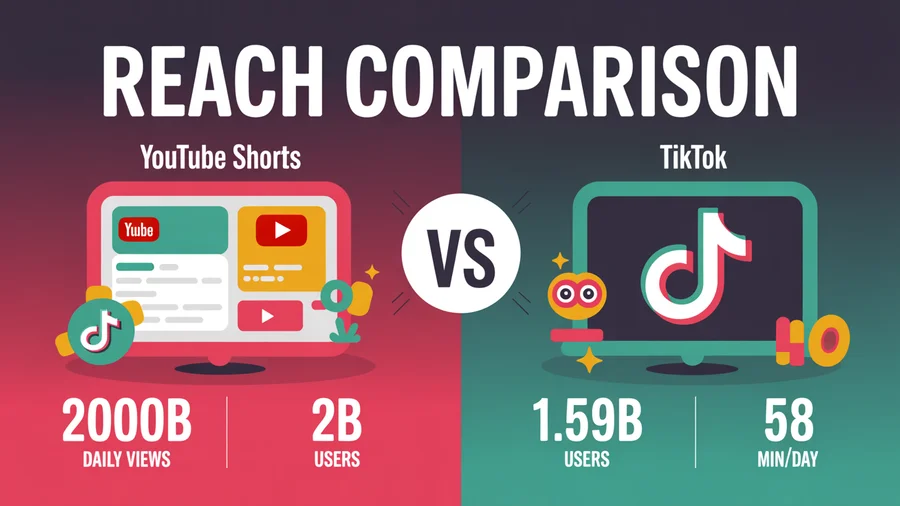
A lot has moved. YouTube Shorts lifted the maximum length from 60 seconds to 3 minutes in October 2024 (a direct shot at TikTok's territory) and now pulls in over 200 billion daily views from 2 billion monthly users. TikTok (schedule with our TikTok scheduler) still leads on time-spent at 1 hour 37 minutes per day per US user (up from 58 min in 2024) across 1.59 billion monthly active users. Meanwhile, the US TikTok divestiture closed in January 2026 (TikTok USDS LLC: Oracle, Silver Lake, MGX) and the European Commission issued a €530M DSA fine in early 2026 over advertising transparency and minor-protection issues.
Both are massive, but they reward different strategies, serve different audiences, and monetize in fundamentally different ways. This guide compares every dimension that matters so you can decide where to invest your time, or how to use both effectively.
YouTube Shorts vs TikTok TL;DR (May 2026)
| Factor | YouTube Shorts | TikTok |
|---|---|---|
| Daily views | 200 billion+ | Not publicly disclosed |
| Monthly users | 2 billion | 1.59 billion |
| Max length | 3 minutes (raised Dec 2025) | 10 minutes in-app; 60-min upload |
| US daily time | ~32 min on Shorts | 1 hr 37 min |
| Best for | Long-term growth, SEO, monetization | Rapid virality, cultural trends, e-commerce |
| Monetization | 45% ad revenue share (YPP) | $0.50–$1.00 per 1K views (Creator Rewards) |
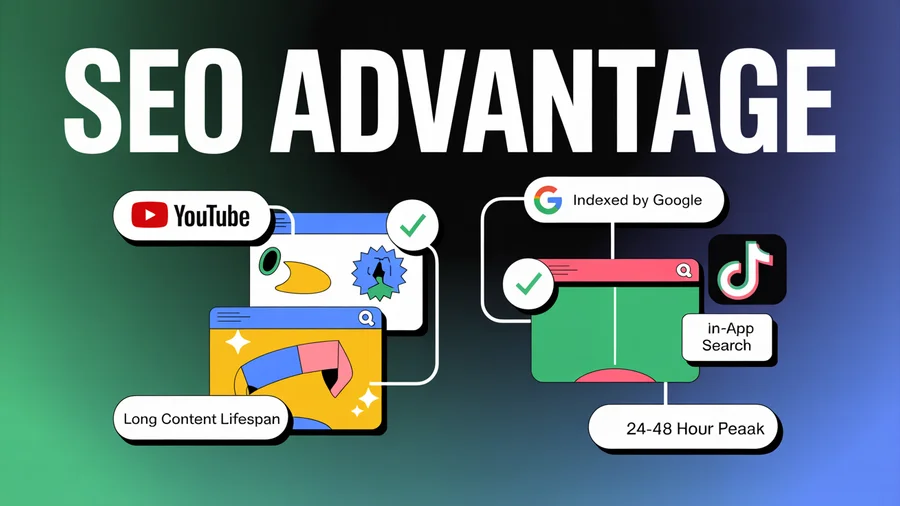
| Content lifespan | Weeks to months | 24–48 hours peak |
| SEO advantage | Indexed by Google Search | Indexed by TikTok search + Google |
| US regulatory status | None | Divested to TikTok USDS LLC (Jan 2026) |
| EU regulatory status | None | €530M DSA fine (2026) |
Table of Contents
- Algorithm: How Each Platform Distributes Content
- Reach and Discovery on Shorts vs TikTok
- YouTube Shorts vs TikTok Monetization
- SEO: Which Platform Has Better Search Visibility?
- Shorts vs TikTok Audience Demographics
- Content Specs and Format Differences
- Best Content Types for Each Platform
- Cross-Posting to TikTok, Shorts and Reels
- Which Is Better for Brands, Creators, and E-commerce?
- Decision Framework: TikTok, Shorts or Reels First?
- 2026 Trends for Each Platform
- TikTok vs Instagram Reels vs YouTube Shorts
- FAQs
Algorithm: How Each Platform Distributes Content
YouTube Shorts algorithm
YouTube Shorts runs an explore-exploit loop that evaluates each Short independently. When you upload, it's tested with a small audience. If those viewers watch instead of swiping away, the algorithm pushes it wider.
The three core signals:
- Swipe-away rate: the percentage who leave without watching. Lower is better.
- Watch time relative to length: a 30-second Short with 95% completion beats a 60-second Short with 40%.
- Engagement: likes, comments, shares, and subscribes after watching.
Key behavior: Shorts and long-form content are evaluated by separate recommendation systems. A poorly performing Short won't hurt your long-form content, and vice versa. This makes Shorts a low-risk testing ground.
TikTok algorithm
TikTok's For You Page is powered by an interest graph: it predicts what each user wants to see based on past behavior, not who they follow. The algorithm analyzes:
- Watch time and completion rate: the strongest signal
- Interactions: likes, comments, shares, follows
- Content signals: captions, sounds, hashtags, on-screen text
A key 2026 change: TikTok now shows new videos to existing followers first before distributing to non-followers. This slightly reduces the "instant viral from zero" advantage that made TikTok famous, but the platform still offers more rapid viral potential than any other platform.
The key difference
TikTok optimizes for immediate engagement: most of a video's impact happens in the first 24–48 hours. YouTube Shorts optimizes for sustained performance: a Short can continue getting views for weeks or months through search and recommendations.
Reach and Discovery on Shorts vs TikTok
YouTube Shorts: Better for consistent long-term reach
- 74% of Shorts views come from non-subscribers: Shorts is YouTube's primary discovery format
- Small creators (1–5K followers) average 2,600 views per Short vs. TikTok's 660 views
- Content stays discoverable for weeks or months via search and recommendations
- Shorts that perform well funnel viewers into long-form content (4.5% click-through rate)
TikTok: Better for rapid viral growth
- The algorithm is famously blind to follower count: zero-follower accounts can go viral immediately
- 67% of viral TikTok content comes from accounts with fewer than 10,000 followers
- For You Page surfaces content based on predicted interest, not social connections
- But content lifespan is short: most engagement happens in the first 24–48 hours
Verdict: TikTok is better for overnight virality. YouTube Shorts is better for compound growth that builds over time. Use PostEverywhere's scheduling to post to both platforms at their optimal times.
YouTube Shorts vs TikTok Monetization
YouTube Shorts: Revenue share model
YouTube pays creators through the YouTube Partner Program (YPP):
- Entry requirements: 500 subscribers + 3M Shorts views in 90 days (limited) or 1,000 subscribers + 10M views (full)
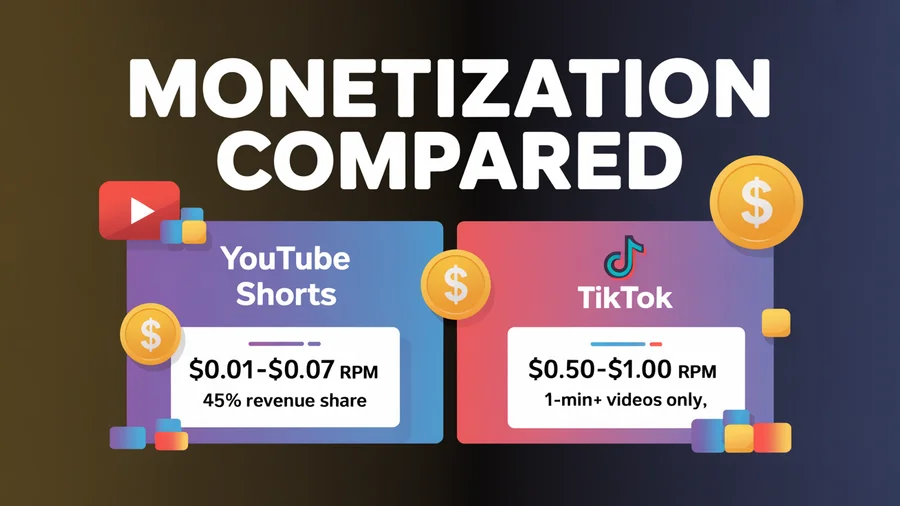
- Revenue split: Creators keep 45% of allocated Shorts ad revenue
- Estimated RPM: $0.01–$0.07 per 1,000 views
- 1 million Shorts views ≈ $10–$70
The real monetization advantage of YouTube isn't Shorts ad revenue. It's the ecosystem. Shorts funnel viewers to long-form content where CPMs reach $5–$20+, and channel memberships, Super Thanks, and affiliate links provide additional revenue streams. The revenue gap between formats is the central thesis in our long-form vs short-form video breakdown.
TikTok: Creator Rewards Program
TikTok's Creator Rewards Program (formerly Creator Fund):
- Entry requirements: 10,000 followers + 100,000 views in last 30 days + original content over 1 minute
- Estimated RPM: $0.50–$1.00 per 1,000 qualified views (videos over 1 minute only)
- 1 million views ≈ $500–$1,000 (if videos qualify)
TikTok pays more per view for qualifying content, but the requirement for videos over 1 minute eliminates most short-form clips from the program. TikTok Shop is becoming the bigger monetization play: $15 billion in US sales in 2025, projected to exceed $20 billion in 2026.
Side-by-side monetization
| Metric | YouTube Shorts | TikTok |
|---|---|---|
| Revenue model | Ad revenue share (45%) | Creator Rewards + TikTok Shop |
| RPM per 1K views | $0.01–$0.07 | $0.50–$1.00 (1-min+ videos only) |
| 1M views earnings | $10–$70 | $500–$1,000 (qualifying only) |
| Indirect monetization | Long-form ads, memberships, merch | TikTok Shop, brand deals, live gifts |
| Best for | Long-term compound revenue | Direct creator payments + commerce |
Schedule your monetized content to both platforms from one calendar. PostEverywhere handles YouTube Shorts and TikTok scheduling with per-platform customization: starting at $9/month.
SEO: Which Platform Has Better Search Visibility?
YouTube Shorts: Google integration is the killer advantage
YouTube Shorts appear in Google Search results. TikTok videos don't (or rarely do). This is the single biggest SEO differentiator.
- YouTube is the second-largest search engine in the world (owned by Google)
- 23% of Google Search results display video content: increasingly including Shorts
- YouTube holds 20% citation share across AI platforms (AI Overviews, Perplexity, etc.)
- Shorts content is indexed by YouTube for months or years: true long-tail SEO
- Transcript and caption data is deeply indexed by Google
TikTok: A search engine in its own right
TikTok has become a legitimate search engine, especially for younger users:
- 41% of Americans have used TikTok as a search engine
- 64% of Gen Z use TikTok for search: ahead of Google for certain queries
- TikTok NLP analyzes captions, hashtags, on-screen text, and spoken words
- Keywords in captions boost visibility by 20–40%
- But content lifespan is short: TikTok search results favor recent, trending content
Verdict: YouTube Shorts wins on long-term SEO because of Google integration. TikTok wins on real-time, trend-driven search. If you want content to be discovered 6 months from now, YouTube. If you want to ride a trending query today, TikTok.
Optimize your titles, descriptions, and hashtags for both platforms using our hashtag generator.
Shorts vs TikTok Audience Demographics
Both platforms skew younger, but there are meaningful differences.
| Factor | YouTube Shorts | TikTok |
|---|---|---|
| Largest age group | 25–34 (21.5%) | 25–34 (overtook teens) |
| Fastest growing | 35–44 and older | Older millennials |
| Global gender | 54.3% male | 54.5% male |
| US gender | 51.2% female | 61% female |
| Top geography | India, then US | Indonesia, then US |
| Gen Z dominance | Shared with older groups | Stronger Gen Z culture |
| Daily time spent (US) | ~32 min (Shorts only) | 1 hr 37 min (full app, Sensor Tower 2026) |
TikTok still has a stronger Gen Z cultural identity, but both platforms' largest demographic is now 25–34. YouTube's fastest-growing segment is 35+, which makes Shorts increasingly relevant for brands targeting older millennials and Gen X.
Content Specs and Format Differences
| Spec | YouTube Shorts | TikTok |
|---|---|---|
| Max length | 3 minutes (raised from 60s in Oct 2024) | 10 minutes (in-app); 60 min (upload) |
| Sweet spot | 50–60 seconds (76% watch-through) | 15–35 seconds |
| Aspect ratio | 9:16 (mandatory) | 9:16 (recommended) |
| Resolution | 1080×1920px | 1080×1920px |
| File format | MP4 (H.264, AAC) | MP4 (Android), MOV (iOS) |
| Music library | YouTube Audio Library + 2026 expanded licensed catalog | TikTok Sounds (trending audio) |
| In-app editing | Basic + 2026 AI auto-edit | Extensive (effects, green screen, stitch, duet) |
| Captions | Auto-generated or burned-in | Auto-generated via NLP |
The biggest content difference: trending audio is a core distribution mechanism on TikTok. Using viral sounds significantly boosts algorithmic reach. YouTube Shorts doesn't have an equivalent trending audio culture: hooks, visuals, and watch time drive distribution instead. Whichever sound you use, clear voice audio matters on both; our audio quality guide covers microphones, room fixes and AI cleanup.
Best Content Types for Each Platform
YouTube Shorts top performers
- Entertainment and viral reactions
- Before/after transformation reveals
- Life hacks and quick tutorials (15–60 seconds)
- Satisfying process videos
- Tech and smartphone content
- Finance tips (highest CPM)
- Educational/fact-based content (strongest evergreen potential)
TikTok top performers
- Trending audio and dance challenges
- Lo-fi, authentic, unpolished content (the "quiet flex" aesthetic dominates 2026)
- POV format videos
- Companion content ("study with me," "get ready with me")
- Short how-to tutorials solving specific pain points
- TikTok Shop product demos
- Beauty, skincare, and wellness content
The key difference: YouTube Shorts rewards information and value. TikTok rewards entertainment and authenticity. Polished, educational content thrives on Shorts. Raw, personality-driven content thrives on TikTok. To streamline production within a single workflow, tools like Riverside video editing can help adapt the same footage to each platform's viewing habits. TikTok also has a format that needs no filming at all: photo slideshows.
Use our AI content generator to create platform-specific scripts and captions for both platforms. Find optimal tags with the hashtag generator.
Cross-Posting to TikTok, Shorts and Reels
You can post the same video to both platforms, and to Instagram Reels as a third, but do it wrong and you'll get penalized on at least one.
Rules for cross-posting
Remove all platform watermarks before cross-posting. TikTok-watermarked videos are deprioritized by YouTube and won't qualify for revenue sharing. YouTube-watermarked videos perform worse on TikTok. Our step-by-step guide on how to remove the TikTok watermark before posting covers the cleanest methods.
Customize captions and hashtags for each platform. Identical captions can trigger duplicate content detection.
Customize the hook per platform. TikTok rewards authentic, personality-driven openings. Reels rewards curiosity hooks with brand context. Shorts rewards value-led openings ("here's how to...").
Match audio per platform. Add trending audio for TikTok; add keyword-rich titles for Shorts. TikTok trending audio rarely matches what's trending on Reels or Shorts, and each platform's licensed library has different commercial-use restrictions, so pick platform-native audio where possible. Native content consistently outperforms cross-posted content on every platform.
Stagger posting times. Don't publish to every platform at the same second. Each algorithm needs fresh signals to evaluate your video independently. See best time to schedule YouTube Shorts and best time to schedule Instagram Reels.
Export clean files. Always download the original, unwatermarked version of your video and upload it separately to each platform. Don't reshare from one to another.
PostEverywhere's cross-posting feature handles platform-specific customization for TikTok, Reels and Shorts from one composer, so you get the efficiency of cross-posting with native optimization. For platform-specific walkthroughs, see how to post to Instagram, TikTok and YouTube Shorts at the same time.
Post to YouTube and TikTok from one dashboard. PostEverywhere lets you customize each platform's version without switching apps.
Which Is Better for Brands, Creators, and E-commerce?
For independent creators
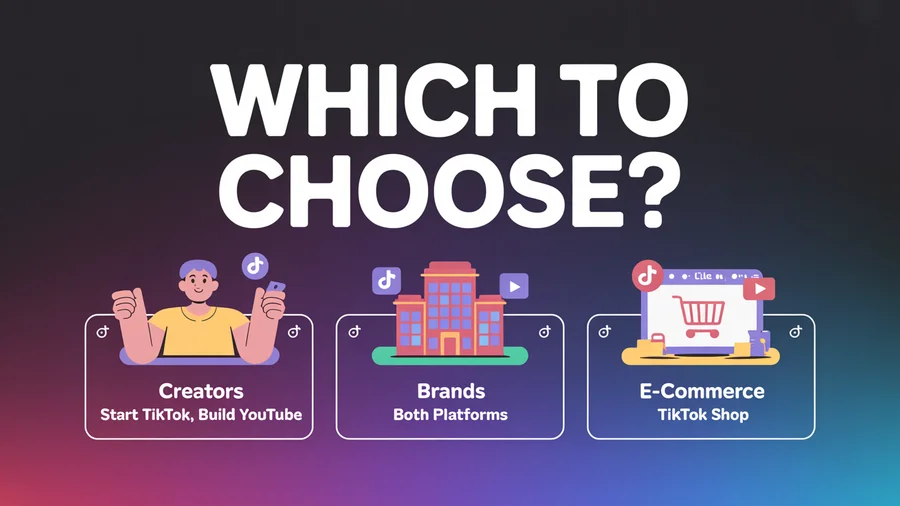
Start on TikTok for fast audience growth from zero. TikTok's interest graph gives unknown creators genuine viral potential. Then build on YouTube Shorts for lasting channel equity, compound subscriber growth, and sustainable monetization through YPP.
For brands
TikTok for top-of-funnel awareness and cultural velocity. The "TikTok made me buy it" phenomenon drives impulse purchases.
YouTube Shorts for authority building, product education, and long-term brand recall. Shorts funnel viewers into longer brand content and are indexed by Google.
For e-commerce
TikTok clearly wins in 2026. TikTok Shop crossed $15 billion in US sales in 2025, with projections exceeding $20 billion in 2026. In-feed shopping with native checkout creates friction-free discovery-to-purchase.
YouTube Shorts is better for considered purchases where education matters: new 2026 features let creators add brand links directly in Shorts.
Rule of thumb: If you want to close a sale in 3 minutes, choose TikTok. If you want to close a sale in 30 days and keep the customer for 3 years, choose YouTube.
For B2B
Neither platform is strongly B2B-native (LinkedIn dominates there). But YouTube Shorts is the better option: thought leadership, tool demos, and case study teasers funnel into long-form content that builds professional trust. Schedule your B2B content with our LinkedIn scheduler alongside your Shorts and manage everything with multi-account management.
Decision Framework: TikTok, Shorts or Reels First?
If you genuinely cannot run every platform (production capacity is real), here's the priority order based on your starting position. Instagram Reels is included because it is the third option most creators weigh.
You have zero followers anywhere
Start with TikTok. Interest-graph distribution gives the fastest path to a first viral hit. Once you have a few thousand TikTok followers, mirror your best-performing content to Shorts and Reels.
You have an engaged Instagram community
Start with Reels. Compounding existing audience signals is more efficient than starting from zero on TikTok or Shorts. Add Shorts second for the SEO compound effect. For the Instagram side, see how Reels compare with Stories, and Instagram Edits, Meta's free editing app for Reels.
You have a YouTube channel with long-form content
Start with Shorts. Shorts funnel viewers into your long-form videos where CPMs are far higher. Add TikTok second for time-spent reach. Our YouTube Shorts strategy guide covers how to build that funnel.
You sell products and want commerce velocity
Start with TikTok. TikTok Shop is the most aggressive commerce surface ($20B+ US sales projected for 2026). Add Reels second for the more mature Instagram Shopping integration.
You're a B2B brand
Start with YouTube Shorts. Shorts funnel into long-form thought leadership that builds professional trust. Reels works if you're targeting marketing, design, or HR audiences. TikTok is rarely the right first move for B2B.
You're a lifestyle, beauty, or fashion brand
Start with Reels. Instagram's aspirational culture is your natural home. Add TikTok second for Gen Z reach and TikTok Shop commerce.
You want maximum long-term safety
Start with YouTube Shorts. The lowest regulatory risk, the deepest SEO compound effect and the longest content lifespan. It is the slowest to grow but the most defensible 3-5 years out.
You're optimizing for direct creator revenue
Start with YouTube Shorts. The long-form ecosystem CPMs ($5-$20+) make Shorts the strongest creator monetization play even though Shorts itself pays less per view than TikTok's Creator Rewards.
2026 Trends for Each Platform
YouTube Shorts trends (May 2026)
- 3-minute cap: Shorts max length raised from 60s to 3 minutes in October 2024. Repositions Shorts as a direct TikTok competitor and gives creators room for mini-tutorials and storytelling.
- AI creator tools: Make Shorts using your own AI likeness, auto-edit features, AI clip generation from still images, rolled out broadly in Q1 2026.
- Shorts-to-long-form bridging: Stronger pathways so Shorts, long-form, and community posts work as an ecosystem.
- Image posts: Now integrated into the Shorts feed.
- Brand partnership tools: Add brand links in Shorts, swap branded segments when deals end.
- Format sweet spot: 50–60 second Shorts still achieve a 76% watch-through rate, but 90s+ Shorts are growing fast after the cap change.
TikTok trends (May 2026)
- US divestiture closed: TikTok USDS LLC (Oracle, Silver Lake, MGX) took ownership of US operations in January 2026. Platform operates normally; ByteDance retains a minority stake under the deal.
- EU DSA fine: European Commission issued a €530M Digital Services Act fine in early 2026 over advertising transparency and minor-protection compliance. TikTok is appealing.
- TikTok Shop dominance: $20B+ projected US sales in 2026, live commerce going global. Now ~25% of revenue for top-performing US TikTok Shop merchants.
- A-Commerce: AI agents streamlining the shopping experience.
- Content aesthetic shift: "Quiet flex", with soft, aspirational aesthetics replacing loud viral-bait.
- Auto-post from live: Auto-clip high-performing moments from livestreams.
- Time-spent up: US users now average 1 hr 37 min/day on TikTok (up from 58 min in 2024), per Sensor Tower 2026 data.
The regulatory factor
TikTok's US ownership transferred to TikTok USDS LLC in January 2026, removing the imminent-ban risk that hung over the platform through 2025. However, the EU's €530M DSA fine and ongoing scrutiny in the UK and Canada keep regulatory pressure live. YouTube Shorts carries effectively zero regulatory risk. For risk-averse brands, diversifying toward YouTube Shorts remains a prudent hedge, even though TikTok is operating normally as of May 2026.
TikTok vs Instagram Reels vs YouTube Shorts
Instagram Reels is the third major short-form platform, and most creators end up weighing all three. Here is the three-way view.
Three-way matrix (May 2026)
| Factor | TikTok | Instagram Reels | YouTube Shorts |
|---|---|---|---|
| MAU | 1.59 billion | 2 billion (IG total) | 2 billion (YT total) |
| Daily views / plays | Not publicly disclosed | 200 billion+ | 200 billion+ |
| Max length | 10 min in-app; 60 min upload | 3 minutes | 3 minutes |
| US daily time spent | 1 hr 37 min (Sensor Tower 2026) | ~30 min (full Instagram app) | ~32 min (Shorts only) |
| Non-follower view share | ~80%+ | ~55% | ~74% |
| Algorithm model | Pure interest graph | Hybrid social + interest | Independent from long-form, evaluates against strangers |
| Direct creator revenue share | Creator Rewards ($0.50-$1/1K, 1-min+) | Limited / invite-only | YPP 45% revenue share |
| Indirect monetization | TikTok Shop ($20B+ US 2026 projected) | Mature Instagram Shopping | Long-form ecosystem CPMs $5-$20+ |
| Google Search indexation | Limited | Very limited | Strong: Shorts in Google + AI citations |
| Content lifespan | 24-48 hours peak; occasional resurfacing | Days to weeks | Weeks to months |
| Best for | Discovery from zero, Gen Z, impulse commerce | Existing IG community, lifestyle, Shopping | SEO compounding, multi-format ecosystem, direct creator pay |
The biggest practical difference: TikTok and Shorts both largely ignore follower count; Reels rewards it. Reels distribution starts with your followers and earns expansion to non-followers from their early signals, so saves and shares-to-friends carry the most weight. With no engaged follower base, Reels is the hardest of the three to grow from a true zero start. With one, it compounds in ways the other two can't. Reels holds an average reach rate of 30.81%, the highest of any Instagram format, but that rate is calculated against your existing followers.
Three-way monetization
| Revenue source | TikTok | Reels | Shorts |
|---|---|---|---|
| Direct revenue share | Creator Rewards ($0.50-$1.00 RPM, 1-min+ videos only) | Limited / Reels Play Bonus (invite-only) | YPP 45% revenue share ($0.01-$0.07 RPM on Shorts ads) |
| Commerce | TikTok Shop ($20B+ US 2026 projected) | Instagram Shopping (mature, deep Shopify integration) | Brand links in Shorts (rolling out 2026) |
| Subscriptions | LIVE gifts, video gifts | Paid monthly Instagram subscriptions | Channel memberships, Super Thanks |
| Brand partnerships | Strong (big budgets in entertainment) | Strong (large Creator Marketplace, lifestyle dominance) | Strong (premium CPMs in tech/finance) |
| Funnel to higher CPM | Direct (Shop checkout in-app) | Via Shopping integration | Long-form ecosystem ($5-$20+ CPM) |
| Niche where it pays best | Beauty, consumer goods, entertainment | Lifestyle, fashion, established e-commerce | Finance, tech, business, productivity |
Reels has no stable revenue-share program at YPP scale. The Reels Play Bonus has been on-and-off and invitation-only. Earnings come from Instagram Shopping commission, brand partnerships through Meta's Creator Marketplace, paid subscriptions, and live gifts. For established lifestyle brands with mature e-commerce stacks, this often outperforms direct platform payouts. So Reels pays the least directly but often pays more through brand deals and Shopping for lifestyle creators with engaged communities.
On search, the order is Shorts, then TikTok, then Reels: Reels visibility is largely contained inside Instagram, with minimal Google indexation and no SEO compound effect equivalent to Shorts.
For the other pairings, see Reels vs TikTok and Shorts vs Reels. Schedule Reels alongside your Shorts and TikToks with PostEverywhere's Instagram scheduler. Maintain your Instagram aesthetic across all formats and track results with the engagement rate calculator.
FAQs
Should I post to both YouTube Shorts and TikTok?
Yes. The expert consensus in 2026 is a dual-platform strategy. Use TikTok for cultural velocity, trending moments, and social commerce. Use YouTube Shorts for compound growth, SEO, and long-term channel equity. Customize content for each platform rather than identical cross-posting. Learn how in our content repurposing guide.
Which platform pays more per view?
TikTok pays more per qualified view ($0.50–$1.00 per 1K) through the Creator Rewards Program, but only for videos over 1 minute. YouTube Shorts pays less per view ($0.01–$0.07 per 1K) but has no minimum video length and offers a more reliable revenue share model through YPP.
Can I post the same video to both platforms?
Yes, but remove platform watermarks, customize captions and hashtags for each platform, and stagger posting times. Native content outperforms cross-posted content on both platforms.
Which platform is better for growing from zero?
TikTok gives new creators more rapid viral potential: 67% of viral content comes from accounts under 10K followers. YouTube Shorts offers more consistent reach for small creators (averaging 2,600 views vs. TikTok's 660 for 1–5K follower accounts) but slower initial growth.
Will TikTok get banned in the US?
The US divestiture closed in January 2026: TikTok USDS LLC (Oracle, Silver Lake, MGX) now owns US operations, with ByteDance retaining a minority stake. There is no imminent ban. The EU separately issued a €530M DSA fine in early 2026 and TikTok is appealing. Regulatory pressure has shifted from "ban risk" to "compliance overhead," but YouTube Shorts still carries effectively zero regulatory risk for risk-averse brands.
Which platform is better for SEO?
YouTube Shorts, by a significant margin. Shorts appear in Google Search results, YouTube search, and AI platform citations. TikTok has strong in-app search (especially for Gen Z), but TikTok videos rarely appear in Google results. For long-term search visibility, YouTube wins.
How do I decide where to focus if I can only choose one?
If you're a creator building a personal brand or channel, choose YouTube Shorts: the compound growth, SEO, and monetization ecosystem make it the better long-term investment. If you're an e-commerce brand or focused on Gen Z, choose TikTok for its superior shopping integration and cultural relevance. When in doubt, start with TikTok for fast audience building, then expand to YouTube.
Which is better: TikTok, Instagram Reels or YouTube Shorts?
It depends on your starting point and goals. TikTok wins on time-spent and discovery from zero. Reels wins on Instagram community and Shopping integration. YouTube Shorts wins on SEO and direct ad revenue plus long-form ecosystem CPMs. Most serious creators run all three with platform-native customization.
Which platform is best for selling products?
TikTok, for impulse-purchase commerce velocity (TikTok Shop is projected to pass $20B in US sales in 2026). Reels suits product-led brands with mature Instagram Shopping integration. Shorts is catching up with brand links in 2026 but trails on direct commerce.
Can I schedule posts to both platforms from one tool?
Yes. PostEverywhere lets you schedule YouTube Shorts and TikTok posts from one dashboard with per-platform customization. Plan everything in the content calendar and use best-time scheduling to hit optimal windows on each platform.
The Bottom Line
YouTube Shorts and TikTok serve different strategic purposes. TikTok is the faster path to attention: viral potential, cultural trends, and frictionless e-commerce. YouTube Shorts is the compounding investment: Google SEO, sustained discovery, and a full channel ecosystem that monetizes long-term.
The best strategy in 2026 uses both. Create content in your niche, adapt it for each platform's norms, and schedule everything from one calendar. Use PostEverywhere to manage both platforms alongside Instagram, LinkedIn, Facebook, and X, without switching apps. Check our engagement rate benchmarks to track performance and find how often to post on each platform.

Founder & CEO of PostEverywhere. Writing about social media strategy, publishing workflows, and analytics that help brands grow faster.