Your social media bio is the most underrated piece of copy you'll ever write. A visitor lands on your profile and spends roughly 2.6 seconds deciding whether to follow you. In that window, your bio needs to answer three questions: Who are you? What do you do? Why should I care?
Most bios fail because they're either too vague ("Passionate about helping people!") or stuffed with keywords that read like a search query. The best social media bios are clear, specific, and end with a reason to take action. This guide gives you the formulas, the platform-specific rules, and 30+ real examples to write bios that actually convert.
TL;DR
- Use the "I help [audience] [result]" formula as your starting framework.
- Each platform has different character limits, tones, and SEO behavior — customize every bio.
- Keywords in your bio now directly affect discoverability on Instagram, TikTok, LinkedIn, and YouTube.
- Include one clear CTA (call to action) — "DM me," "Shop below," or "Get the free guide."
- 2–4 emojis max. Use them as visual separators, not decoration.
Table of Contents
- The Bio Formulas That Work
- Platform-by-Platform Guide
- 30+ Real Bio Examples
- Bio SEO: Do Keywords Actually Help?
- Link in Bio Best Practices
- Emojis: Help or Hurt?
- Call-to-Action: What CTAs Convert Best
- Business vs. Creator vs. Personal Brand Bios
- 10 Bio Mistakes to Avoid
- FAQs
The Bio Formulas That Work
You don't need to be a copywriter. Start with a formula and customize it.
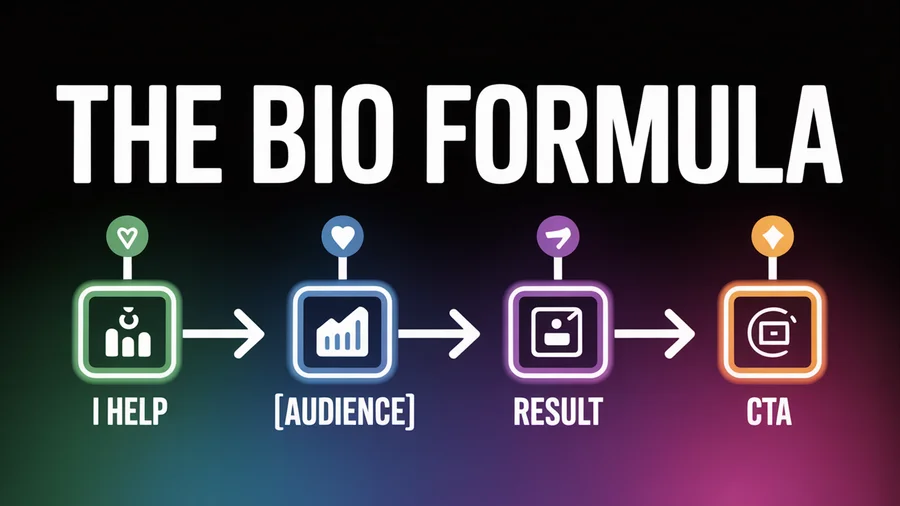
The "I Help" formula (most effective)
I help [target audience] [achieve specific result] through/with [method].
Examples:
- "I help B2B companies generate 3x more leads through LinkedIn"
- "I help busy moms lose weight without giving up wine"
- "I help tech executives turn expertise into authority through ghostwritten books"
This formula works because it immediately tells the visitor what's in it for them. It's about the reader, not about you.
The "We Help" business formula
We help [audience] do [result] by [method]. [CTA].
Example: "We help small businesses grow online through smart social media. Try free →"
The 3-line Instagram formula
Line 1: What you do / your niche + keyword
Line 2: Credibility point (numbers help: "10K+ clients," "Since 2015")
Line 3: CTA → link in bio
The credential stack (for authority figures)
[Title] | [Notable Achievement] | [Media Feature] | [Mission]
Example: "NYT Bestselling Author | TED Speaker | Forbes 30 Under 30 | Teaching 100K+ home cooks"
The problem-solution formula
[Niche audience]? [Pain point]? [What you provide]. [CTA].
Example: "Overwhelmed by social media? I make it simple. Weekly tips for busy founders → link below"
Platform-by-Platform Guide
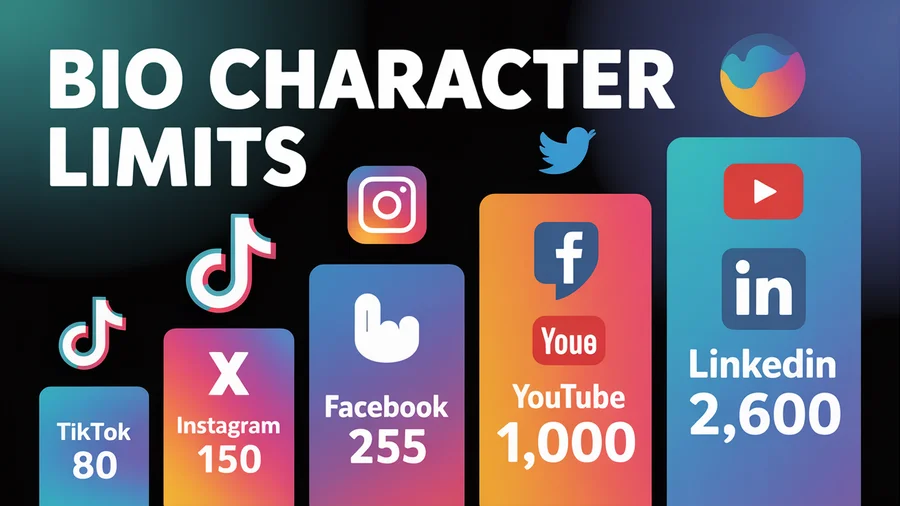
Each platform has different character limits, audiences, and bio behaviors. Here's what matters for each.
Instagram (150 characters)
Instagram bios are short and visual. Line breaks, emojis as bullets, and scannable structure matter because a dense paragraph won't get read.
- Name field is the most important SEO element — "Jane Doe | NYC Realtor" will rank for "NYC Realtor" searches; plain "Jane Doe" will not
- Use emojis as visual bullet points: 🌿 Organic | 💧 Clean | 🌍 Sustainable
- End with a CTA pointing to your link in bio
- Include a branded hashtag if you have one (but keep it to one)
Schedule your Instagram content with our Instagram scheduler and track engagement with the engagement rate calculator.
TikTok (80 characters) — schedule TikTok content
The most restrictive bio field on any major platform. Every word must earn its place.
- Clarity beats cleverness — state what you do over being witty
- Pack 2–3 primary keywords that define your content niche
- TikTok bios are now indexed for both in-app search AND Google
- Formula: "[What you do] | [Who it's for] | [CTA]"
- Example: "Fitness for busy moms 💪 | New videos daily | Shop link below"
LinkedIn (2,600 characters personal / 2,000 company)
LinkedIn gives you the most space — use it.
- 80% of readers prefer bios written in first person
- The About section is factored into LinkedIn's search algorithm — keyword-rich summaries improve discoverability
- Hook the first 2–3 lines hard — LinkedIn truncates and shows only ~265 characters before "see more"
- Include quantified achievements: "increased engagement by 45%," "generated $50M in revenue"
- Avoid buzzwords: "passionate," "results-driven," and "detail-oriented" are meaningless filler
Schedule your LinkedIn posts with our LinkedIn scheduler. Want a deeper rewrite on your LinkedIn About section, headline, and skills? Run the page through our free LinkedIn profile optimizer — it scores each field and tells you exactly where keyword density and structure are letting you down.
X/Twitter (160 characters)
X bios are about personality and clarity. You have one short line to make an impression.
- Lead with what you do, not who you are
- Humor works here if it's on-brand — Wendy's, Frank's RedHot, and Arby's all use witty bios that reinforce their brand identity
- Include relevant keywords — X uses bio text for suggested accounts and topic discovery
- A branded hashtag or link at the end can drive action
Schedule your X content with our X scheduler.
YouTube (1,000 characters)
YouTube's About section is indexed by the platform's search algorithm — treat it like on-page SEO.
- First ~150 characters show without clicking "more" — front-load the essentials
- Structure: What content you make → upload schedule → CTA to subscribe → links
- Include keywords your target audience searches for
- If you're growing with Shorts, your bio matters even more — see our YouTube Shorts strategy guide
Schedule your YouTube content with our YouTube scheduler.
Facebook (255 characters About / 50,000 Additional Info)
- Use the short About field for your tight value proposition or tagline (our slogan generator drafts tagline options if you are starting from a blank page)
- Leverage the "Our Story" section for brand narrative and founding story
- Include Facebook's native CTA buttons ("Shop Now," "Book Now") — they extend your bio's function
- Consider creating a Facebook Group to complement your Page bio with deeper community engagement
Schedule your Facebook content with our Facebook scheduler.
Threads (150 characters)
- Same limit as Instagram but different audience expectations — Threads skews conversational
- More casual and discussion-forward than Instagram
- Use natural voice over formal language
- Consider humor if it's on-brand — the platform rewards personality
- Find the right posting frequency to back up your bio with consistent content
30+ Real Bio Examples
Brand bios that work
Nike (Instagram): "Winning Isn't For Everyone." — Identity-defining. No explanation needed at Nike's scale. Short, powerful, memorable.
Wendy's (X): Humor-forward, "spicy" personality. Their bio leans into the brand's well-known sass, which matches their social content strategy perfectly.
Frank's RedHot (X): "I put that $#!t on everything. Including Twitter." — Witty adaptation of their TV commercial slogan that's instantly recognizable.
BarkBox (TikTok/Instagram): "Monthly boxes of toys and treats for dogs 🐾" — Clear, concise, no fluff. You know exactly what they sell.
Bombas (Instagram): Mission-led bio highlighting "one purchased = one donated to shelters" rather than just advertising products. Leads with values.
Duolingo (TikTok): Combines brand mission (language learning) with absurd humor matching their "unhinged" content strategy. The bio tells you what to expect.
West Elm (X): Tagline + keywords + clear CTA — balances brand voice with a practical next step.
Creator bios that convert
Fitness creator formula: "Certified trainer | Weight loss for moms 💪 | 10K+ clients transformed | Free workout plan → link below" — credentials → niche → social proof → CTA.
Author formula: "I help executives turn their expertise into books | 20 years Fortune 500 experience | Author of 60+ books." — credential stack with an "I help" opener.
B2B consultant: "I help B2B companies generate 3x more leads through LinkedIn | Ex-Salesforce | 500 clients scaled | DM to connect" — quantified result + credibility + CTA.
Finance creator: "Helping you build wealth with $0 in the bank | 100K+ community | Free budget template → link below" — relatable hook + social proof + CTA.
Business bios that sell
SaaS product: "Schedule social media posts to every platform from one calendar. AI-powered, built for teams. Try free → [link]"
Local business: "📍 Portland's favorite coffee roaster since 2014 | Ethically sourced | Order online ↓"
Agency: "We manage social for 200+ brands so you can focus on your business. Results → link below"
E-commerce: "Sustainable swimwear for every body 🌊 | Ships worldwide | 15% off first order → link below"
Restaurant: "Farm-to-table dining in downtown Austin 🍴 | Open daily 11–10 | Reservations ↓"
Your bio tells people what to expect. Your content calendar keeps the promise. Plan and schedule your posts so your profile always has fresh content backing up your bio.
Bio SEO: Do Keywords Actually Help?
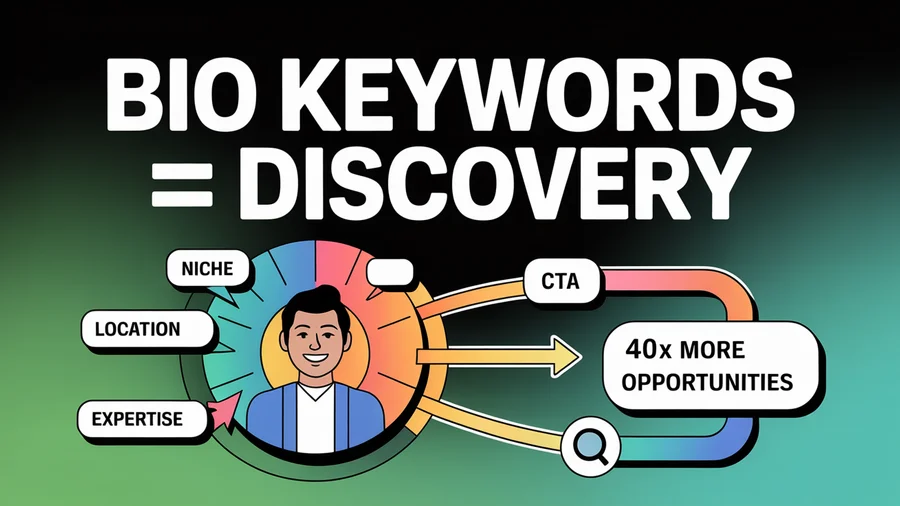
Yes — and this is the biggest shift in social media bios in the last two years. Platforms have moved from hashtag-driven discovery to keyword-driven discovery. Natural language keywords now outperform hashtags for search-based discoverability across Instagram, TikTok, and LinkedIn.
How bio keywords affect discovery by platform
Instagram: The name field is the most heavily weighted keyword signal. Instagram's AI-powered search indexes username, name, bio text, and hashtags. Your bio text also shows up in Google results for branded searches. If your handle is still up for grabs, try our free username generator to brainstorm name variants across platforms before claiming one.
TikTok: Bio keywords are indexed for both in-app search and Google. In 2022 a Google executive said almost 40% of young US users turn to TikTok or Instagram rather than Google Maps or Search to find somewhere for lunch. But only 4% of Gen Z say they rely on TikTok more than Google (Adobe, 2026), so treat TikTok search as an extra channel, not a Google replacement. Natural language keywords outperform hashtag-style keywords.
LinkedIn: The About section directly feeds LinkedIn's search ranking algorithm. Keywords in headline, About, job titles, and skills all contribute. LinkedIn profiles with complete About sections receive up to 40x more opportunities.
YouTube: The Channel About section is indexed by YouTube's search algorithm and by Google. YouTube is the world's second-largest search engine — bio keywords have real reach.
X/Twitter: Bio keywords help accounts appear in suggested accounts and topic-related discovery, though less heavily weighted than other platforms.
Use natural language ("I help small businesses with social media") rather than keyword lists ("social media | marketing | strategy | content"). The algorithm reads context, not just terms. Research keywords for your bio with our hashtag generator.
Link in Bio Best Practices
Most platforms allow one clickable link. This makes it the single most important conversion point on your profile.
When to use a multi-link tool
If you have multiple content types (blog, products, podcast), regularly rotate promotions, or want analytics, a link-in-bio tool like Linktree, Beacons, or Stan Store generates 25–40% higher conversion rates compared to a single direct link.
When to use a direct link
If you have one primary goal ("book a call," "shop now"), a direct link can outperform a multi-link page by reducing friction.
Best practices
- Update the link with seasonal promotions and new content — regularly updated links drive 50% more click-throughs
- Mention the link in captions: "Find it at the link in bio" reduces friction
- Use a branded domain if possible (posteverywhere.ai/free rather than linktr.ee/posteverywhere)
- Track clicks — unclicked links signal a misaligned CTA. See our guide on how to see who clicks on your Instagram link for the full setup
Emojis: Help or Hurt?
They help when used strategically (2–4 max). They hurt when overused.
Posts and profiles with emojis generate 72% more likes and 70% more comments on average. But research shows diminishing returns — heavy emoji use in brand content looks unprofessional.
Platform-specific emoji guidance
- Instagram: Emojis as visual bullet points work well (🌿 Organic | 💧 Clean | 🌍 Sustainable)
- TikTok: 1–2 max — with only 80 characters, each emoji costs precious space
- LinkedIn: Minimal — 1 emoji in a headline can stand out, but heavy use looks unprofessional
- X/Twitter: Strategic — emojis count as 2 characters in Twitter's system
- Threads: More emoji-friendly than LinkedIn, less than Instagram
What emojis do well
- Replace filler words (📍 instead of "Based in")
- Create scannable visual hierarchy
- Signal brand personality instantly (🔥 = edgy, 🌿 = eco-friendly, 💼 = professional)
- Break up text in character-limited bios
Call-to-Action: What CTAs Convert Best
A bio with no CTA is a missed conversion opportunity. Posts with clear CTAs see 25%+ higher click-through rates, and personalized CTAs perform 202% better than generic ones.
CTAs that work
For traffic: "Shop our latest styles ↓" · "Download the free guide → link in bio" · "Watch the latest video →"
For leads: "DM me 'START' for your free audit" · "Join 50K entrepreneurs → link below" · "Book a free call →"
For followers: "Follow for daily [niche] tips" · "New posts every Monday — tap Follow"
For e-commerce: "Shop now → link below" · "Use code INSTA10 at checkout" · "New arrivals weekly"
CTA placement
Put the CTA on the last line of the bio so it's the final thing read before the follow button. Use an arrow emoji (→ or ↓) to direct attention to the link.
A great bio gets the follow. Great content keeps it. Use our AI content generator to keep your feed fresh and on-brand.
Business vs. Creator vs. Personal Brand Bios
Business/brand bio
- Focus: What you do, who you serve, social proof, values or mission
- Tone: Professional but human — can include humor if brand voice allows
- Structure: Value proposition → differentiator → CTA → link
- Key elements: Location (if local), product category, unique selling prop
Personal brand bio
- Focus: Who you are, your expertise, what you can do for the audience
- Tone: First person, conversational — "I help" not "She helps"
- Must answer: "Why should I follow THIS person specifically?"
- Include: Credentials that matter to your target audience, signature achievement, personal touch
Creator bio
- Focus: What content to expect, upload frequency, niche specificity, personality
- Tone: Casual, authentic, niche-coded
- Key: The bio should attract your specific niche, not everyone. Generic means forgettable.
- Algorithm note: Keyword-rich niche descriptions help TikTok and Instagram categorize your account and serve it to interested audiences
Post consistently to back up your bio. Use PostEverywhere to schedule across every platform from one calendar — starting at $9/month with a 7-day free trial.
10 Bio Mistakes to Avoid
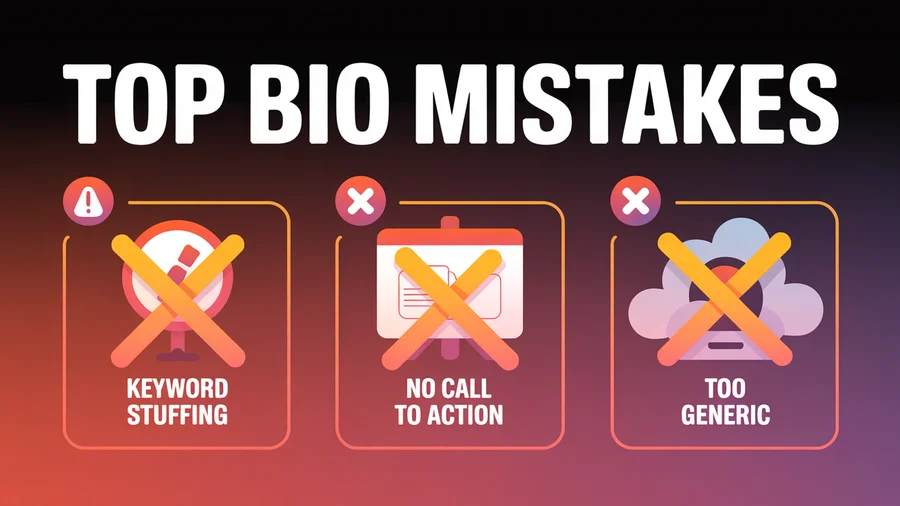
1. Keyword stuffing. "Alice | Fitness Yoga Wellness Gym Health Coach Trainer Nutrition" — looks spammy, gets flagged by algorithms, and humans ignore it.
2. Being too generic. "Best quality products | Excellent service | Passionate about helping people" — zero differentiation. Could describe literally any business.
3. Information overload. Listing every service or feature creates an unreadable wall. Focus on one core value proposition.
4. Missing CTA. A bio with no call to action wastes your most visible real estate. Tell people what to do next.
5. Writing in third person on personal profiles. "Sarah is a marketer who loves..." feels cold. 80% of readers prefer first person.
6. Ignoring platform context. A LinkedIn-style formal bio on TikTok repels the audience. A TikTok-style casual bio on LinkedIn repels hiring managers.
7. No line breaks. A single dense paragraph in an Instagram bio rarely gets read. Use line breaks and emojis as visual structure.
8. Outdated information. Old links, discontinued products, or expired achievements damage credibility. Review your bio quarterly. Use a social media audit to spot gaps.
9. Too many hashtags. More than one branded hashtag in a bio looks spammy and wastes characters. Keep it to one or zero.
10. Not testing. Change your bio, track profile visits and follows for two weeks, then compare. Small tweaks in wording can make a measurable difference.
FAQs
Does a good bio actually increase my follow rate?
Yes. Optimized bios are linked to 25% higher profile engagement and visitors spend roughly 2.6 seconds deciding whether to follow. A clear, specific bio with a CTA significantly improves conversion from profile visit to follow.
How often should I update my social media bio?
Review quarterly at minimum. Update immediately when you have new offers, achievements, or link destinations. Bios with regularly updated links drive 50% more click-throughs.
Should I use the same bio on every platform?
No. Core value proposition and keywords should overlap for brand consistency, but tone, length, and format need to match each platform's norms. A LinkedIn bio should not read like a TikTok bio.
Do keywords in my bio help people find me?
Yes — significantly. Instagram, TikTok, LinkedIn, and YouTube all index bio keywords for search. Natural language keywords now outperform hashtags for discoverability. This is one of the biggest shifts in social media in the last two years.
What's the most important part of a social media bio?
The first line. On most platforms, only the first 125–150 characters display before truncation. Front-load your value proposition and primary keyword. Everything after that is bonus context.
Should I include my job title or what I do for people?
What you do for people. "Social Media Manager" tells me your job. "I help small businesses double their social media engagement" tells me why I should follow you.
How do I write a bio if I'm just starting out and have no followers?
Focus on what you create, not credentials. "Daily tips on [your niche] | Building in public | New here? Start with the pinned post ↓" — clarity about your content and a CTA are enough. You don't need social proof to start.
Is there a tool that helps write social media bios?
Our AI content generator can help you draft bio variations for each platform. Start with the formulas in this guide, then use AI to iterate on wording and test different angles.
The Bottom Line
Your social media bio is your pitch — and you have 2.6 seconds to land it. Use the formulas above to write bios that are specific, scannable, and end with a clear reason to take action. Match the tone and format to each platform, include keywords for discoverability, and update it quarterly.
Then back up your bio with consistent content. Use PostEverywhere's social media scheduler to keep your posting cadence steady, plan your content in the visual calendar, find optimal posting times, and maintain your Instagram aesthetic. Your bio makes the promise — your content keeps it.
Beyond the bio
The bio is one surface of a coherent profile: Instagram bio ideas gives you working examples to adapt, and building an Instagram aesthetic plus Instagram Story ideas cover the visual layer that sits around it.

Founder & CEO of PostEverywhere. Writing about social media strategy, publishing workflows, and analytics that help brands grow faster.